By Elizabeth Williams
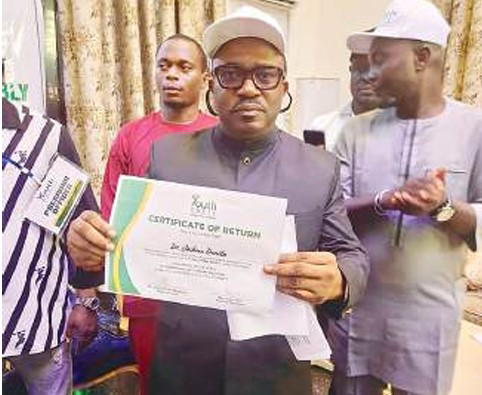
A strong signal emerged from Delta State’s political landscape, on Friday, as the Youth Party, YP formally presented Dr. Joshua Denila as its governorship candidate for the 2027 election, in what political observers are already describing as a bold attempt by young people to challenge the long-standing dominance of the state’s traditional political elite.
Denila’s emergence followed the conclusion of the party’s statewide primary election conducted across the 25 local government areas of the state.
Broader conversation
But beyond the routine process of selecting a candidate, the development appears to have ignited a broader conversation about generational leadership and the growing demand among young Deltans for a departure from the political order that has governed the oil-rich state for decades.
Addressing party delegates, supporters and journalists after his emergence, Denila declared that the time had come for a new generation of leaders to take responsibility for the future of Delta State, arguing that despite enormous revenues accruing to the state over the years, living conditions for many residents remain far below expectations.
His candidacy, he said, represents more than a political ambition; it is a movement by young people determined to replace what he described as governance driven by improvisation with one anchored on planning, data and measurable outcomes.
According to him, successive administrations have managed the affairs of the state without comprehensive development frameworks capable of addressing persistent challenges in security, infrastructure, education, power supply and job creation.
“The challenge facing Delta State is not a lack of resources but a lack of preparation and strategic governance,” Denila said.
He noted that his administration would be guided by the party’s newly unveiled U-Turn 2027 Blueprint, a policy document developed from findings contained in the Delta State Liveability Report 2026, a research-based assessment of socio-economic conditions across the state.
The governorship candidate maintained that unlike the established political class, his team was entering the race with clearly defined policy options and measurable targets aimed at improving the quality of life of citizens.
Political analysts say the emergence of Denila may further strengthen ongoing conversations about youth participation in governance, especially at a time when younger Nigerians are increasingly demanding greater representation in leadership positions.
Future generation ready to assume responsibility
For many of the young supporters, who attended the event, the significance of the moment was not merely about electing another governor but about demonstrating that a generation often described as the future is now prepared to assume responsibility for the present.
The Youth Party, which has consistently positioned itself as a platform for merit-driven and technology-enabled governance, described Denila’s candidacy as a direct challenge to the politics of entitlement and patronage that has shaped electoral contests in the state.
Party leaders said the 2027 governorship race offers Deltans an opportunity to decide whether governance should remain in the hands of the established political order or move toward a new generation of leaders armed with fresh ideas and evidence-based solutions.
As the countdown to the 2027 elections begins, Denila’s emergence may well be remembered as one of the earliest signs that Delta youths are no longer content with being spectators in the state’s political evolution but are increasingly positioning themselves to lead it. This version mirrors Vanguard’s political reporting style by focusing less on party publicity and more on the political implications of the development-particularly the narrative that Delta youths are rising to challenge the status quo and make a case for generational leadership in the state.
Disclaimer
Comments expressed here do not reflect the opinions of Vanguard newspapers or any employee thereof.