.Expands water transport infrastructure
By Olasunkanmi Akoni
The Lagos State Government has raised concerns over the growing scarcity of sand caused by indiscriminate reclamation, dredging activities, warning that unchecked exploitation of waterways could trigger serious environmental, economic and food security challenges across the State.
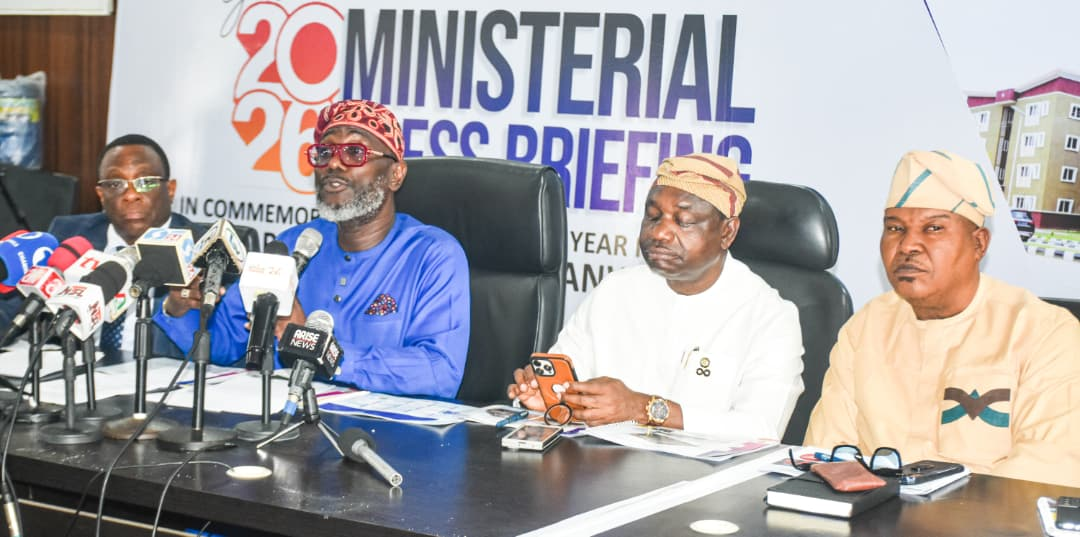
Commissioner for Waterfront Infrastructure Development, Dayo Alebiosu, stated this on Thursday, during the annual ministerial press briefing to commemorate the seventh anniversary of the administration of Governor Babajide Sanwo-Olu and Deputy Governor, Dr. Obafemi Hamzat, held at Alausa, Ikeja.
Alebiosu said the increasing demand for sand, especially for reclamation projects in the Lekki-Ajah Corridor, was putting immense pressure on Lagos’ coastal and aquatic resources.
According to him, some developers now source sand from communities in Ikorodu and pump it across distances of up to 12 kilometres for projects in Ajah due to the depletion of nearby deposits.
“For me, it confirms my fears. If you are reclaiming land in Ajah and you now have to pump sand from Ikorodu, it means the sand resources within Ajah are gradually running out,” he said.
The commissioner warned that the trend could worsen construction costs, increase housing prices and negatively affect infrastructure delivery if stricter regulation and accurate monitoring mechanisms are not introduced.
Alebiosu stressed the need for comprehensive data on dredging operations, including the number of operators, daily extraction volumes and the quantity of sand deposits still available across various locations in the state.
“We need proper data. We need to know how many people are dredging, how much sand is being dredged daily, and what is left within those areas,” he stated.
Beyond its impact on construction, the commissioner linked indiscriminate dredging to threats against food security, particularly for fishing communities dependent on healthy aquatic ecosystems.
According to him, aggressive dredging disrupts marine habitats and destroys aquatic microorganisms, forcing fishermen to travel farther before making catches and ultimately increasing the cost of fish in local markets.
“It is putting food security at risk. We are encouraging people to consume more protein, such as fish, but whenever dredging disturbs aquatic life, fishermen are forced to work harder, and naturally, the cost of fish goes up,” he added.
Alebiosu also disclosed that some communities hosting dredging activities were experiencing infrastructural damage caused by heavy-duty equipment and increased commercial traffic.
He cited Ibese in Ikorodu as one of the affected communities where roads and public infrastructure had reportedly deteriorated because of dredging operations.
The commissioner said the ministry remains the agency legally empowered to regulate sand dredging and sand dealing activities in the State.
He noted that the ministry works with the Ministry of Environment and Physical Planning as well as local communities to combat illegal dredging through surveillance, enforcement and whistleblowing mechanisms.
While reacting to allegations involving foreign nationals in illegal dredging, Alebiosu maintained that some local collaborators also aid such activities.
“We cannot continue blaming foreigners alone. We must ask ourselves how they got there in the first place. They definitely have the connivance of some locals,” he said.
Meanwhile, he said the State government has intensified efforts to modernise water transportation infrastructure with the completion of over 50 kilometres of channelisation works across major ferry routes in the state.
Alebiosu explained that the project was designed to improve navigation, reduce boat accidents and expand ferry operations as part of Governor Babajide Sanwo-Olu’s THEMES Plus development agenda.
He said routes covered under the project include: the Ikorodu–Mende and Ikorodu–Agboyi channels in Kosofe, the Five Cowries–Lekki–Lagoon–Parkview corridor, among others.
The commissioner added that navigation buoys had also been installed to improve safety and ease of movement for ferries and commercial boats operating within Lagos waterways.
Installation works, he said, are currently ongoing at Agboyi Ketu, Ijegun Egba and Bayeku, while additional locations, including Ebute Ero, Ijede, Apa, Mile 2 and Mowo, have been earmarked for similar upgrades.
Disclaimer
Comments expressed here do not reflect the opinions of Vanguard newspapers or any employee thereof.