By Peter Egwuatu
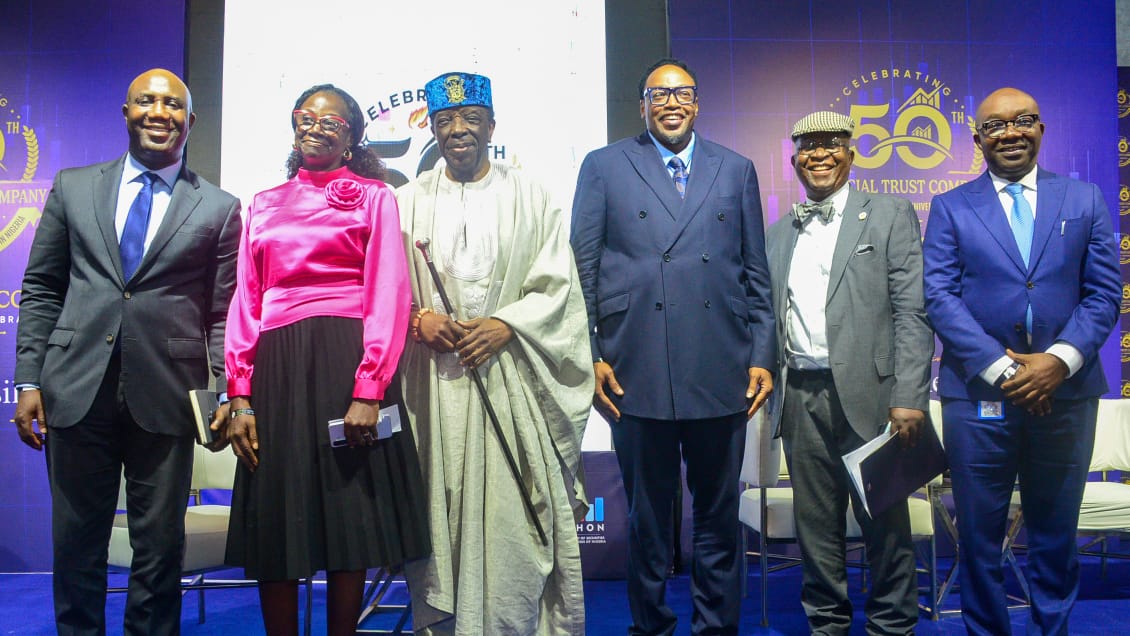
Key stakeholders in Nigeria’s financial sector, such as the Securities and Exchange Commission, SEC, Chartered Institute of Stockbrokers, CIS, Nigerian Exchange Limited, NGX and other capital market operators have called for stronger indigenous participation, enhanced professionalism and deeper reforms in the nation’s capital market as Financial Trust Company (FTC) Nigeria Limited marked its 50th anniversary in Lagos.
Speaking at the Golden Jubilee celebration themed, “50 Years of Indigenous Excellence: Shaping the Future of the Nigerian Capital Market,” Chairman and Group Managing Director of FTC, Alexander Ajayi, said the company’s founding vision was rooted in the belief that Nigerians could build and sustain globally competitive financial institutions.
Ajayi traced the company’s origin to 1976 when the late founder, Otunba William Olufemi Ajayi, alongside other pioneers, established the firm as one of the first wholly indigenous stockbroking institutions in Nigeria.
According to him, the founders believed Nigerian capital markets should be driven by Nigerian institutions and Nigerian capital.
“They made a wager that this country, only a few years removed from colonial rule, was capable of building financial institutions that could stand alongside and one day surpass firms previously dominated by foreign ownership,” he said.
Reflecting on the company’s survival through difficult economic periods, including the 1994 banking crisis, Ajayi said FTC endured because it prioritised integrity, continuity and prudence above aggressive expansion.
“When others exited the market, we stayed. When confidence wavered, we rebuilt. When recovery came, we were still here ready to serve,” he stated.
He noted that FTC had evolved into a diversified capital market institution with operations spanning stockbroking, fund management, investment banking and offshore trading capabilities.
Ajayi also stressed that Nigeria’s ambition of becoming a $1 trillion economy would depend largely on the strength of its capital market.
“The question is no longer whether Nigeria can build a trillion-dollar economy. The question now is who will finance that economy. The answer must be a deep, liquid, trustworthy and predominantly indigenous capital market,” he said.
Also speaking, Fiona Ahimie ,the 14th President and Chairman of Council of the Chartered Institute of Stockbrokers, commended FTC for sustaining indigenous excellence over five decades.
The CIS President said the Nigerian capital market had witnessed significant reforms over the years, including electronic trading, growth in the bond market, financial technology adoption and improved regulatory frameworks.
According to her, despite the progress recorded, Nigeria remains largely undercapitalised relative to the size of its economy and population.
“Market penetration remains low, especially among young people, rural communities, women-owned enterprises and small businesses. This presents significant opportunities for growth and expansion,” she said.
She identified technology, investor education, sustainable finance, professionalism and indigenous capacity development as critical factors that would shape the future of the market.
“The future of the Nigerian capital market depends significantly on ethical leadership, continuous professional education, competence and integrity,” she added.
In his remarks, Director of the Lagos Zonal Office of the Securities and Exchange Commission, John Briggs, who represented SEC Director-General Emomotimi Agama, paid tribute to pioneers of the Nigerian capital market.
Agama described them as “ancestors of the market,” noting that the growth of the capital market was built on sacrifice, resilience and patriotism.
“The Nigerian capital market did not emerge fully formed. It grew from modest beginnings shaped by limited capital, shallow investor confidence and an evolving regulatory environment,” he said.
He added that the post-2008 market reforms, demutualisation of the exchange, modernisation of infrastructure and adoption of technology had strengthened the market.
“We owe it to the pioneers, today’s investors and operators, and the generation yet to come to build a market that is trusted, inclusive, innovative and globally competitive,” Agama stated.
Also speaking, the Chief Executive Officer of Nigerian Exchange Limited (NGX), Jude Chiemeka, represented by Abimbola Babalola, Head of Trading and Products at NGX, said the story of FTC is deeply intertwined with the evolution of Nigeria’s capital market.
“Fifty years is not merely a corporate milestone but a testament to resilience, relevance, institutional character, and sustained contribution to national economic development,” he said.
“As Nigeria seeks to strengthen its position as a leading African investment destination, collaboration across the ecosystem will become even more important. We must work collectively to build a market that is globally competitive while remaining locally relevant,” he added.
Disclaimer
Comments expressed here do not reflect the opinions of Vanguard newspapers or any employee thereof.