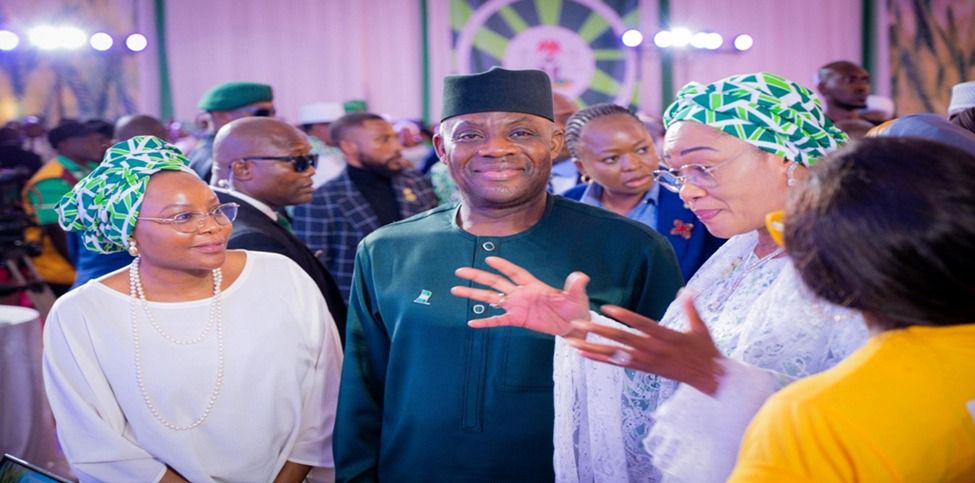
From Left, Aisha Garba, Executive Secretary, UBEC, Dr. Tunji Mauruf Alausa, Honourable Minister of Education and Her Excellency, Senator Remi Tinubu at the 2025 Children’s Day celebration in Abuja.
By Mathew Johnson
Since President Bola Ahmed Tinubu assumed office under the Renewed Hope Agenda with a pledge to reposition Nigeria’s education sector through improved quality, expanded access, and greater technological integration, basic education has once again returned to the centre of national discourse. The conversation is gradually shifting beyond familiar criticisms of the system to a closer examination of emerging policy, directions, institutional reforms, and administrative adjustments. This piece takes a cursory look at the trajectory of education policy under the current administration and what it may signal for the future of the sector.
For years, the education sector has struggled under fragmented interventions, weak coordination, and financing systems that rarely translated into real impact at the school level. Policies were drafted, funds allocated, yet the child in the classroom often saw little change.
However, a review of the sector shows that what is now emerging is an attempt to do things differently. The Minister of Education, Maruf Alausa, through the National Education Sector Renewal Initiative NESRI, is said to be driving a system-wide reset designed to align federal ambition, state execution, and partner support. It is an acknowledgement of a long-standing truth, that reform in Nigeria’s education sector often fails not in conception, but in coordination.
Driving this effort on the ground is the Universal Basic Education Commission, UBEC under Executive Secretary, Aisha Garba. Increasingly, UBEC is evolving beyond its traditional role as a funding agency into a central coordinating hub, tasked with ensuring that policies are not just announced, but felt in classrooms across the country.
From diagnosis to direction
One of the early signals of intent has been a willingness to confront uncomfortable realities. A system-wide diagnostic carried out at the onset of these reforms laid bare the depth of the crisis, millions of out-of-school children, uneven teacher quality, fragile learning environments, and, perhaps most telling, vast sums of education funds that had remained unutilised for years.
Rather than gloss over these gaps, the response as observed has been to build around them. For instance, UBEC’s 2025–2031 Strategic Blueprint, aligned with NESRI, sets out a clear path, focused on improving learning quality, expanding access, strengthening financing systems, and rebuilding institutional capacity. It marks a shift from reactive interventions to a more structured, execution-driven approach.
Reform meets the classroom
For many Nigerians, reform only becomes real when it reaches the classroom. There are early signs of movement. Teacher development, long the weakest link, is receiving renewed attention, backed by a ₦22 billion investment targeting nearly one million educators.
By 2025, over 500,000 teachers have undergone training in modern pedagogy, inclusive education, and digital skills, an effort aimed at improving not just teaching, but learning.
The curriculum, too, according to UBEC’s six-year Strategic Blueprint, is evolving. Beyond rote memorization, it showed that there is a growing emphasis on critical thinking, entrepreneurship, civic values, and digital literacy, reflecting the demands of a changing world.
Across states, interventions are reportedly gradually reshaping learning environments. For instance, thousands of classrooms have been constructed or rehabilitated, while more than 7 million textbooks and hundreds of thousands of library resources are being distributed. Digital tools, including tablets, laptops, and smartboards, are also reportedly finding their way into schools, signalling a cautious step toward modernization. Though these changes are far from uniform, they represent a departure from years of inertia.
Opening school gates wider
Access remains one of the most pressing challenges, and also one of the clearest indicators of progress.
Through coordinated enrollment drives and community engagement, nearly 700,000 out-of-school children have been brought back into classrooms through the Universal Basic Education Commission initiative. Executive Secretary of the commission, Aisha Garba, disclosed this in Abuja recently during the distribution of instructional materials to FCT public basic schools organised by the FCT UBEB in collaboration with the commission. Each number tells a human story, a child returning to learning, a parent rediscovering hope.
Infrastructure investments seem to be reinforcing this shift. In 2025 alone, UBEC and State Universal Basic Education Boards,SUBEBs partnered to deliver thousands of classrooms and rehabilitated, alongside new schools, sanitation facilities, and hundreds of thousands of pieces of furniture, collectively improving conditions for over 900,000 learners.
Early childhood education is also receiving attention, with the construction of more than 2,300 ECCDE centres, laying the foundation for lifelong learning.
At the grassroots, School-Based Management Committees are being strengthened through targeted grants, giving communities a more active role in school governance. It is a recognition that sustainable reform cannot be imposed from above, it must be owned locally.
Unlocking the system’s hidden wealth
Perhaps the most transformative shift is happening out of sight, in the way education is financed.
For years, billions of naira in matching grants remained untouched, caught in a web of rigid policies and weak planning systems. While schools struggled, resources sat idle.
That cycle is beginning to break. With the redesign of the Basic Education Action Plan into a digitized, results-based framework, now adopted by 27 states and the FCT, funding is increasingly tied to outcomes rather than intentions. States are also gaining more flexibility, allowing them to respond to their most urgent needs while still operating within a structured system.
The results are beginning to show. Over ₦100 billion in previously unaccessed funds has been unlocked, alongside an additional ₦67 billion from the 2025 allocation. Though gaps remain, the shift from stagnation to utilization signals a system slowly learning to function.
Building for the long term
Beyond immediate gains, there is also a growing focus on building institutions that can sustain reform.
UBEC itself is being restructured, with stronger emphasis on data systems, digital tools, and performance management. Real-time monitoring and improved coordination with state education boards are helping to close long-standing gaps between planning and execution.
Partnerships are also being realigned. Development partners such as the World Bank, UNICEF, Japan International Cooperation Agency, and Korea International Cooperation Agency are increasingly working within a more coordinated national framework, reducing duplication and strengthening impact.
The road ahead
Yet, for all the progress, the journey is far from over. Sustaining momentum will require more than policy clarity. It will demand consistent implementation, stronger accountability at the state level, and continued investment in teachers and infrastructure. The challenge of out-of-school children, in particular, will require deeper, more targeted solutions.
Still, something has shifted. Under the Renewed Hope Agenda, education is being repositioned, not just as a social obligation, but as a foundation for national development. Whether this translates into lasting change will depend on continuity and scale.
Disclaimer
Comments expressed here do not reflect the opinions of Vanguard newspapers or any employee thereof.