By Esther Onyegbula
Former Minister of Aviation and Chancellor of the Athena Centre for Policy and Leadership, Osita Chidoka, has challenged pharmaceutical manufacturers in Nigeria to abandon what he described as an “alibi culture” of excuses and embrace global standards capable of positioning the country as a leading pharmaceutical hub in Africa.
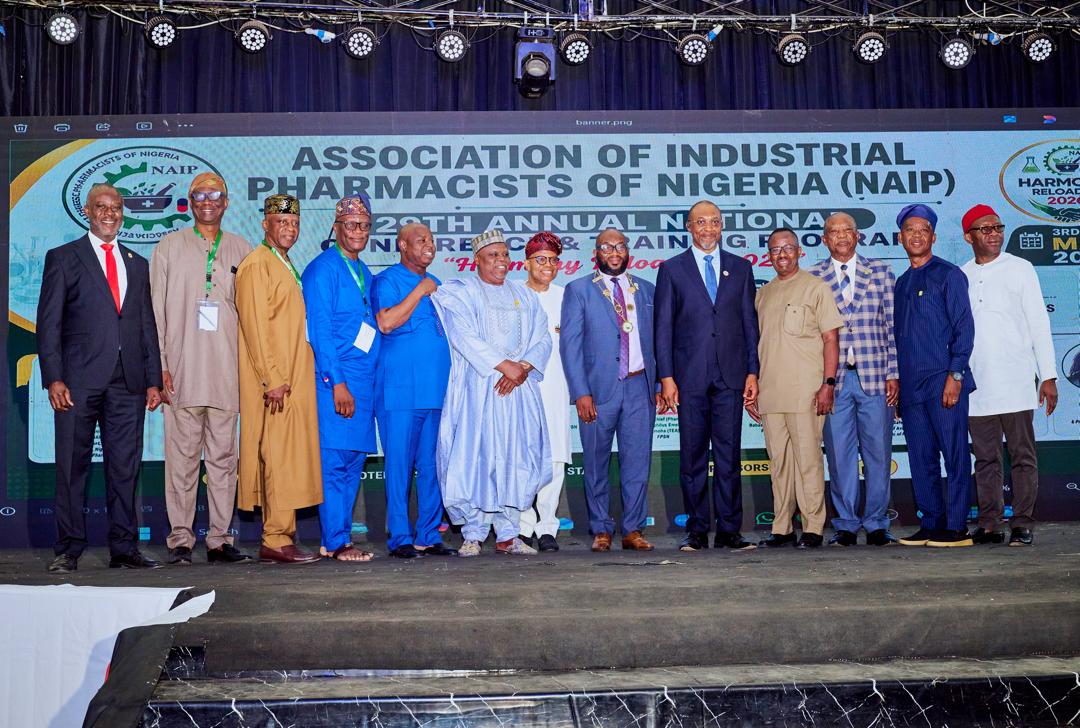
Chidoka gave the charge while delivering a keynote address at the 29th Yearly National Conference and Training of the Association of Industrial Pharmacists of Nigeria, NAIP, held in Ilorin, Kwara State.
Addressing pharmaceutical stakeholders, regulators, policymakers and industry leaders at the conference, the former minister warned that Nigeria’s pharmaceutical sector stands at a critical point and must urgently build governance and production systems capable of guaranteeing national health security and industrial competitiveness.
He lamented the rising cost of medicines and healthcare products in Nigeria, noting that ordinary citizens now face severe economic pressure in accessing basic medical supplements and over-the-counter healthcare products.
According to him, four common healthcare products, Creatine, Magnesium Glycinate, Vicks Sinex and a pain relief ointment, currently cost about N130,520 in Nigeria despite having a combined international market value of about $88.
Chidoka said while workers in countries like the United States spend only a small fraction of their earnings on such products, Nigerian workers on minimum wage could spend as much as 15 per cent of their monthly income, or nearly two months’ salary in some cases, to purchase the same items.
He attributed the situation not only to currency challenges but also to structural weaknesses in the pharmaceutical industry, especially the heavy dependence on imported Active Pharmaceutical Ingredients, APIs.
According to him, between 70 and 80 per cent of APIs used by local manufacturers are imported, thereby exposing the industry to foreign exchange volatility and supply chain disruptions.
“The future will not reward those who merely work harder in the same direction,” Chidoka said. “It will reward those who are willing to work differently with a long-term vision.”
He urged pharmaceutical manufacturers to adopt what he termed an “Agency Culture,” where organizations take full responsibility for quality outcomes regardless of infrastructural, regulatory or economic challenges.
Chidoka further stressed that regulatory compliance should no longer be treated as a burden but as a strategic opportunity for manufacturers to improve product quality, strengthen operational efficiency and gain international market confidence.
“The regulator’s weakness is not your permission to be weak,” he said.
“You are not building for NAFDAC alone; you are building for WHO, AfCFTA, and the Nigerian consumer.”
The former minister challenged local manufacturers to move beyond the minimum standards of the National Agency for Food and Drug Administration and Control, NAFDAC, and align their systems with global benchmarks set by the World Health Organization and the United States Food and Drug Administration, FDA.
He also urged industry operators not to wait for regulators before initiating reforms, but instead to lead proactively through innovation, accountability, self-regulation and data-driven decision-making.
Speaking at the conference, National Chairman of NAIP, Bankole Ezebuilo, also called on pharmaceutical manufacturers to embrace excellence beyond regulatory compliance.
Ezebuilo said quality and institutional excellence must become internal organizational values rather than obligations imposed externally by regulators.
He advocated the adoption of modern performance management systems such as Key Performance Indicators, KPIs, balanced scorecards, benchmarking tools and continuous feedback mechanisms to improve productivity and sustainability within the industry.
The conference featured participation from pharmaceutical executives and stakeholders across Nigeria and abroad, including United States-based pharmaceutical executive, Henrietta N. Ukwu, who attended as keynote speaker and trainer.
Former Presidents of the Pharmaceutical Society of Nigeria, PSN, including Mohammed Yaro Budah, Azubike Okwor, Olumide Akintayo, Ahmed Iyakassai and Sam Ohuabunwa, were also present at the event.
Other dignitaries included President of the Pharmaceutical Society of Nigeria, Ayuba Tanko Ibrahim, represented by Gafar Lanre Madehin, and Registrar of the Pharmacists Council of Nigeria, Ibrahim Babashehu Ahmed.
Officials of the Kwara State Government at the conference included Commissioner for Finance, Hauwa Nuru; Commissioner for Social Welfare, Mariam Nana Fatima Imam; Commissioner for Communication, Bolanle Olukoju; and Executive Secretary of the Hospital Management Board, Abdulraheem Abdulmalik.
As part of his reform proposals, Chidoka introduced what he described as “Mekaria,” an African operational philosophy centred on continuous improvement and supported by his M²I framework, Measure, Monitor and Improve.
He maintained that accountability and operational excellence must be institutionalised at every level of the pharmaceutical industry if Nigeria hopes to become competitive within the African Continental Free Trade Area, AfCFTA, and emerge as a major pharmaceutical manufacturing destination on the continent.
Chidoka concluded by urging stakeholders to regard quality not as a compliance expense but as a strategic competitive advantage capable of opening global contract manufacturing opportunities for Nigerian pharmaceutical firms.
He added that the responsibility for tackling the high cost of medicines and fixing institutional weaknesses within the sector must be jointly shared by manufacturers, regulators and consumers to secure Nigeria’s healthcare future and economic resilience.
Disclaimer
Comments expressed here do not reflect the opinions of Vanguard newspapers or any employee thereof.