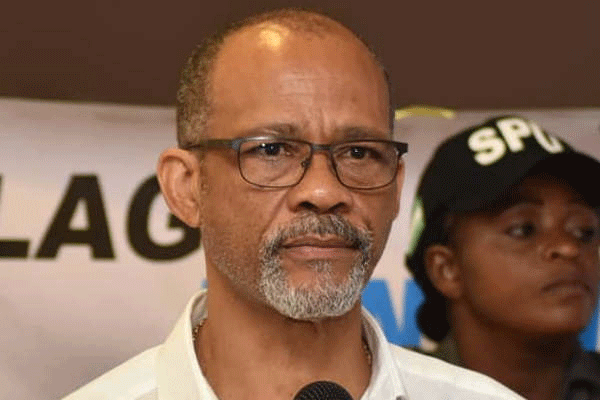
Professor Akin Abayomi, Lagos State Health Commissioner.
.Moves to reduce over 33,000 doctor deficit
By Olasunkanmi Akoni
The Lagos State Government has projected N100 billion funding through healthcare financing, workforce and infrastructure reforms to bridge gap in the health sector.
Meanwhile, the State Government has disclosed that it required about 40,000 medical doctors to adequately cater for its growing population but currently has only about 7,000 doctors in the system, leaving a deficit of more than 33,000 physicians.
Commissioner for Health, Prof. Akin Abayomi, speaking on Tuesday, during the 2026 Ministerial Press Briefing, held at Alausa, Ikeja, to commemorate the seventh anniversary of the administration of Governor Babajide Sanwo-Olu, and Deputy, Dr. Obafemi Hamza, stressed that the mandatory health insurance and stronger public-private partnerships would remain central to the state’s healthcare transformation agenda.
According to Abayomi, Lagos currently allocates about eight per cent of its budget to healthcare, far below the 15 per cent benchmark recommended under the Abuja Declaration, creating a significant financing shortfall.
“There is a gap of at least N100 billion between what we currently have and what we ideally need to provide quality healthcare services,” he said.
The commissioner explained that declining donor support, rising healthcare demands and Lagos’ rapidly growing population had made alternative financing mechanisms inevitable.
Abayomi disclosed that Governor Babajide Sanwo-Olu had already domesticated the National Health Insurance Authority Act through an Executive Order signed on July 16, 2024, making health insurance compulsory for all Lagos residents.
He said Ministries, Departments and Agencies, MDAs, had begun implementing measures requiring residents seeking government services to provide evidence of accredited health insurance coverage.
Abayomi revealed that more than 1.46 million residents had so far enrolled under the Ilera-Eko health insurance scheme, although he admitted that universal health coverage remained a long-term target.
He described Nigeria’s current healthcare financing structure as unsustainable, noting that about 77 per cent of healthcare spending still comes directly from citizens’ pockets, while only two per cent is funded through insurance coverage.
Abayomi further outlined the state’s broader healthcare vision under the Lagos 2052 Development Plan, which seeks to transform Lagos into a model mega city and rank it among Africa’s top three healthcare destinations within the next decade.
“The State plans to reverse outbound medical tourism by expanding specialised healthcare services locally.
“We do not want Lagosians travelling abroad for treatment in Dubai, London, India or South Africa. We want to provide every specialty and subspecialty right here in Lagos,” the commissioner stated.
According to Abayomi, the state required an additional 33, 000 health personnel to bridge manpower gaps in the health sector, describing the shortage of healthcare personnel as part of a broader global workforce crisis affecting many countries.
He said, “Nigeria has 40,000 doctors currently at a ratio of one doctor to 5000 population. Nigeria needs 300,000 new doctors while Lagos requires 40,000 additional doctors. Currently, Lagos has 7000. The gap for Lagos is 30,000 doctors and 40,000 nurses.”
Abayomi, described the shortage as part of a global phenomenon, but noted that Lagos was becoming increasingly attractive to healthcare professionals.
“For every doctor we have in Lagos, they are doing the job of ten,” he stated.
To tackle brain-drain, Abayomi said the government was implementing healthcare financing reforms, improving welfare and living conditions for medical personnel, and creating pathways for Nigerian doctors in the diaspora to return home.
He announced plans for a standalone University of Medicine and Health Sciences in Lagos State to increase the production of doctors, nurses, pharmacists and other healthcare workers.
Abayomi also stated that Lagos was strengthening collaboration between public hospitals, private healthcare providers and informal medical practitioners as part of efforts to improve healthcare delivery across the state.
By 2052, Abayomi projected, Lagos State to become a top medical tourism destination with a mandatory health insurance to achieve Universal Health Coverage (UHC).
He also said infrastructure remained a key priority of the administration, adding that the state had developed a medical blueprint focused on sustainable and renewable designs for health facilities.
“We are making sure that the health sector is robust enough to manage everything that comes its way,” Abayomi said.
According to him, Lagos currently has 34 secondary and tertiary public health facilities, 325 Primary Healthcare Centres, about 3,500 private health facilities, and over 10,000 Community Pharmacies and Patent and Proprietary Medicine Vendors operating within the informal sector.
Abayomi said Lagos State remained one of Africa’s leading healthcare destinations, noting that the state is currently ranked eighth among top African cities for healthcare delivery and is striving to move into the top three.
He listed other cities on the ranking to include Cape Town, Pretoria, Nairobi, Johannesburg, Durban, Algiers, Tunis, Cairo and Casablanca.
Meanwhile, the Special Adviser to the Governor on Health, Dr. Kemi Ogunyemi, urged residents to patronise only healthcare facilities accredited by the Health Facility Monitoring and Accreditation Agency (HEFAMAA), warning against the dangers of substandard medical practice.
Disclaimer
Comments expressed here do not reflect the opinions of Vanguard newspapers or any employee thereof.