By Chioma Obinna
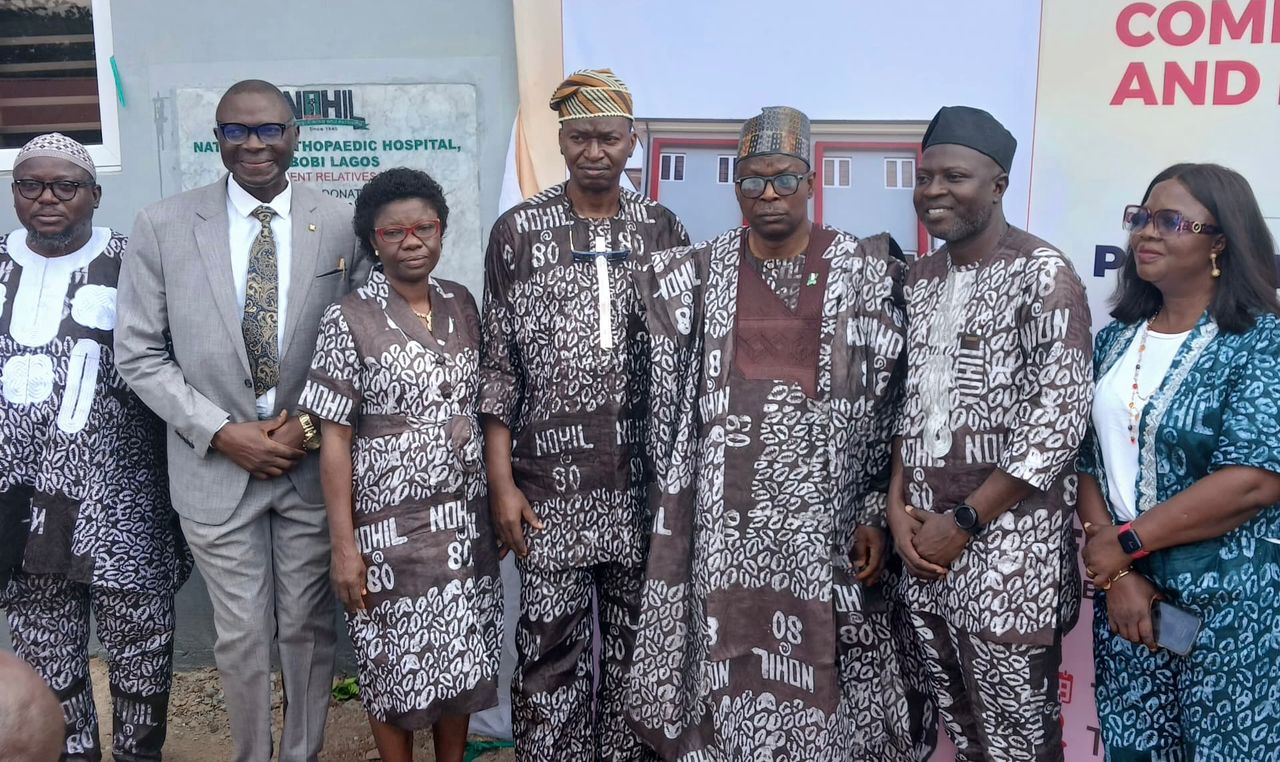
The Federal Government has called for stronger private-sector participation and increased investment in Nigeria’s healthcare sector, as the National Orthopaedic Hospital, Igbobi, Lagos, marked its 80th anniversary amid growing pressure from trauma cases, rising operational costs, and inadequate funding.
Speaking at the anniversary lecture and commissioning of major projects at the hospital, the Minister of State for Health and Social Welfare, Iziaq Adekunle Salako, said the government remained committed to repositioning tertiary healthcare institutions through strategic investments, infrastructure development, and public-private partnerships.
Salako described the National Orthopaedic Hospital, Igbobi Lagos as “a beacon of excellence” that has, for eight decades, restored hope to thousands of Nigerians battling trauma, bone diseases, and complex reconstructive conditions.
“The story of Igbobi is one of resilience, professionalism, innovation, and commitment to quality healthcare delivery. Thousands of lives have been restored, limbs salvaged, mobility regained and hope renewed through the dedication and expertise of the institution’s workforce,” he said.
The minister said the commissioning of new projects within the hospital reflected growing confidence by donors and stakeholders in the institution’s future.
Among the projects commissioned were a staff quarters donated by the Murtalha Adegboyega Ibraheem Foundation, a patient relations hostel facilitated by the Chief of Staff to the President, Femi Gbajabiamila, and renovated wards supported by the NNPC Foundation.
Salako also disclosed that the second phase of the hostel for the College of Nursing Sciences, facilitated by the Office of the Senior Special Assistant to the President on Sustainable Development Goals led by Adejoke Orelope-Adefulire, was nearing completion.
He urged corporate organisations, philanthropists, and development partners to support healthcare institutions, warning that emerging healthcare challenges such as road traffic injuries, workplace accidents, and degenerative bone diseases were increasing pressure on specialised hospitals.
“These realities call for sustained investment in specialised healthcare institutions such as the National Orthopaedic Hospital, Igbobi,” Salako stated.
Speaking, the Medical Director of the hospital, Dr. Wakeel Lawal, said the institution had continued to advance despite enormous financial and infrastructural challenges, stressing that the hospital now spends between N13 million and N15 million monthly on electricity alone.
“Power is one of the things consuming us. Most of the equipment we use is high-energy-consuming equipment. Despite solarising most parts of the hospital, we still depend heavily on public power supply and generators,” Lawal said.
He appealed for increased government funding and stronger support from philanthropists and the private sector to enable the hospital to expand facilities, upgrade equipment, and improve training capacity.
“We need to expand our facilities, continue to upgrade our equipment, and improve training. Government has been assisting us, but we need improvement in funding and more collaborations with the private sector,” he added.
Former Lagos State Governor, Babatunde Raji Fashola, who was a special guest at the event, said the sustainability of healthcare institutions required continuous investments and stronger partnerships.
“There needs to be leadership from the front. Sustainability requires that we continue to improve and diversify capacity and optimise the services the hospital provides,” Fashola said.
He described the hospital as “a place of care, hope and recourse for many Nigerians,” while urging continued support for the institution.
Also speaking, a representative of the Lagos State Government, Prof Akin Abayomi said the domestication of the National Health Insurance Authority Act in Lagos would improve healthcare financing and access to quality medical care.
According to him, health insurance remained critical to sustaining hospitals and protecting citizens from catastrophic health expenses.
“You may be going about your normal activities and suddenly require orthopaedic care after an accident. Health insurance provides that safety net,” he said.
He added that Lagos State was partnering with private healthcare providers and Health Maintenance Organisations, HMOs, to make health insurance more accessible to residents.
Founded in 1945, the National Orthopaedic Hospital, Igbobi, remains one of Nigeria’s foremost specialist hospitals for orthopaedic, trauma, and reconstructive care, training hundreds of medical specialists over the decades.
Disclaimer
Comments expressed here do not reflect the opinions of Vanguard newspapers or any employee thereof.