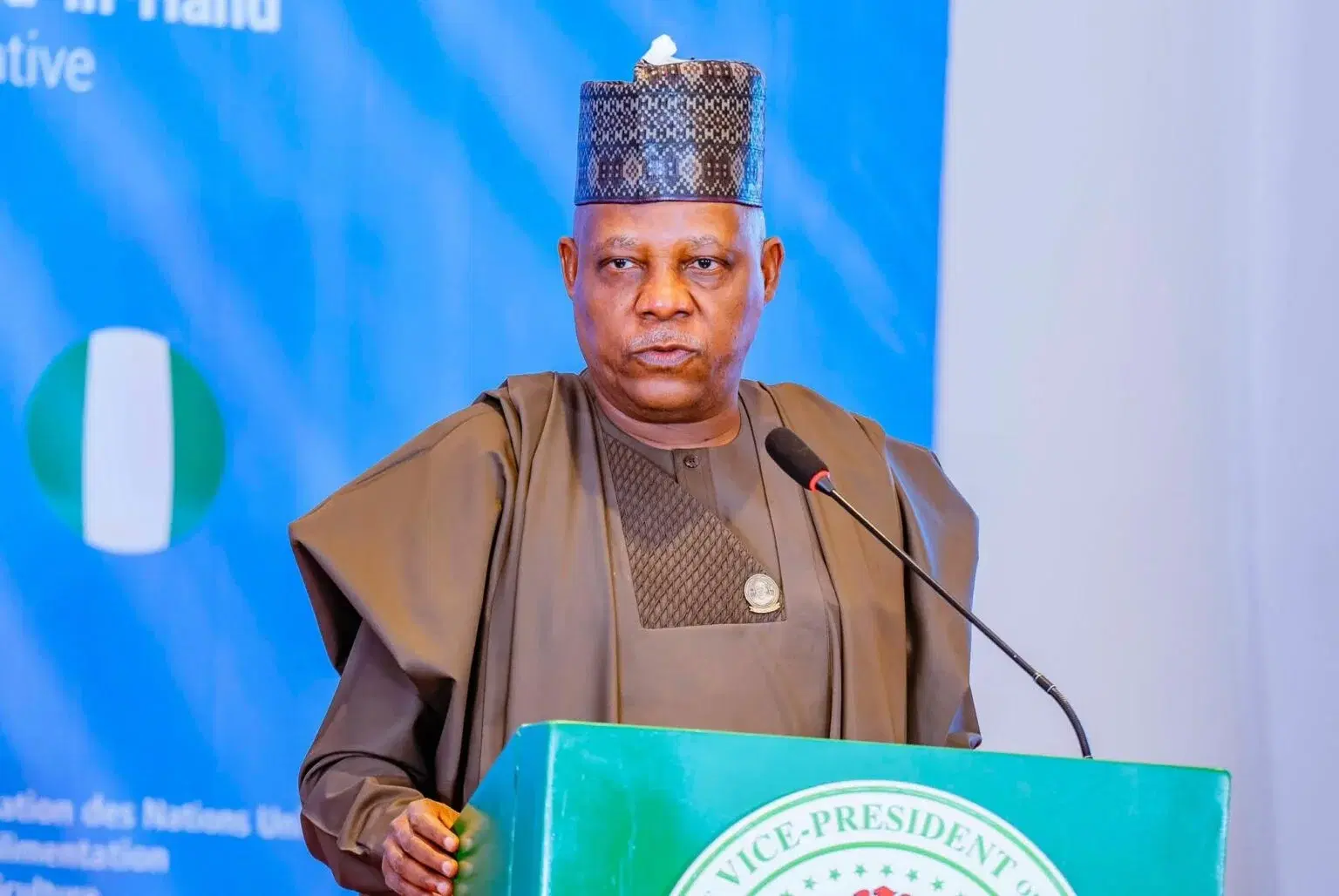
Shettima
By Joseph Erunke
The Federal Government on Friday, launched a major innovation-driven mining technology initiative aimed at transforming Nigeria’s vast solid minerals sector into a powerhouse for industrial growth, job creation and global competitiveness.
Speaking at the high-level launch of the Mine-Tech UniPod at Nasarawa State University, Keffi, the Vice President, Kashim Shettima, declared that Nigeria was strategically shifting from exporting raw minerals to building a knowledge-driven industrial economy powered by technology, research and innovation.
Represented by the Minister of Education, Dr. Tunji Alausa, the Vice President described the Mine-Tech UniPod as “a bold national vision” designed to reposition Nigerian universities as centres of enterprise development, commercialisation, industrial competitiveness and economic transformation.
He said the initiative aligns with President Bola Ahmed Tinubu’s Renewed Hope Agenda, which places human capital development, youth empowerment, innovation and industrialization at the core of national development.
According to him, “Education is no longer viewed merely as a social service; education is now being positioned as a strategic national investment for economic growth, job creation, technological advancement and global competitiveness.”
Shettima disclosed that Nigeria possesses over 44 commercially viable mineral resources valued at more than one trillion dollars, lamenting however that the country had for decades exported raw materials while importing finished products at far higher value.
“We exported opportunities, jobs, technology and prosperity. But today, Nigeria is making a strategic shift from extraction to value addition, from raw export to industrial processing, from dependence to innovation-driven growth,” he said.
He noted that the global economy was rapidly evolving around critical minerals such as lithium, cobalt, graphite, coltan and rare earth elements needed for electric vehicles, renewable energy systems, semiconductors and advanced manufacturing.
He identified Nasarawa State as a strategic hub in the emerging global mineral economy due to its rich deposits of lithium, tantalite, gemstones, lead-zinc and other industrial minerals already attracting major processing investments.
Shettima explained that the Mine-Tech UniPod was established to bridge the long-standing gap between academic research and industrial commercialisation by connecting students, researchers, investors, environmental experts and mining professionals within one innovation ecosystem.
The facility, he said, houses four cutting-edge laboratories, namely the Mineral Intelligence Lab, Materials and Processing Lab, Geo-Spatial Innovation Studio and Green Mining/ESG Technology Hub.
“These facilities represent the future of interdisciplinary learning and innovation. They combine Artificial Intelligence, Machine Learning, Materials Science, Digital Mapping, Sustainability and Environmental Governance into a single ecosystem for industrial problem-solving,” he stated.
The Vice President revealed that seven UniPods had already been established across Nigeria’s geopolitical zones, focusing on Artificial Intelligence, Green and Blue Technology, Manufacturing and Trade, Agriculture, Resilience Technology, Industrial Technology and Mine-Tech Innovation.
He stressed that the Federal Ministry of Education, through the Nigeria Education Sector Renewal Initiative, NESRI, was aggressively promoting STEMM education, Technical and Vocational Education and Training, TVET, digital literacy, research commercialisation, and university-industry collaboration.
Highlighting ongoing reforms, Alausa disclosed that about 160,000 youths were currently undergoing TVET training in approximately 1,200 centres nationwide, adding that over one million applications were received within one month after reopening the TVET portal.
“We are on track to train another 100,000 youths within the next few months,” he added.
He further applauded the Mine-Tech UniPod’s emphasis on environmentally responsible mining practices, digital traceability systems and ESG compliance, saying the future mining economy must be technologically driven, socially inclusive and environmentally sustainable.
He said the initiative targets the creation of over 5,000 green jobs by 2028 and seeks to expand Mine-Tech innovation ecosystems to at least 20 public universities across the country.
Shettima assured stakeholders of the Federal Government’s commitment to supporting innovation-driven tertiary education and strengthening partnerships among universities, industry players, development agencies and the private sector.
“The future belongs to nations that can successfully connect education to productivity, research to enterprise, innovation to industry and talent to opportunity,” he declared.
He urged students and researchers to maximise the opportunities provided by the UniPod to create globally competitive technologies, enterprises and solutions capable of addressing national challenges.
“The launch of the Mine-Tech UniPod is more than a ceremony. It is a declaration that Nigeria is ready to build a knowledge-driven, innovation-powered and industrially competitive future,” he stated.
Speaking earlier, Governor Abdullahi Sule of Nasarawa State, described the facility as a timely intervention that would position the state as a major hub for mining innovation and technology-driven industrial development in Nigeria.
The government assured that the state government would provide a solar mini-grid to guarantee sustainable power supply for the facility and ensure uninterrupted operations.
He tasked investors, development partners and private sector players to leverage the opportunities being created through the innovation ecosystem to support research, entrepreneurship, technology transfer and job creation for young Nigerians.
According to him, his state’s vast mineral resources, particularly lithium and other strategic minerals, place it at the centre of the global transition toward clean energy and advanced manufacturing, adding that the state was committed to creating an enabling environment for responsible mining and industrial investments.
The Executive Secretary of TETFund, Sonny Echono, in his remarks, said more than 20 UniPods would be established across the country before the end of the year as part of efforts to deepen innovation and enterprise development within Nigerian universities.
Disclaimer
Comments expressed here do not reflect the opinions of Vanguard newspapers or any employee thereof.