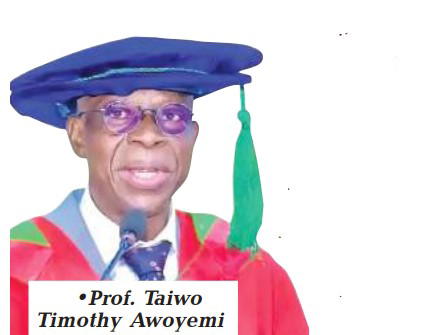
By Adeola Badru, IBADAN
A Professor of Development Economics in the Faculty of Agriculture, University of Ibadan, Prof. Taiwo Timothy Awoyemi, has blamed Nigeria’s persistent struggles and development challenges on the polarisation of its socio-economic structure along ethnic, religious and economic lines.
He made the assertion while delivering the 610th Inaugural Lecture (2025/2026) of the University of Ibadan, held at Trenchard Hall, with the theme, “Nigeria in Persistent Struggle: Nuisance of Unfaithfulness to the Trio of Economic Development.”
Awoyemi said poverty in Nigeria had remained deeply entrenched despite modest improvements in social indicators over time, stressing that, “the problem of poverty in Nigeria has by no means diminished, but now appears more severe than ever.”
He maintained that poverty reduction remained a central development challenge requiring urgent and sustained attention.
The don explained that development outcomes were shaped by the interaction of growth, inequality and poverty, noting that, “economic status and social categories such as ethnic groups and religion are strongly correlated,” making inclusive development more difficult to achieve.
According to him, inequality affects economic growth in different ways depending on prevailing conditions, warning that inadequate understanding of these dynamics often resulted in weak policy design.
He also cautioned that ignoring intra-household inequality could lead to mismeasurement of poverty and flawed policy interventions, including ineffective wage and social transfer programmes.
Awoyemi criticised Nigeria’s recurring reliance on crisis-driven economic management, saying government functionaries often failed to adopt comprehensive and forward-looking strategies, which led to deteriorating outcomes and repeated policy failures.
He called for stronger coordination, long-term planning, effective monitoring and evaluation systems, and stricter anti-corruption enforcement.
The don urged Nigeria to prioritise pro-poor growth rather than aggregate economic expansion, stressing that growth must be inclusive to significantly reduce poverty.
He recommended increased investment in agriculture, rural infrastructure and agro-value chains, describing agriculture as one of the most effective sectors for poverty reduction.
The professor also called for deliberate measures to reduce inequality through progressive taxation, expanded social spending on health, education and nutrition, and targeted development of disadvantaged regions, adding that, reducing inequality was itself a “growth-enhancing strategy.”
Awoyemi raised concern over widening regional disparities driven by unequal access to infrastructure, security and skilled labour, urging increased government support for social intervention schemes such as the Government Enterprise and Empowerment Programme (GEEP) to strengthen small and medium-scale enterprises.
He warned that the weakening of the middle class posed a threat to economic stability and called for policies to protect purchasing power, expand employment opportunities and strengthen digital and vocational skills.
On gender inequality, he said poverty alleviation efforts would remain ineffective if rural women continued to be excluded, calling for stronger implementation of gender policies in agriculture, legal reforms to guarantee land rights, and increased investment in maternal health and education.
Disclaimer
Comments expressed here do not reflect the opinions of Vanguard newspapers or any employee thereof.