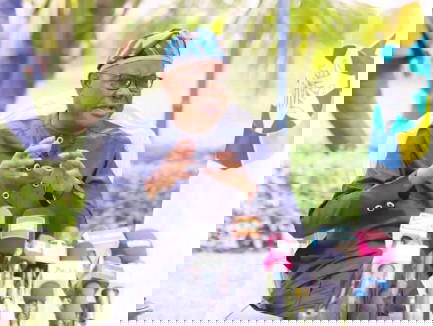
Every few weeks, as predictably as Lagos traffic, the FCT Minister turns an ordinary afternoon into a national spectacle, commanding cameras, microphones, and attention like a one-man headline industry while ordinary Nigerians wonder if Abuja is funding governance or the longest-running political talk show in the country.

Wike may be the most interview-ready politician Nigeria has ever produced.
If microphones had a favourite public official, they would probably choose him without hesitation.
Just when the country is recovering from the last round of headlines, there he is again, seated before cameras like a man who feels more at home under studio lights than most news anchors.
For a country whose presidents speak so rarely that citizens hear more from rumours than from the State House, Wike’s media chats now feel like a genre of their own.
It is no longer public communication.
It is appointment television.
Why preserve words when you can spend them like confetti?
At this point, Wike does not just speak to the media.
He is in a committed relationship with it.
Every few weeks, as predictably as Lagos traffic or NEPA disappointment, there he is. Chairs are arranged. Microphones stand at attention. Journalists settle in with the quiet excitement of people about to leave with tomorrow’s headlines. And there he is, the FCT’s indefatigable master of ceremonies, ready for another episode of what now feels less like governance and more like a political drama. It is both, some will say.
He speaks on roads.
He speaks on demolitions.
He speaks on party quarrels, Abuja land, security tensions, political enemies, former allies, current allies, future enemies.
And controversies that often seem to spring into existence simply because his microphone noticed an empty afternoon.
Where most politicians manage visibility, Wike pursues it like a constitutional duty.
He is not just available.
He is professionally impossible to ignore.
In another life, he might have been Nigeria’s most successful talk show host.
But perhaps that is the brilliance of it all.
Governance today is not just about roads or budgets. It is about occupying space in the national imagination.
It is about never letting silence make someone else feel bigger.
In the age of attention, obscurity is political death.
Wike has clearly decided he will never die.
He keeps talking.
And the media keeps showing up.
He is a one-man headline industry.
Some politicians build roads. Wike builds the news cycle and roads.
Some build bridges. Wike builds clips and bridges.
Some commission projects. Wike commissions conversations and projects.
At this point, one suspects there is a permanent ring light in the FCT minister’s office, always charged, always glowing, waiting for the next national inconvenience.
A military officer blocks access to disputed land in Abuja. Ring light comes on.
A building is demolished. Ring light comes on.
Street traders protest. Ring light comes on.
A rival clears his throat in Port Harcourt. Ring light comes on before the cough is complete.
If tomorrow one stubborn Abuja goat refuses to leave a roundabout, nobody should be surprised if journalists are invited for an emergency media chat on livestock discipline, urban order, and the growing suspicion that the goat may be acting on behalf of unnamed political enemies.
And if that goat returns with reinforcements, a sheep, or maybe a politically exposed donkey, the press corps may need a special extended edition.
Some politicians offer dry bureaucratic updates.
Wike offers fire.
Quotable outrage, dramatic jabs, one-liners that travel from studio to WhatsApp before cameras are packed away.
Who will he praise today?
Who will he roast?
Which phrase will Nigerians turn into memes before sunset?
At the same time, there is a cost to this spectacle. Live transmission on major stations alone can swallow frightening sums. Add Channels, Arise, AIT, TVC, NTA, aides, protocol men, journalists, invited guests, security, refreshments, and the familiar crowd of one hundred seated in quiet expectation of tomorrow’s headlines. The result is not just a media chat but also a small economic summit of spectacle.
If one does the rough mathematics, week after week, sometimes twice in the same week, the bill begins to climb into numbers that make ordinary Nigerians wonder whether Abuja is funding governance or underwriting the longest running political talk show in the country. In almost three years of being FCT Minister, Wike may have spent a lot on these chats. Is he getting the commensurate results for himself and government? It’s debatable. Wine sails on.
This is governance as theatre. This is the economics of attention. This is a man who has turned the national imagination into a newsroom.
Years from now, historians may dig through policy files and budget speeches to understand this era. But the truest archive may not be in government cabinets.
It may be in studio lights.
In journalists clearing their microphones.
In the certainty that somewhere, Wike is already preparing the next episode.
Because in another age, powerful men built monuments in stone.
In this one, some build them in soundbites. And no Nigerian politician has loved the sweet romance of the microphone quite like Wike. Is he getting the results? Time will tell.
Disclaimer
Comments expressed here do not reflect the opinions of Vanguard newspapers or any employee thereof.