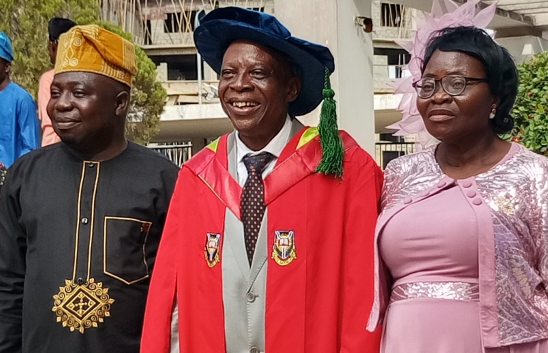
By Adeola Badru
A Professor of Development Economics at the University of Ibadan, Taiwo Timothy Awoyemi, has attributed Nigeria’s persistent development challenges to the polarisation of its socio-economic structure along ethnic, religious, and economic lines.
Awoyemi made the observation while delivering the institution’s 610th inaugural lecture (2025/2026 session) at Trenchard Hall, themed “Nigeria in Persistent Struggle: Nuisance of Unfaithfulness to the Trio of Economic Development.”
He noted that poverty remains deeply entrenched despite some improvements in social indicators, stressing that it continues to pose a major development challenge requiring sustained attention.
According to the professor, development outcomes are shaped by the interaction of economic growth, inequality, and poverty, adding that the correlation between economic status and social identities such as ethnicity and religion complicates efforts toward inclusive development.
He explained that inequality can influence economic growth in different ways depending on prevailing conditions, warning that limited understanding of these dynamics often leads to weak policy design. He also highlighted the importance of addressing intra-household inequality to ensure accurate poverty measurement and effective social interventions.
Awoyemi criticised the country’s reliance on short-term, crisis-driven economic management, noting that the absence of long-term planning and coordination has contributed to inconsistent policy outcomes. He called for improved monitoring and evaluation systems, as well as stronger institutional frameworks.
He emphasised the need for pro-poor and inclusive growth, urging increased investment in agriculture, rural infrastructure, and agro-value chains, which he described as critical to reducing poverty.
The professor also advocated measures to address inequality through progressive taxation, expanded social spending on health, education, and nutrition, and targeted development initiatives for disadvantaged regions.
He expressed concern over widening regional disparities linked to uneven access to infrastructure, security, and skilled labour, and called for strengthened support for small and medium-scale enterprises through social intervention programmes.
Awoyemi further warned about the implications of a shrinking middle class for economic stability, urging policies that protect purchasing power, expand employment, and enhance digital and vocational skills.
On gender inequality, he stressed the need for inclusive policies that improve women’s access to resources, including land rights, education, and healthcare, particularly in rural areas.
He also highlighted the importance of boosting agricultural productivity through agro-processing, digital commodity exchanges, increased research funding, and a stronger focus on science and technical education.
The economist cautioned against frequent policy reversals associated with political transitions, noting that consistency in policy implementation is essential for sustainable development.
Awoyemi concluded that Nigeria’s economic transformation depends on a sustained commitment to inclusive growth, poverty reduction, and inequality management.
Disclaimer
Comments expressed here do not reflect the opinions of Vanguard newspapers or any employee thereof.