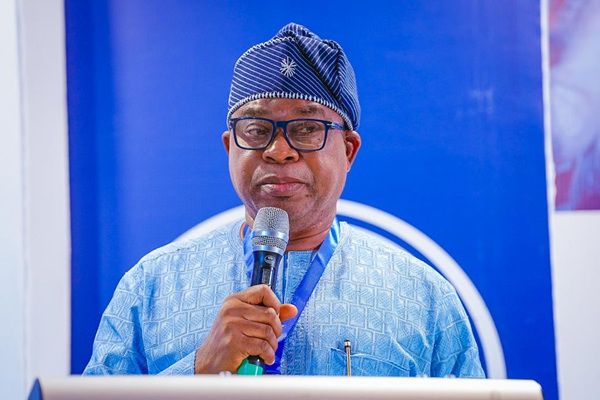
Oyebamiji
By Kunle Adegboye
As the August 15 governorship election approaches, Bola Oyebamiji’s candidacy carries an unmistakable signal from Abuja that could prove decisive.
The signals from Abuja have grown impossible to ignore. In Bola Oyebamiji, President Bola Tinubu appears to have found a familiar political archetype: the steady technocrat, shaped by institutions rather than rallies, whose value lies not in volume but in reliability. It is a model Tinubu has trusted before across various South West states, and one he is now projecting into Osun with increasing clarity.
With barely four months until the August 15, 2026 governorship election, Oyebamiji’s candidacy is no longer just another name in a crowded field. It is beginning to carry the quiet weight of federal interest—the kind that does not always announce itself but rarely goes unnoticed.
So much so that the incumbent administration in Osun State has begun to pay particular attention to the APC standard-bearer.
For a state long accustomed to the theatre of politics, this introduces a fundamentally different kind of contest.
The Architecture of Alignment
Political alignment with a sitting President, particularly within the South West’s intricate political architecture, is never a trivial advantage. It brings organisational coherence, access to resources, and a narrative of continuity that has proven persuasive in a region that often prizes political alignment as a pathway to development.
Oyebamiji’s camp understands this calculus perfectly.
The former Commissioner for Finance and current Managing Director of the National Inland Waterways Authority (NIWA) has positioned himself not merely as a candidate but as an extension of a broader governing vision. This distinction matters in ways that poll watchers are only beginning to fully appreciate.
“This is not about imposition,” an APC strategist who spoke on condition of anonymity explained. “This is about what federal support can achieve when channelled through a homegrown candidate who already understands the terrain. Oyebamiji is from Ikire. He served Osun as Finance Commissioner. He is not an outsider being parachuted in. He is a son returning with federal backing.”
The distinction is carefully crafted, and potentially potent.
The Incumbent’s Challenge
Governor Ademola Adeleke, now running on the Accord Party platform following internal friction within the PDP, remains a formidable opponent. His grassroots appeal is undeniable. The man popularly known as the “dancing governor” has cultivated a style that thrives on direct connection with the electorate, on visibility, on the politics of presence.
But political observers note that Adeleke’s 2022 victory margin of roughly 28,000 votes is vulnerable to reversal through the current APC unity and voter mobilisation.
And that is where the federal factor becomes critical.
The APC has achieved what many considered improbable: internal cohesion. In December 2025, over 1,600 delegates affirmed Oyebamiji as the sole candidate after other aspirants, including those supported by high-ranking leaders like Iyiola Omisore and Babajide Omoworare, agreed to step down. Even Omisore, who had signified his intention to run and was among seven aspirants barred by the APC Screening Committee, accepted the decision following President Tinubu’s endorsement of Oyebamiji.
That kind of unity does not happen by accident. It happens when the highest office in the land signals a preferred direction.
Beyond the Noise
What makes Oyebamiji’s candidacy particularly intriguing is how it contrasts with the incumbent’s approach.
Where Adeleke has leaned into performance, into the theatre that has become his political trademark, Oyebamiji represents something less immediately captivating but potentially more durable. One speaks the language of presence. The other speaks the language of systems.
Oyebamiji’s résumé tells the story of accumulation. Banking halls before government offices. Balance sheets before campaign slogans. More than two decades in the financial sector, followed by a consequential tenure as Commissioner for Finance in Osun, where the job was less about applause and more about survival during a period when the state’s fiscal space was incredibly tight.
The counterargument to the half-salary of that era has always been that those decisions, however painful, prevented something worse—that they were not acts of indifference but of constraint
Even institutions like the World Bank would later acknowledge the state’s efficiency in public expenditure during that period, though such endorsements rarely erase lived experience.
The Broader Political Moment
There is also the matter of timing.
Nigeria’s broader political mood is shifting, if only slightly, from a fixation on personality toward a renewed, if cautious, interest in performance. It is not a wholesale transformation. Charisma still counts. Narrative still matters. But there is also a growing impatience with governance that dazzles without delivering.
Oyebamiji’s candidacy seems calibrated to that moment. It offers a different proposition—one that suggests the era of improvisation can give way, however gradually, to one of structure.
Whether that argument lands in the markets of Osogbo or the ward meetings of Irewole remains to be seen. But the presence of federal weight behind the proposition gives it a gravity that cannot be easily dismissed.
As one political observer put it: “In Nigerian elections, federal might does not guarantee victory. But it makes defeat significantly less likely.”
For Osun’s incumbent, that is a reality that no amount of dancing can obscure.
Adegboye is an Abuja-based financial expert
Disclaimer
Comments expressed here do not reflect the opinions of Vanguard newspapers or any employee thereof.