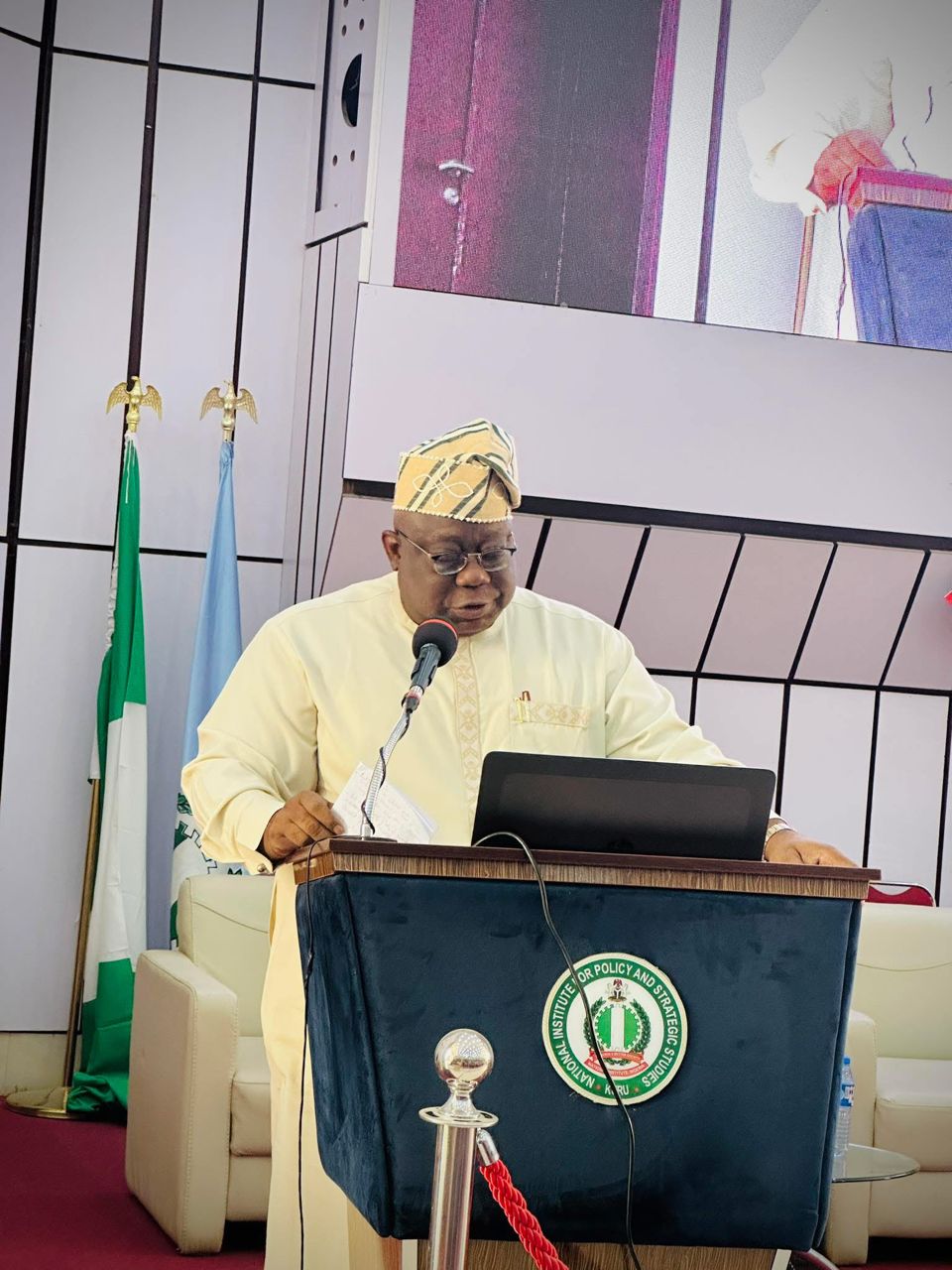
By Prof. Tunji Olaopa
In this piece, I will be taking seriously the wisdom of Pericles and Aristotle; one was one of the founding statesmen of Athenian democracy, and the other one of Greece’s greatest philosophers. Both participated in the crafting of the general principles of political life and understanding that Greece gave to the rest of the world. I am interested in teasing out the critical implication of their understanding of politics and the political life on how we live within the political community in contemporary times. This, especially in the age of the internet and the social media, and the short attention span that dilutes the essence and the ubiquity of politics in daily life. In an age where political matters compete with entertainment news and the violence of daily life, how do we continue to mediate Aristotle’s insistence that we are political animals? What does he mean by that profound statement? How does the statement give credence to his understanding of political science as a master science? And finally, how does political life make being apolitical impossible, and instead give room for reflection on political participation?
In the Politics, Aristotle made a timeless statement with the force of a universal axiom. For him, humans are “political animals.” What does that imply? It is a statement that hits at the very core of human self-realization and communal relations. Being a political animal means that humans can only be truly humans—and fulfil their potentials—through an active participation and civil investment in the political community. This makes politics, for Aristotle, a communal enterprise that enable people and community members to live together in order to be able to achieve collective happiness. The humans cannot therefore live alone since it is only natural for them to live together. The polis or the political community is the space within which humans deploy speech and reason as the mechanism for enhancing social order and harmony that bring our human flourishing. Aristotle concluded that since the achievement of self-realization comes from living within the political community, anyone who refuses to live in the polis is either a beast or a god.
Aristotle’s philosophical analysis of politics and the political nature of humans serves as the basis for understanding Pericles’ celebration of the political life of the Greeks and the noble understanding of the active citizenry in the Funeral Oration. The active citizen, for Pericles and Aristotle is the one who is fully involved in the governance of the polis. According to Pericles, “Here each individual is interested not only in his own affairs but in the affairs of the state as well: even those who are generally occupied with their own business are extremely well-informed on general politics – this is a peculiarity of ours: we do not say that a man who takes no interest in politics is a man who minds his own business; we say that he has no business here at all.” In other words, anyone who prefers to withdraw into private life among the ancient Greeks is considered to be utterly useless. Being apathetic or withdrawing from political and political life was not even an option. This was because every citizen was expected to contribute her quota to the wellbeing of the community.
It is in this sense—in the sense of the happiness of the community outweighing that of the individual—that Aristotle insisted that politics must be seen as the “master science.” It is for him the science that is concerned with how the society is to be so structured and ordered according to those principles, laws, processes and rules that will enable the citizens to live the good life—and the good life is a life of happiness; a life that enables the citizens to realize themselves fully as humans. Indeed, as Pericles critically observed, “Just because you do not take an interest in politics doesn’t mean politics won’t take an interest in you.” For the ancient Greeks, this statement demonstrates the extent of the choice that the citizens are confronted with in ordering their society according to their collective dictates. The interest that politics will take in the citizens is what is meant to transform the life prospect of the citizens.
The danger, however, as the condition of apathetic politics in postcolonial Nigeria demonstrates, is that when politics is left to the whims of those whose stakes are essentially selfish and greedy self-aggrandizement, then politics becomes dirtier and more perilous. The interest that politics then take in the citizens is that of draining their lifelines. In this sense, Pericles’ statement becomes even stark in a way that resonates with postcolonial Nigerians than with ancient Greeks. But it is still a stern instruction to actively participate in ways that chain politics to human welfare and flourishing. Here, we get the first sense of the reason why politics is concerned with everything. Harold Lasswell conceives politics as the study of who gets what, when and how. Politics, in other words, is concerned with the dynamics of power and how it is deployed towards the distribution of scarce resources, as well as the benefits and burdens, in the society. In the first instance, therefore, politics is everything because every decision that is made in the political community has political implication. When for instance citizens refuse to participate in politics through, say, voting, the decision cascades down into political consequences.
The second implication is that government’s policy decision permeates every critical aspect of the citizens’ lives, from infrastructures to even the possibility of their death. It would seem that there cannot be any aspect of a citizen’s life that could escape the surveillance of political decisions. Our lives are connected with the functioning of political processes, procedures, rules and regulations. No matter how apolitical we think we are, we will need to obey the traffic lights, pay taxes, register our vehicles, pay tenement bills, not get involved in criminal activities, and many others. Even the mere discussion of politics, for example, in the comment sections of social media platforms is an indication that we are dragged into the whirlpool of political events and circumstances, whether we like it or not.
The Greeks got it right, and our own existential circumstances in a postcolonial state demonstrates it, that politics is deeply entrenched into our lives and existence. There is a reason Aristotle denominates politics as the master science, and that reason goes beyond its ubiquitous reach into all lives and all matters. Within the complexities of the political community, it is the task of politics—and politicians—to ensure that power and power relations are appropriately deployed towards human flourishing through governance dynamics that enable citizens to connect with what Amartya Sen calls capabilities that will enable the citizens to function well within the state and in line with whatever life prospects they have chosen. Politics ought to make life more meaningful, and this goes beyond the mere provision of infrastructural dividends to achieving a level playing field within which citizens can satisfy economic, psychological and cultural well-being. The meaning of capabilities also goes into the ability of politics and politicians to enable citizens participate together in resolving the complex interactions between competing individual and community preferences and interests that are bound to cause rancor and destabilize the social harmony that politics seeks in the first place.
This is where politics is failing Nigeria’s national integration project of melding the disparate constituents of the postcolonial Nigerian state. In this context, and unlike the Greek city-state, politics is called on with renewed urgency to play a more strategic role in the mediation of human flourishing in the charged political community. The unfortunate thing is that Nigerians face the penetrative gaze of politics in their lives and the attendant responsibilities to the state, without the correspondent benefits of the enhancement of their capabilities to function well as citizens. The national integration project is therefore derailed at two fundamental levels. On the first level, ethnonational wrangling keeps piercing the fabric of unity within the national space. The capacity of consecutive governments to articulate a civic nationalism that will reduce the vagaries of ethnic loyalties is diminished by the bad politics that these governments play with the well-being of the Nigerian state and of the citizens themselves. We therefore have a Nigerian state, unlike the Greek city-state, where the citizens do not feel a sense of civic belonging that enable them to give their talents and competences to assist the state in mediating the role of politics in achieving human flourishing.
And this leads directly to the second dimension of the derailment of the Nigerian national integration project. Within the cracks of the state’s failure to deploy good politics that articulate civic nationalism, citizens are having a field day fending for themselves, and most times at the expense of the state and its scarce resources. In most instances, the political class and its clientele and cronies are deploying state power to achieve primitive accumulation that further scatter the capacity of politics to determine who gets what, when and how. And when politics consistently fails to fairly share the benefits and burdens—when democratic governance becomes clogged by political and bureaucratic corruption—the citizens find the way by themselves and their own means to exist meaningfully. Quite unfortunately, the informal sector accounts for 65% of Nigeria’s GDP, and has close to 90% of Nigeria’s total workforce. This tells a dismal story of the failure of the political class to manage the potentials of politics to weld all variables together for a capable democratic governance dynamic.
I am a political scientist and an institutional reformer, and this reflections and analyses bring home to me poignantly not only the fundamental significance of politics and the means by which people are enabled to achieve self-realization within the political community. It also signals some of the critical issues that political science—the discipline that studies politics and its many dynamics—has to weather successfully to be able to achieve some level of relevance especially within a besieged national state like Nigeria. At the moment, political science is a discipline that is characterized by a methodological flux, from the quantitative and the qualitative to mathematical modelling and many more. This is further complicated by increasing hyper-specialization that seems to take the discipline away from public comprehension. Within the Nigerian context, this generates an expectation gap between what the government wants to gain from and achieve with research, and what political scientists are able to deliver with their methodologies.
This gap can be breached by the willingness of the political science community to resolve the relevance question in ways that triggers a collective effort to embrace available methodological tools that increase research relevance for the Nigerian state, from proactive immersion in Nigeria’s political predicament to an enabling interdisciplinary methodology that deploy an ethical harnessing of technologies like artificial intelligence in understanding political matters. Politics has a lot to offer Nigeria and Nigerians only if we are deliberate about its nature and its possibilities. Nigerians are also political animals who need an intentional government to fairly decide who gets what, when and how.
Prof. Tunji Olaopa Chairman, Federal Civil Service Commission & Professor of Public Administration
Disclaimer
Comments expressed here do not reflect the opinions of Vanguard newspapers or any employee thereof.