By Gabriel Ewepu
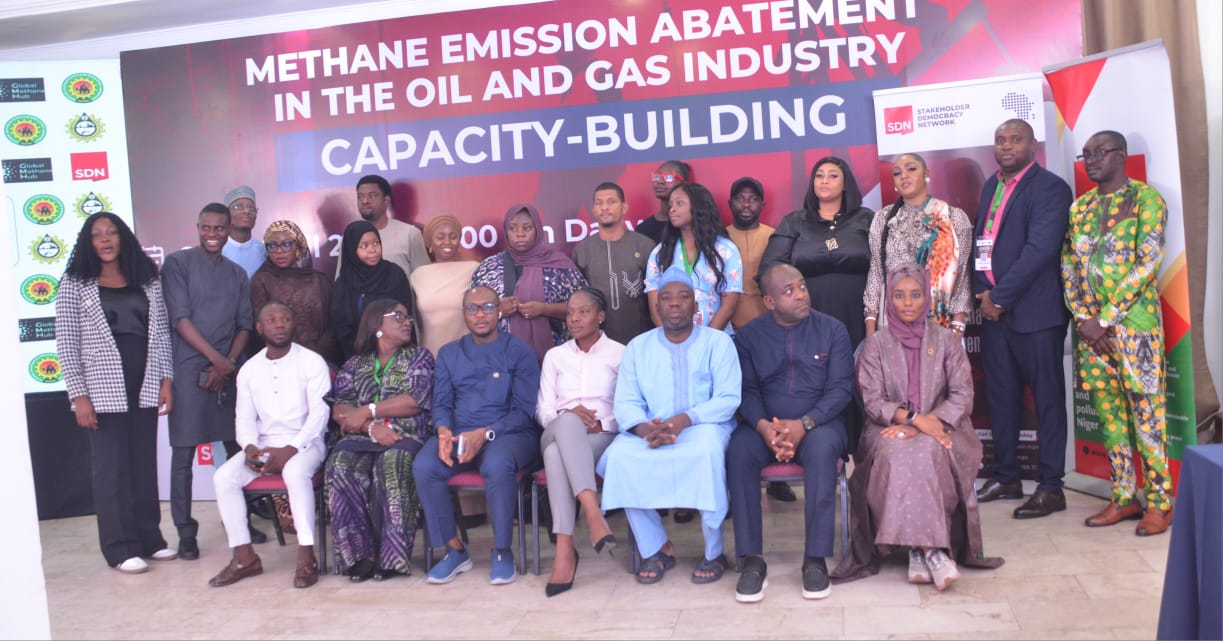
ABUJA – AS emissions remain critical factor negatively impacting on the environment, Stakeholder Democracy Network, SDN, Tuesday, disclosed embarking on a high-level capacity-building programme aimed at strengthening regulatory oversight of methane emissions in Nigeria’s oil and gas industry.
Speaking at the opening session, the Country Director, SDN, Florence Ibok-Abasi, described the training as a strategic investment in enhancing the ability of regulators to tackle Nigeria’s environmental challenge.
Ibok-Abasi explained that SDN, with support from the Global Methane Hub, brought together officials from key regulatory bodies to strengthen collaboration, technical expertise, and enforcement capacity on methane abatement.
She said: “This training represents a significant investment in your capacity to strengthen regulatory oversight of methane emissions in the oil and gas industry, which is one of Nigeria’s most pressing environmental and economic challenges.
“Over the next two days, we will examine methane abatement strategies and technologies, enforcement mechanisms, and international best practices. It is a working session designed for practical application.
“Every module has been tailored to the regulatory perspective you face daily: – operational challenges, compliance dilemmas, data gaps, and enforcement questions.”
Ibok-Abasi said that the training is the first segment of the capacity-building programme adding that the second segment will follow once the Nigerian Oil and Gas Industry Emission Tracker, NOGIET, is completed.
“The tool, which SDN is developing for you, will provide near real-time emissions data and transform how you regulate.
“When we reconvene, we will build on what you learnt here and show you how to integrate NOGIET into your enforcement workflows”, she said.
The Country Director also explained that the training was foundational in equipping regulators with the knowledge and strategies to lead their sector toward meaningful methane reductions, and necessary as Nigeria is committed to the Global Methane Pledge.
According to her (Ibok-Abasi), the Nigerian Midstream and Downstream Petroleum Regulatory Authority (NMDPRA) and Nigerian Upstream Petroleum Regulatory Commission (NUPRC) are central to delivering on that commitment.
“The regulators in this room have the authority, responsibility, and now the knowledge to drive accelerated change in methane management across Nigeria’s oil and gas sector.
“Let’s make these two days count. Let’s build the capacity that will make NUPRC and NMDPRA the gold standard for methane regulation in Africa”, she added.
In a remark, the Head, Environment and Climate Change, SDN, Dr Jude Samuelson, stated that the training exposed regulators to advanced methane abatement technologies, financing mechanisms, and policy frameworks.
Samuelson further said it was also designed to accelerate enforcement and emissions reductions in the oil and gas sector.
Meanwhile, in his presentation, Dr James Ogunleye, the Principal Consultant and Managing Director, Carbon Limits Nigeria, emphasised the critical role of technology, financing, and policy alignment in driving emissions reduction across Nigeria’s oil and gas industry, and outlined three core pillars necessary for effective capacity building in the sector.
“While discussions around emissions reduction have intensified globally, meaningful progress can only be achieved when supported by practical solutions.
“We are looking at three fundamental things in capacity building, the technology, the financing, and the policy alignment.
“Adopting abatement technologies is essential for reducing emissions, but technology alone is insufficient without viable financing mechanisms.
“You can talk about emissions as much as you want, but if you can’t provide financing options, there is a limit to what can be achieved”, Ogunleye said.
He also highlighted the importance of aligning national policies with investment opportunities, saying regulators needed to ensure that existing frameworks support and attract the financing needed to deploy emissions-reducing technologies.
“The training is designed to equip regulators, described as both industry overseers and key decision-makers, with the knowledge required to guide stakeholders effectively.
“These include understanding available technologies, identifying funding opportunities, and ensuring that policies enable sustainable industry practices”, he added.
According to him, methane is a major contributor within the oil and gas sector, accounting for an estimated 39 per cent of emissions, which affect the environment, and that targeting methane reduction can significantly lower overall emissions while also delivering economic benefits.
He added that a coordinated approach, combining innovation, funding access, and supportive policies, would be essential for Nigeria to achieve meaningful climate outcomes while maximising value from its natural resources.
Disclaimer
Comments expressed here do not reflect the opinions of Vanguard newspapers or any employee thereof.