By Temidayo Akinsuyi
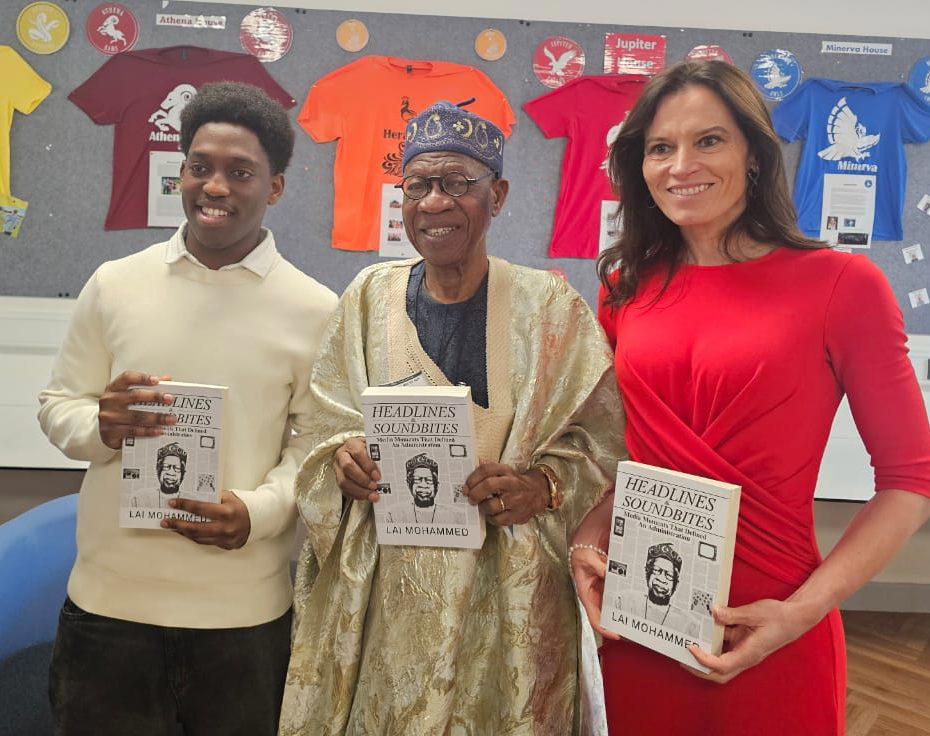
When Lai Mohammed took his engagements to the United Kingdom — with stops at Abbey College Cambridge, the University of Cambridge and the London School of Economics and Political Science — the objective was clear: to present Nigeria’s story from a first-hand perspective and address widely held misconceptions about key national issues.
In many ways, the engagements achieved that purpose.
The engagements, facilitated by Olugbenga Ogunbode, the CEO TIEC group offered a unique opportunity for the former minister to clear the air on some of the misinformation about Nigerian government as regards free speech, religious tolerance and alleged complicity indifference to terror attacks by insurgents.
Through interactions with students, academics and participants, including sessions moderated by Mohammed Monguno and contributions from students, Mohammed provided context to some of the most debated developments during the administration of former President Muhammadu Buhari.
Central to his engagements was the need to correct narratives around the suspension of Twitter in Nigeria, the #EndSARS protests and allegations of Christian persecution — issues that drew significant global attention at the time.
On the Twitter suspension, Mohammed reiterated the government’s position, framing the decision within the context of national security.
“We did not ban Twitter. We simply suspended the operations to give them time to take measures to rid their platform of those elements. Twitter became a platform of choice for those who wanted to destabilise Nigeria… so we took the decision very painfully, but we believed that in the circumstances, national security trumps every other consideration.”
By presenting this explanation directly to an international audience, Mohammed was able to clarify a policy that had often been interpreted without sufficient context. He also punctured the long held belief that the suspension was done to silence the opposition and critics of government policies.
On the #EndSARS protests, he acknowledged the genuine concerns that sparked the demonstrations, while also highlighting the role of misinformation in shaping the trajectory of events.
According to him, the widespread circulation of unverified information across traditional and digital platforms contributed significantly to the escalation of the protests.
This perspective offered a broader understanding of the complexities surrounding the protests and the challenges faced by government in managing both reality and perception during a fast-moving crisis.
Mohammed also addressed concerns about religious tensions in Nigeria, pushing back against claims of Christian persecution. He explained that insurgent groups like Boko Haram initially targeted Muslims before extending their attacks to Christians in order to gain attention and global traction. He urged the global community to support the Tinubu administration in putting an end to the scourge.
While emphasising examples of religious coexistence within the country, he cited personal experiences, including his annual Ramadan lecture and empowerment initiatives in hometown of Oro, Kwara State which he said was done in a church open field , as well as the interfaith marriage of President Bola Tinubu, a devout Muslim to Oluremi Tinubu, a leader in the Redeemed Christian Church of God (RCCG).
Beyond these issues, Mohammed’s engagements also touched on the structural realities of Nigerian politics, particularly the cost of contesting elections.
A participant had alleged that Nigerian political parties are deliberately excluding young Nigerians from participating in the electoral process. He made reference to the ruling All Progressives Congress (APC), which announced that its nomination and expression of interest forms goes for N100m, which is equivalent to £50,000 in the United Kingdom.
While acknowledging that the cost of participation in election in Nigeria is high, Mohammed however, defended his party, the APC. He explained that political parties rely on such funding mechanisms, such as sale of nomination forms to run the party affairs till the next election cycle rather than depending on the federal government to fund the party from tax payers money. He acknowledged that most politicians don’t pay their membership dues, which the party needed to run its affairs. His explanation offered deep insight into how party systems operate in Nigeria.
On his involvement in politics, Lai Mohammed said his decision was driven by a desire to serve humanity and add value to people’s lives. He recalled that while serving as chief of staff to the then governor of Lagos State, now President Bola Tinubu, he was deeply impressed by the transformative impact of his leadership. According to him, this inspired him to resign in 2003 to contest the Kwara state governorship election, which he lost. Undeterred, he returned to the party and went on to serve as its spokesperson — a role that eventually made him a household name in Nigeria.
Equally important was his reflection on governance and communication. Responding to questions from participants, including Qish Namala, Mohammed emphasised that effective leadership requires not only speaking to the people but also listening to them.
“My priority was not just to communicate government policies, but also to listen. I realised that until you get feedback from the people, you are not going to really address their real issues. So as much as speaking is good, you must also listen and when you listen, you get the sentiments of the people.”
He further stressed the importance of clear and consistent communication in governance.
“In today’s fast-moving, information-driven world, governments must recognise that policies alone are not enough. They must be clearly explained, consistently articulated and meaningfully engaged with the people.”
And in what could be seen as a central theme of his engagements, Mohammed underscored the relationship between governance and perception.
“Governance today is as much about managing reality as it is about managing perception. When both are aligned, trust is built, legitimacy is strengthened and nations move forward with clarity and confidence.”
These remarks resonated with the broader aim of his UK tour — to bridge the gap between how Nigeria is perceived globally and the realities on the ground.
His book, Headlines and Sound Bites: Media Moments That Defined an Administration, also formed a key part of the engagements. According to Mohammed, the publication documented his experiences as the longest-serving Minister of Information and Culture, while providing context and firsthand accounts of major events during the Buhari administration.
The visit also drew commendation from the leadership of Abbey College Cambridge. The principal, Ellen Hesse, praised Mohammed for honouring the invitation and sharing his wealth of experience with the students. She said the occasion was a very special one for the school and the interaction with Mohammed will be discussed in lessons afterwards.
In a post shared on its social media platforms, the school wrote: “Our Year 12 student, Mohammed led a powerful conversation with former Nigerian Minister for Information and Culture, Lai Mohammed, exploring some of the most pressing global challenges of our time – from social media and governance to youth participation in politics, climate change in Africa, insecurity, and the transformative role of education.
Our Head of Politics, Tauhida, reflected: ‘Lai Mohammed reminded us of the virtues of old-school politics, where public service sits at the heart of leadership, and where young people must be prepared to truly pay their dues.’
We were especially proud to hear our students’ questions praised for their depth and rigour, with some likened to those asked at PhD level. Immense pride in our students, and sincere gratitude to our guests who so generously share their time, insight, and warmth with our community.”
By combining personal insights with direct engagement, Mohammed created an avenue for dialogue that allowed participants to ask questions, challenge assumptions and gain a deeper understanding of Nigeria’s governance landscape.
In the end, the significance of these engagements lies not just in the explanations offered, but in the opportunity they created for conversation. At a time when global narratives are often shaped by limited information, such direct interactions play an important role in presenting a more balanced and nuanced picture.
The visit, by all indications, was a positive one, helping to correct some of the erroneous impressions often held about Nigeria in the international community. We need more of this at this critical times in our nation’s history.
Akinsuyi, former group politics editor of the Daily Independent, writes from the United Kingdom. He can be reached at [email protected]
Disclaimer
Comments expressed here do not reflect the opinions of Vanguard newspapers or any employee thereof.