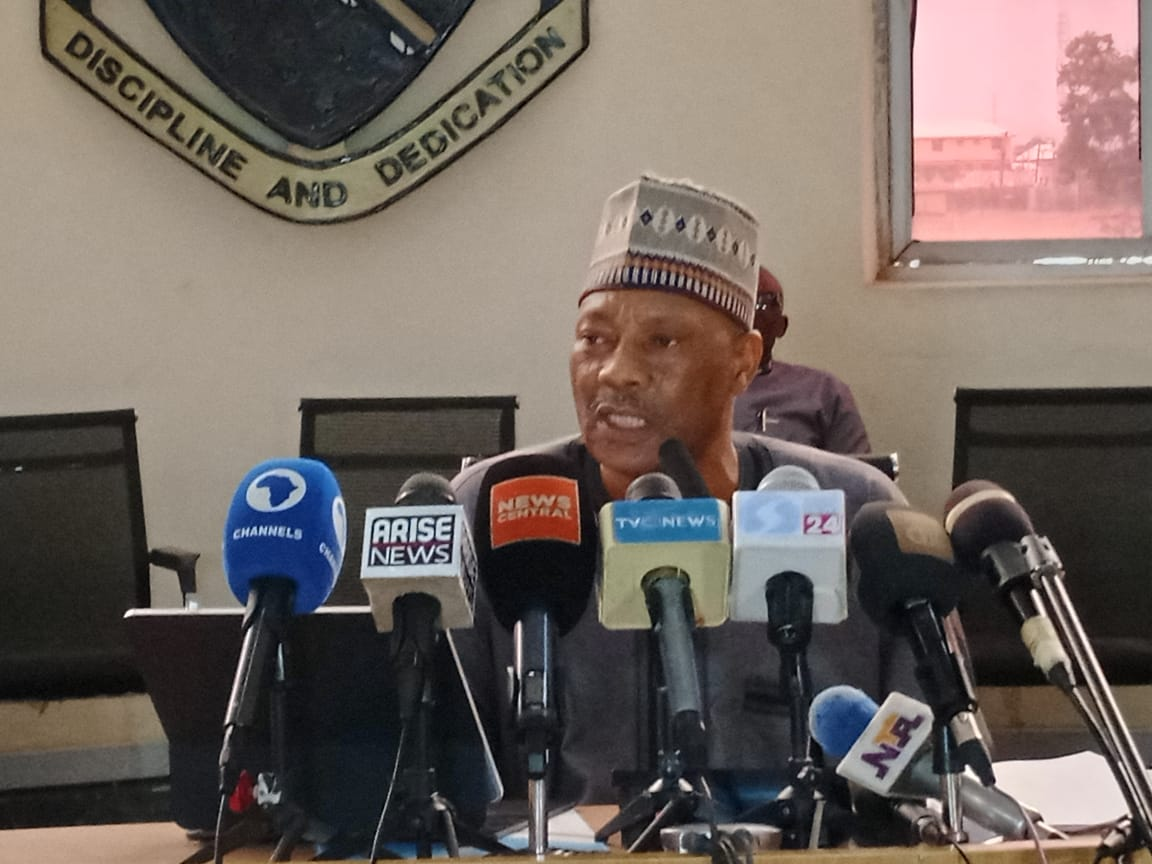
UNIJOS Vice-Chancellor Prof. Tanko Ishaya
By Golok Nanmwa, JOS
The University of Jos (UNIJOS) has confirmed the death of two of its students following the recent wave of violence in Jos, while three others – two students and a staff member – sustained injuries and are currently receiving treatment in hospital.
Vice-Chancellor Prof. Tanko Ishaya disclosed this on Thursday during a press briefing in Jos, where he also stated that there are no plans to relocate the institution from its current location despite the security challenges.
The deceased were identified as Abel Joro Gershon, a 300-level Building student who was shot in the stomach during the Angwan Rukuba attack.
He was admitted to the Intensive Care Unit of the Jos University Teaching Hospital (JUTH), where he died on April 5. He was buried on April 8.
The second victim, Adeyomo Oluwafemi Temitope, a 500-level quantity surveying student, was reportedly shot and macheted to death by hoodlums on April 1 while outside the campus along Bauchi Road, the vice-chancellor said.
Those injured and currently hospitalised include Ishaya Patrick, a 300-level Geography and Planning student, who was shot in the leg and is receiving treatment at JUTH.
Also injured is Longji Molshap Wumnokol, a 300-level geology student, who sustained critical injuries during the April 1 attack along Bauchi Road.
He was initially stabilised at Ola Hospital before being transferred to JUTH, where he remains on admission.
In addition, Duguryil Ufialas Daniel, a staff member of the Directorate of Student Affairs, was shot in the thigh and is currently receiving medical attention.
According to the vice-chancellor, the attacks affected five members of the university community, four students and one staff member, leaving two students dead and three others injured.
Prof. Ishaya, on behalf of the university community, extended condolences to the families of the deceased students and residents of the Angwan Rukuba community, where unknown gunmen reportedly killed more than 30 persons, with many others injured during the initial attack.
He stressed that the university has no plans to relocate.
“There are no plans to relocate the institution from its current location. We are working in collaboration with security operatives to ensure the safety of our students and staff,” he said.
The vice-chancellor explained that the university had commenced its first semester examinations on March 16 but rescheduled papers slated for March 30 and 31 following the security breach and the 48-hour curfew imposed by the Plateau State Government in the Jos North Local Government Area.
Examinations scheduled for April 1 and 2 were also shifted after fresh violence erupted on April 1.
According to him, management later aligned the resumption of examinations with the end of the Easter break, announcing that examinations would continue on Monday, April 13, to allow students who travelled to return safely.
The vice-chancellor stressed that the university was never closed and that no directive was issued for the total evacuation of staff and students.
While management advised students who wished to travel for the Easter break to make use of available buses, he said the uncoordinated arrival of vehicles from different state governments and organisations created unnecessary panic.
He noted that many students remained both on and off campus, adding that there was no breach of the campus and no staff member on campus was evacuated.
Normal academic activities, he said, resumed on Tuesday, April 7.
Prof. Ishaya commended the response of security agencies, including visits by the Chief of Army Staff, Waidi Sahibu, the General Officer Commanding 3 Division, E.F. Onyinlola, and other security officials, who assured that the university remains a top security priority.
He added that security on campus has since been significantly strengthened.
The vice-chancellor also appreciated leaders of neighbouring communities for protecting students and called on the media to continue supporting efforts aimed at tackling insecurity affecting the institution.
He further thanked the Plateau State Government led by Governor Caleb Mutfwang; the Minister of Humanitarian Affairs, Bernard M. Doro; the management of JUTH and Ola Hospital; security agencies; and well-meaning Plateau indigenes for their support during the crisis.
Prof. Ishaya said the university has always maintained cordial relations with its host communities.
“We have never had any instance of our students being at loggerheads with our immediate community. We have had cordial relations, and we will continue to sustain them,” he said.
He explained that the university maintains regular engagement with security agencies to protect students, staff, and residents in surrounding communities.
The vice-chancellor noted that building a strong university requires decades of deliberate investment in infrastructure and human relationships.
“The essence of this university is not only for the students who come here. It is also to ensure that the immediate community is involved socially, economically and in overall development,” he stated.
He added that the university management remains committed to dialogue with security agencies and community leaders to address emerging challenges promptly.
Our correspondent reports that the attacks have heightened tension in Jos, prompting several state governments to evacuate some of their students from the university.
Disclaimer
Comments expressed here do not reflect the opinions of Vanguard newspapers or any employee thereof.