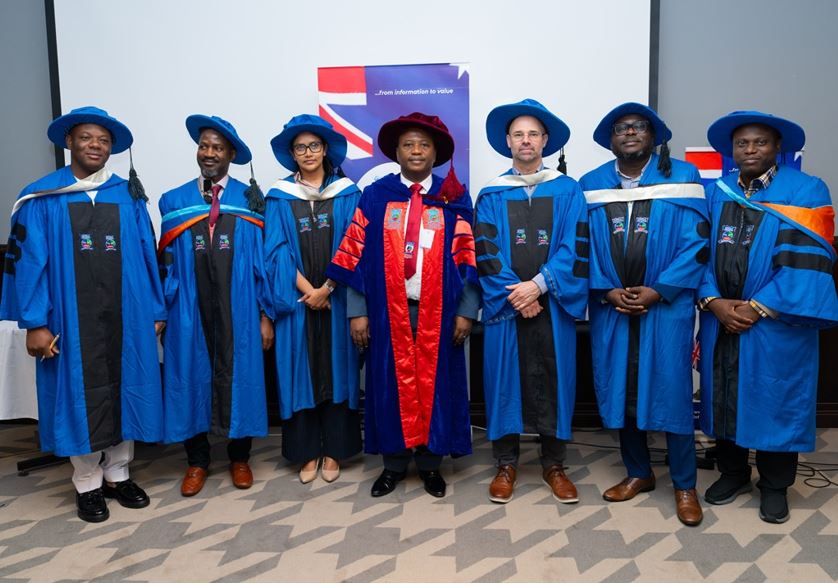
From left: Pastor Opeyemi, FIIM LFC Brisbane, Dr. Olabode Akinola Agbasale, FIIM – Mountview Doctors, Redbank Plains, Queensland, Dr. Ayodhya Wathuge, Scholar and Educator in Information Systems, Southern Cross University, Gold Coast, Queensland, Amb. (Dr) Oyedokun A. Oyewole, FIIM, International President- IIM Africa, Scott Spence – ICT PMO Lead, Queensland, Oladapo Owolabi, FIIM – Founder & President, SEEIA Connect and Dr. Oladapo Olukomaiya, FIIM – Data Governance SME, Queensland
The Institute of Information Management (IIM) Global Network has ended its Australia Annual Conference, Induction and Investiture Ceremony with the theme “AI-Driven Transformation: Strengthening Public Trust, Ethics, and Data Resilience in a Digital Australia” in Brisbane, Queensland, Australia.
The one-day conference that held on Saturday, April 11, 2026 was attended by global thought leaders, senior data governance professionals, technology policymakers, academics, enterprise executives and industry stakeholders who engaged in impactful discussions on the transformative and complex forces reshaping the digital world.
Drawing on his extensive international experience in technology, policy and institutional leadership, Ambassador (Dr) Oyedokun Ayodeji Oyewole, the International President/Chairman, IIM Africa who delivered the keynote address said, “Artificial Intelligence is only as powerful as the trust that underpins it.
“As we accelerate digital transformation globally, we must ensure that our systems are transparent, accountable and ethically grounded. Data resilience and governance are no longer optional – they are strategic imperatives for sustainable development.”
Oyewole enlightened the gathering on the critical intersection of AI innovation, regulatory compliance and institutional trust and challenged leaders across sectors to move beyond performative commitments towards genuinely-embedded ethical cultures in their organisations.
He disclosed that in an era of unprecedented data proliferation, the quality of governance frameworks will ultimately determine whether digital transformation delivers equitable, sustainable and trustworthy outcomes for citizens and societies.
In her own presentation, Dr Ayodhya Wathuge, a distinguished Scholar and Educator in Information Systems at Southern Cross University on the Gold Coast, Queensland, Australia addressed the challenge of the persistent and often widening gap between high-level AI ethics and their meaningful operational implementation.
Wathuge who spoke on the sub-theme of “From Principles to Practice: Building Trustworthy AI through Governance, Risk and Ethical Accountability”said the proliferation of AI ethics frameworks, even though a welcome development, has not yet translated into consistent accountable governance practices across industries and governments.
She added that principles such as fairness, transparency, explainability and accountability remain aspirational for many organisations rather than embedded features of their AI development and deployment processes. Wathuge disclosed that bridging this gap requires a fundamental shift from treating AI governance as a compliance checkbox to treating it as an active, continuous and organisation-wide discipline.
Based on her expertise in information systems and technology governance, Wathuge presented a practical and structured framework for making AI trustworthiness operational.
In her words, “Trustworthy AI is not an outcome you declare – it is a discipline you embed. Governance without accountability is policy without consequence, and risk management without ethics is control without conscience. Organisations that are serious about trustworthy AI must build it into their culture, their processes, and their leadership.”
Wathuge further highlighted the critical role that information management professionals play in ensuring that AI systems remain aligned with organisational values and legal obligations over time. She called on practitioners to champion the integration of ethics into risk registers, governance frameworks and technology procurement decisions, noting that professionals in this space are uniquely positioned to serve as guardians of trustworthiness in an increasingly-automated world.
There was also a panel session moderated by Scott Spence, a Senior Portfolio Governance and PMO Leader with expertise in strategic programme delivery across Queensland. The panellists at the panel session were Dr John Onubogu, Founder, CyberNova Academy; Huw Grossmith, a Fellow of the institute, Document Control Subject Matter Expert, Western Australia and Dr Ayodhya Wathuge.
The session which drew on the diverse professional experiences and disciplinary perspectives of the panelists highlighted challenges and opportunities at the intersection of AI governance, organisational trust and digital resilience.
The conference was brought to a close by Dr Oladapo Olukomaiya, Fellow of the institute, in his capacity as IIM Australia Chapter Representative.
Disclaimer
Comments expressed here do not reflect the opinions of Vanguard newspapers or any employee thereof.