By Wole Mosadomi
In the bustling heart of Minna, Niger State, where survival of ten dictates destiny, 28-year old Rabiu Shuaibu has carved a story that defies the weight of cir cumstance, a story stitched together with grit, hunger for knowledge, and an unyielding refusal to be defined by deprivation.
Humble Beginnings
He was born into a modest family in Kebbi State, the second of six children: three boys and three girls.
In a household where Western education was neither a priority nor a shared dream, Rabiu stood
alone, nursing a quiet but stubborn desire to go to school.
His parents did not believe in that ambition. For them, the path was clear: the Almajiri system.
At a tender age, he was sent far from home to Minna for Islamic education. It was meant to shape his future.
But Rabiu, even as a boy, knew he wanted more: Western education! There was no financial support, no encouragement, no safety net but there was resolve. He refused to be broken by neglect.
Instead, he chose defiance,not loud or con frontational, but steady, deliberate, and deeply personal. Out of sheer determination,
Rabiu wangled his way into acquiring elementary education in Minna. It was a fragile start, but it lit a fire he would not allow to die.
Not satisfied, he proceeded to a secondary school in Minna, but like many dreams built on thin air, his ambition soon hit a wall.
Brick Wall
At the Junior Secondary School level, the journey came to an abrupt halt: no money, no support, no way forward.
Where many would have surrendered, Rabiu pivoted. He turned to the streets, not to beg, but to learn. He became a cobbler.
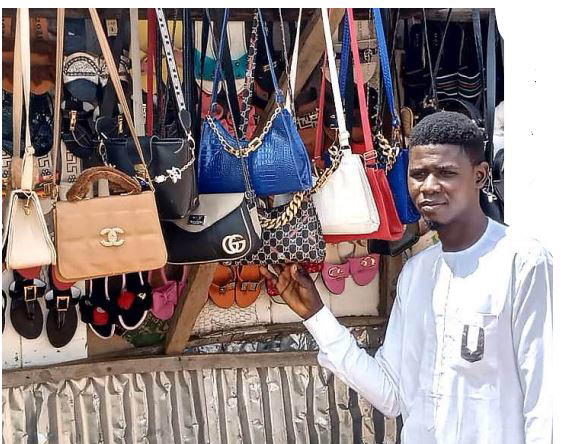
Today, with just one machine, his hands produce sandals of various sizes, elegant hand bags, and purses that rival imported goods, each piece a proof of resilience shaped by hardship.
Rabiu Speaks
Narrating his journey in a voice that carries both the scars of struggle and the pride of survival, Rabiu said:
“It was not easy, but I told myself that against all odds, I must go to school, and I began to pursue that goal. I had my primary and junior secondary (JSS) education at Barkin Saleh, and my senior
secondary (SSS) at Limawa Day Secondary School, Minna. I combined Almajiri education with Western education, and my Malam supported me in doing both. It wasn’t easy balancing Almajiri lessons, Western education and trading to earn money to take care of myself I attended classes
in the mornings, went straight to trade after school, and later returned to my Malam for Islamic lessons. I succeeded because of my Malam’s understanding and support.”
Passion
“I have a strong passion for reading.
What helped me educationally was that I bought textbooks with the little money I had, read and digested them, then resold them to recover my money. That was how I was able to see myself through school. Today, I have grown from being an Almajiri to an eployer of labour.
I have not less than ten apprentices in my shop. Most of them are Almajiri, and I have been encouraging them to go to school and also learn a trade so they can become self-reliant instead of roaming the streets begging for food, clothing and money. Some of those who passed through me have established their own shops and are doing well.”
Determination
“I am not carried away by what I earn yet.
I am still focused successful. Between 2020 and 2022, we were asked to apply for interest-free loans ranging from N200,000 to N500,000. I applied but did not scale through, and I have almost lost hope.”
“There are many others like me across the country who are eager for education but lack he means. Self-determination, like combining Western education with Islamic learning, has been the best decision I have made. Although I am not yet satisfied with my educational level, it has helped me to get to where I am today, especially in my trade. just as I continue to seek more know
edge in Islam, I am also determined to return to school because I have realised that combining Western and Islamic education is one of the best things that can happen to anyone in life.
For other Almajirai across the country, seeking Western education is not a crime and is not against Islam. I encourage them to summon the courage to combine both, so they can fit into society and
live a better life,” he admonished, his tone firm with a deep sense of conviction.
and determined to return to school if I can raise enough money or find someone to support me in acquiring my first degree. I have apprentices between the ages of 12 and 25 whom I can trust to manage the shop while I go back to school.
I am proud of them—they are eager to learn, succeed and become self-reliant. They are already taking after me.”
Hurdle
“Since I started this trade, I have been struggling to expand my shop by acquiring more machines, but I have not been able to do so because of financial constraints.
I need sewing machines, filing machines, and a generator, among others, to double my production and improve the finishing of my products. I am grateful to a pharmacist who gave me a loan of N200,000, which I was able to repay within a few months.
I have also tried to get assistance from the state government through soft loans meant for petty traders, but I have not been successful. Between 2020 and 2022, we were asked to apply for interest-free loans ranging from N200,000 to N500,000. I applied but did not scale through, and I have almost lost hope.
“There are many others like me across the country who are eager for education but lack the means. Self-determination, like combining Western education with Islamic learning, has been the best decision I have made. Although I am not yet satisfied with my educational level, it has helped me to get to where I am today, especially in my trade. Just as I continue to seek more knowledge in Islam, I am also determined to return to school because I have realised that combining Western and Islamic education is one of the best things that can happen to anyone in life.
“For other Almajirai across the country, seeking Western education is not a crime and is not against Islam. I encourage them to summon the courage to combine both, so they can fit into society and live a better life,” he admonished, his tone firm with a deep sense of conviction.
Government’s Response
Responding to concerns over access to financial support, the Niger State Government reiterated that one of the core priorities of Governor Muhammed Bago’s administration is the upliftment of the downtrodden engaged in various businesses.
However, such interventions, it stressed, are structured around cooperative societies and organised groups, not individuals.
The immediate past It was not easy, but I told myself that against all odds, I must go to school, and I began to pursue that goal Commissioner for Micro, Small and Medium Enterprises (MSMEs), Mrs. Elizabeth Shaba, in an exclusive interview, disclosed that within one year, the governor had supported no fewer than 1,000 women across different associations with a total sum of N100 million.
According to her, “Under my ministry, we have given interest-free loansto different cooperative societies, the less privileged, groundnut sellers, charcoal sellers,mineral traders, including orange sellers, and most of them are women and youths.
The least beneficiary got N20,000, and they are spread across the three senatorial zones of the state. We implemented it in batches, and it is a revolving, interest-free loan scheme. This makes it easier for beneficiaries to repay, while others also get the opportunity to benefit accordingly.”
She urged individuals seeking such support to align with recognised structures, noting that access is tied to colelective participation. “Interested members of the society should join a cooperative society or identify with a recognised and registered group to benefit from such assistance. Government does not deal with individuals for financial support but with identified and registered cooperative societies and groups,” she added.
In the rhythm of Rabiu’s tools and the quiet determination in his voice lies a deeper truth: even in a system that often abandons the vulnerable, resilience can birth purpose. As he keeps one eye on his trade and the other on a future back in the classroom, Rabiu stands not just as a survivor, but as living proof that destiny, no matter how constrained at the start can be deliberately rewritten.
Disclaimer
Comments expressed here do not reflect the opinions of Vanguard newspapers or any employee thereof.