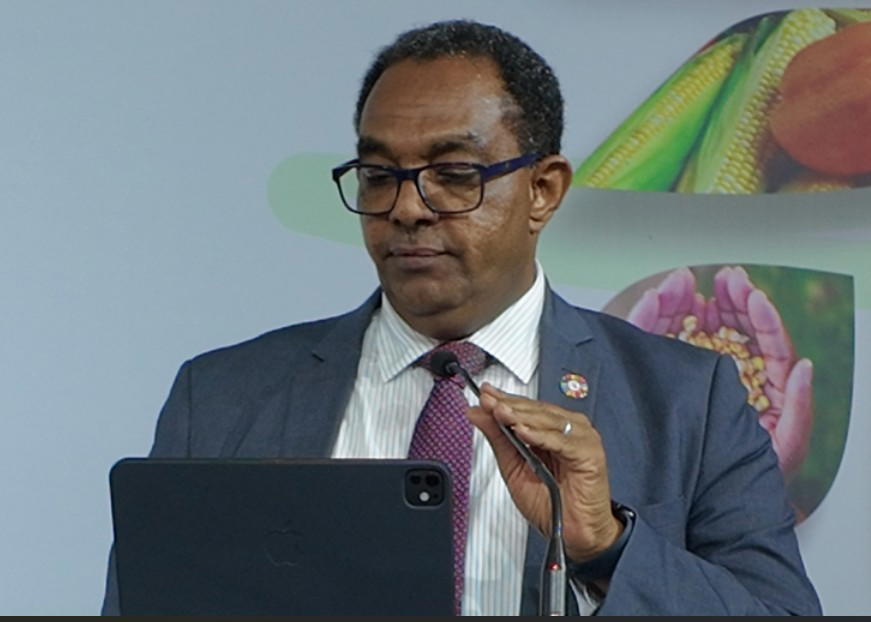
Hussein Gadain, Country Director, UN Food and Agricture Organisation. speaking at the 9th Vanguard Economic Discourse in Lagos
The Country Director of the Food and Agriculture Organization (FAO) in Nigeria, Hussein Gadain, has outlined key strategies to reposition Nigeria’s agricultural sector, warning that millions of Nigerians face worsening food insecurity.
Speaking at the Vanguard Economic Discourse held in Lagos on Wednesday, Gadain identified six strategic pathways to drive food security and socioeconomic stability, stressing the need for urgent and coordinated reforms.
He said Nigeria must prioritise sustainable and climate-resilient agriculture to boost productivity.
“Agriculture in Nigeria must move beyond subsistence farming and pursue sustainable high-yield production without compromising environmental integrity,” he said, adding that improving access to quality seeds, animal breeds, fertilisers and water management systems is essential.
Gadain, however, noted that infrastructure remains the biggest challenge facing the sector.
“The problem today is not AI or innovation. It is infrastructure. If we look at the value chains, infrastructure is missing,” he said.
On value chains, the FAO official stressed the need to reduce post-harvest losses and improve food distribution systems across the country.
“Food security relies on availability, access, utilisation and stability. It is not achieved on the farm alone,” he said, warning that “we lose up to 70 per cent of farm produce” due to inefficiencies.
He added that inclusive systems must ensure that smallholder farmers, women and youth benefit from agricultural reforms.
Gadain also emphasised the importance of access to affordable finance, particularly for young farmers and agribusinesses.
“A sector cannot rebound without access to finance… many of our youth today are left to struggle with huge loans up to 36 per cent,” he said, calling for “affordable single-digit loans” to unlock growth.
On trade and competitiveness, he urged Nigeria to strengthen export-oriented agriculture, especially in cash crops such as cocoa, cashew and cassava, while improving processing and logistics.
“Nigeria’s agriculture rebound hinges on strengthening trade and market-led growth… to ensure export earnings and reduce import dependence,” he said.
He further warned that insecurity remains a major threat to food production, particularly in farming communities.
“Violent conflict, kidnapping and banditry… continue to pose severe threats to food security,” he said.
Citing recent data, Gadain disclosed that millions of Nigerians are already facing acute food shortages.
“In Nigeria alone, between seven million to 35 million people are experiencing acute food insecurity between 2025 and August 2026,” he said, noting that the crisis is most severe in the North-East, North-West and North-Central regions.
He called for integrated solutions, including conflict-sensitive dialogue, land use planning and sustainable resource management, to address the crisis.
The FAO country director also highlighted the role of governance, data and partnerships in driving transformation, urging collaboration among government, private sector and development partners.
He underscored the role of the media in shaping public understanding of food security issues.
“The media plays a critical role in reshaping public understanding and political will around food security… platforms such as Vanguard help to elevate agriculture from a subsistence narrative to an economic and strategic imperative,” he said.
Gadain reaffirmed FAO’s commitment to supporting Nigeria’s agricultural transformation.
“Nigeria’s agriculture sector holds the key to food security, economic recovery and social stability… the rebound we seek is within reach if it is intentional, inclusive and climate-smart,” he added.
Disclaimer
Comments expressed here do not reflect the opinions of Vanguard newspapers or any employee thereof.