By Esther Onyegbula
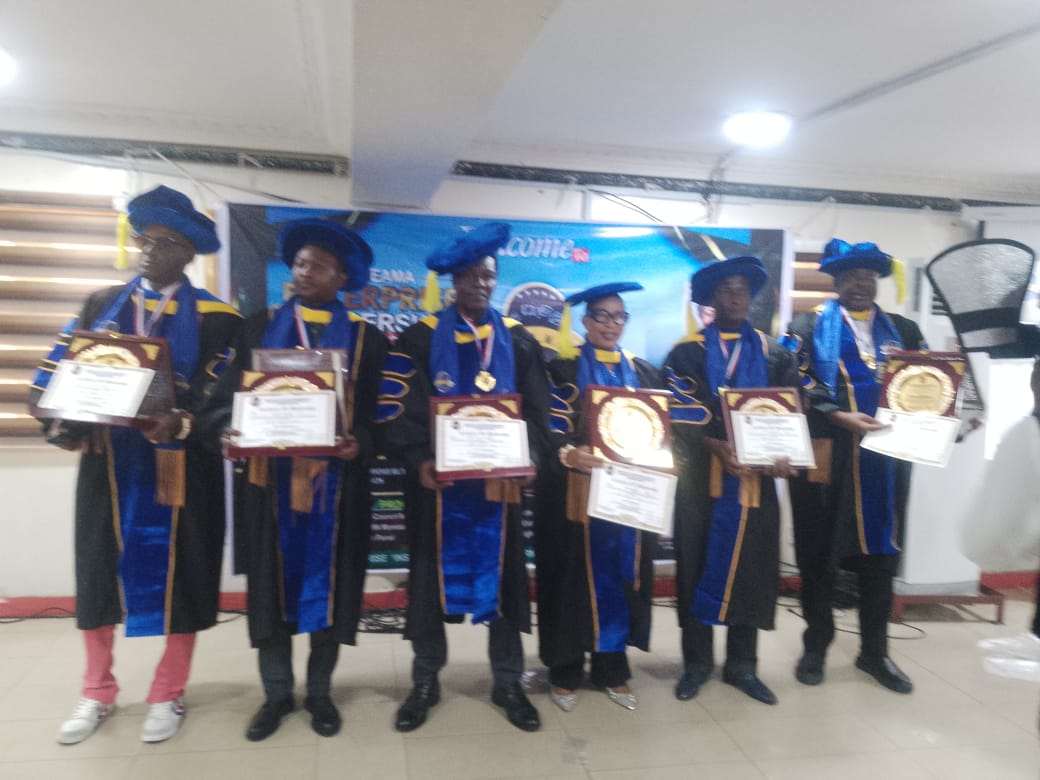
The Institute of Entrepreneurship and Apprenticeships Management and Administration, IEAMA, on Wednesday, inaugurated its pioneer governing council and inducted new members as part of efforts to institutionalise entrepreneurship and formalise Nigeria’s apprenticeship system.
The event, held at the Enterprise Leadership Summit 2026 in Lagos, brought together policymakers, business leaders and key stakeholders to chart a pathway for structured enterprise development across Nigeria and Africa.
Speaking at the summit themed, “Leadership for National Growth: Entrepreneurship as a Catalyst for Economic Transformation,” Director-General and President of IEAMA, Dr. Jerry Ibeh, described the initiative as a historic move to reposition entrepreneurship from an informal practice to a regulated profession.
“It is with immense honour and a deep sense of responsibility that I welcome you to this landmark gathering. Today marks a historic milestone not only for IEAMA as an institution, but for the future of entrepreneurship and apprenticeship development in Nigeria and across Africa,” he said.
Ibeh noted that while entrepreneurship has long thrived within informal systems, the absence of standardisation, certification and governance has limited its impact.
“We move from tradition to transformation, from practice to professionalism, and from individual effort to institutional legacy,” he stated.
He added that the inauguration of the governing council signals the beginning of a framework that will shape enterprise policies and standards for future generations.
“To our pioneer council members, history will remember your courage to lead at inception and your commitment to excellence. You are the custodians of a legacy that begins today,” he said.
In his keynote address, Rector and Founding CEO of OASIS, Prof. Abiola Lanre Awosika-Fapetu, described apprenticeship as a critical but under-structured economic system with vast potential for wealth creation.
“Apprenticeship is a distributed economic engine, a mentorship ecosystem, a wealth transfer mechanism and a leadership development pipeline,” he said.
He, however, stressed the need to refine and institutionalise the system for scalability and global relevance.
“We do not discard it; we refine it, document it, institutionalise it and globalise it. That is why IEAMA’s work is not just relevant, it is urgent,” he added.
Awosika-Fapetu further called for a transition from what he termed a “hustle economy” to a “systems economy,” warning that many African businesses collapse due to lack of structure.
“Hustle creates survival; systems create wealth. The tragedy of many African businesses is that they die with their founders because they are built around personality, not process,” he said.
Also speaking, the Vice President, member of the governing council, Dr. Bukola Alimot Ajani, said sustainable national development must be driven by structured entrepreneurship and visionary leadership.
“Nations do not rise by chance; they rise because leadership provides direction, institutions provide structure, and entrepreneurs convert ideas into measurable economic value,” she said.
Ajani warned that Nigeria risks underutilising its entrepreneurial potential without deliberate institutional frameworks.
“Nigeria stands today at a defining crossroads. We can either continue with fragmented enterprise and policy inconsistency or deliberately build structured entrepreneurial systems and scalable business ecosystems,” she said.
She added that IEAMA is positioned to serve as a hub for standard-setting and bridge the gap between informal enterprise and formal economic productivity.
An inductee, Mr. Adeniyi Samson, emphasised the need for capacity building and mentorship to drive sustainable entrepreneurship, noting that quick wealth schemes often derail young people.
“When you do any shortcut, that shortcut will cut you short. There is a process in building entrepreneurs, and that process is what matters,” he said.
He called for stronger collaboration between entrepreneurs, government and financial institutions to support startups and returning youths.
“No matter the skill you have, without access to finance and structure, growth will be limited. We must build capacity and link people to opportunities,” he added.
Also, founder of Enterprise Grooming Institute, Dr. Ajisefinni Ayodele Tajudeen, urged young Nigerians to embrace entrepreneurship, describing it as key to economic survival.
“As an entrepreneur, you must have discipline, commitment, resilience, determination and focus. Skill acquisition is the backbone of success, and age is no barrier to learning,” he said.
He added: “Nigeria is increasingly driven by a private economy. We must encourage our young people to embrace that reality.”
The summit also featured the formal induction of new members, marking what stakeholders described as the beginning of a coordinated push to build a globally competitive entrepreneurship ecosystem.
Disclaimer
Comments expressed here do not reflect the opinions of Vanguard newspapers or any employee thereof.