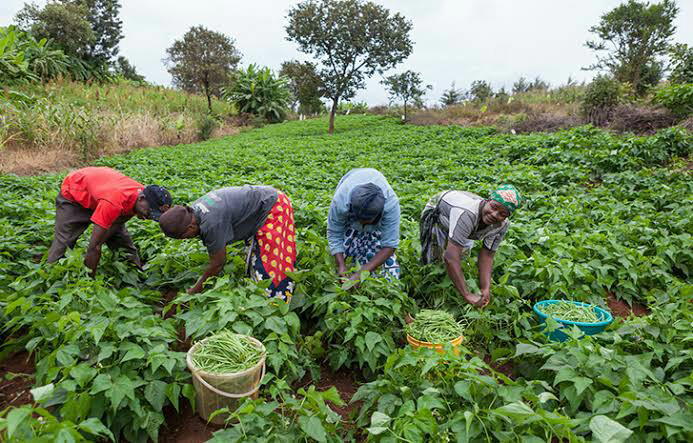
FILE IMAGE
By Gabriel Ewepu
ABUJA – THE Federal Ministry of Agriculture and Food Security and Korea-Africa Food and Agriculture Cooperation Initiative, KAFACI, have moved to upscale farmers’ access and adoption of simple Climate Smart Agriculture, CSA, technologies to boost food production.
This was on the heels of a 3-day stakeholders’ sensitization workshop on the development of climate-smart agriculture technologies for Africa, that was held in Abuja held from 3rd to 5th February 2026.
The workshop was organized by the Federal Ministry of Agriculture and Food Security in collaboration KAFACI to ensure inclusivity of relevant key stakeholders from the beginning of the CSA-KAFACI project.
Meanwhile, the key areas of discussion were: Development of the CSA technologies; and Development of an action plan for implementation and adoption of the technologies.
The workshop was declared open by the Director of Agricultural Land and Climate Change Management Services, Mr. Olanipekun Oshadiya, who also explained that the objective of the workshop is to develop locally friendly CSA technologies that will lead to increased agricultural productivity, high income and profit, and reduce greenhouse gas emissions.
The Honourable Minister appreciated the donor—KAFACI—for their collaboration on the project. He reiterated that their support is very important to help the Ministry achieve its national mandate on food sovereignty and climate resilience.
The CSA is coordinated by the Federal Ministry of Agriculture and Food Security through the Department of Agricultural Land and Climate Change Management Services (ALCCMS).
The CSA is a pivotal initiative of the National Agricultural Technology and Innovation Policy (NATIP) and Nigerian Farmers’ Soil Health Scheme (NFSHS) for sustainable agriculture, climate resilience, and national food security.
Meanwhile, during the technical session comprehensive exploration of the essential aspects of climate change, greenhouse gas emissions, and climate-smart agriculture was provided.
Participants unanimously approved the development of an actionable plan for the next steps and resloutions reached during the technical session from the discussions, deliberations, and interactions include; The CSA to promote the Alternate Wetting and Drying (AWD) technique and Biochar should be a homegrown solution to Nigeria’s soil health challenge.
It should be simple, affordable, and effective; Local resources should be used as much as possible; Strong monitoring and evaluation should be developed by Federal Ministry of Agriculture and Food Security to successful implementation of the project, and Training and capacity building should be planned to involve all categories of stakeholders (Farmers, extension, researchers, and policy makers) to ensure sustainability.
The government representatives, farmers, and other participants deeply appreciate KAFACI for their support at this critical time when climate change is threatening global agriculture and livelihoods. Over 39 stakeholders from FCT participated at the workshop.
Disclaimer
Comments expressed here do not reflect the opinions of Vanguard newspapers or any employee thereof.