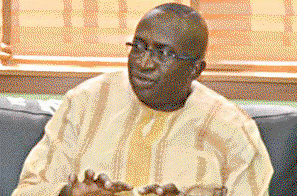
Ndoma-Egba
· Warns APC to learn lessons from the plight of former ruling party
· Narrates how he was thrown out of PDP when he was Senate Leader
· ON CLOCKING 70: I think God has been partial to me
Senator Victor Ndoma-Egba, SAN, was the Senate Leader in the 7th Senate. Ndoma-Egba just turned 70 years. In this interview, he speaks on his political journey, how he was thrown out of the Peoples Democratic Party (PDP) even when he was the Leader of the Senate. The former senator also speaks on how arrogance and impunity ruined the PDP, and how he took the ill-treatment meted out to him to the Wailing Wall in Israel. He warns the All Progressives Congress (APC) to learn a lesson from the plight of the PDP. He also speaks on the injustice against Cross River State in the ceding of 76 oil wells to Akwa Ibom. Excerpts:
By Johnbosco Agbakwuru
You just turned 70 years old. How has life been for you in the past 70 years?
Well, like I said in church, life is like a balance sheet. You have debits and credits, and where the credits exceed the debits, it means that you have had a fair life. In my own case, the credits are far in excess of the debits. So, yes, I’ve had the good, the bad, and the ugly, like every other person experiences. You can’t have life on a platter of gold all through. But on balance, I think God has been partial to me.
You started being in public life at a very tender age. Give us the experience.
The first appointment was actually by Dr. Clement Isong. I had just returned from Youth Service, and the state Housing Corporation had built some houses that they were going to sell. I discovered that the houses in Ogoja, which were more or less rural compared to Calabar, were more expensive than the houses in Calabar. So I wrote a letter to the governor, and the governor sent for me and invited the then general manager of the Housing Corporation. We had a chat, and then the next thing I knew, when they were announcing appointments, I was appointed as chairman of the governing board of my old school, Government Secondary School, Ikom. I was about 23, I think—23 or turning 24.When President Shehu Shagari introduced the River Basin Authorities, I was appointed to the first board of the Cross River Basin Development Authority. I was barely 24, and President Shagari himself told me later that I was to have been his minister if my father hadn’t intervened to appeal to him to let me mature first. But I became commissioner three months short of my 27th birthday. The governor said we should just say I was 27. In those days, we had 19 states—it’s not like now with 36 states. Akwa Ibom was still part of Cross River, and every state had only seven commissioners—no special advisers or special assistants. Every ministry just had a commissioner, a permanent secretary, and your personal staff. You had just one personal assistant, who was taken from the public service. It was a most revealing and rewarding experience for me because the public service was still working then, so you were guided. The rest is history from there. I think that opportunity commended me for every other opportunity I’ve had in life.
Some people have alleged that Nigeria appears to be tilting towards a one-party state. What’s your take?
Well, I have heard those allegations, but you know we were all in PDP. What happened to PDP was that it buckled under the weight of its own arrogance. If you recall, in 2014, there was a registration or re-registration exercise where people called “point men” were appointed. Their whole assignment was to stop some people from registering as members of PDP, if you recall. My idea of a political party is that a party is like a church—it’s open for those who are looking for salvation, it is open for those who have found salvation, and it is open for those who will never be saved. Everybody has the opportunity of belonging. So when you begin to shut the doors against some people—for instance, people think I left PDP. I didn’t leave PDP; I was thrown out of PDP. At the time I was thrown out, I was Leader of the Senate and Chairman of the National Assembly Caucus of the party, but I was thrown out and I had no protection. I was the only one in leadership from the same zone as the then president. So I think PDP became just arrogant, and that is what it is suffering from today. I just hope that the APC has lessons to learn from the trajectory of the PDP. If we are moving towards a one-party state, it is not the party in power that should nurture the opposition. The opposition should feed itself to be an opposition to the party in power.
Do you think PDP will survive what is happening to it presently?
I doubt it. On a personal note, when I went through that bitter experience with them, I went to the Wailing Wall in Israel to pray against PDP. For them to survive, I would have to withdraw all the prayers I prayed against them. I doubt it. I think PDP is now history.
Does it mean that you contributed to the affliction the PDP is suffering from, as you went to Israel to pray against the party?
PDP is responsible for what has happened to it. If anybody contributed, it was just a mere contribution, but PDP is absolutely responsible for what has happened to it. PDP is a lesson because it was a well-organized party, a well-structured party. But at some point, it collapsed under the weight of its own arrogance, and it couldn’t manage power anymore. If you remember, there was a time in Adamawa State— I don’t want to mention his name now because the person is late—he was appointed point man to stop Atiku Abubakar’s supporters from registering in the party. A party doesn’t function that way.
But some critics are saying that the APC, your party, only has two persons—the former president, late Muhammadu Buhari, and the current president, Bola Tinubu—as the rallying point, and that after Tinubu’s administration, the party may not have someone to hold it together again and it may follow the path of the PDP. What’s your take?
A political party should keep reinventing itself. A political party shouldn’t be static, it shouldn’t be stagnant, and that’s my prayer for APC—that as we move on, we appreciate our own dynamics, our own internal dynamics, and begin to respond to those dynamics early enough. Now everybody is moving to APC; it is a good thing, but it also comes with its own consequences because they are internalizing all the tendencies—all the contradictory tendencies—within the party. So we must begin to address those dynamics within our party.
Some people are of the view that since the APC took over the mantle of leadership in 2015, life has been so hard on Nigerians. Do you agree with them?
I agree that things have been tough, but Nigerians were living on borrowed time. If certain steps were not taken at the time they were taken—and those steps are for the ultimate good—it’s like surgery or medicine. What is good for you doesn’t taste good to you. So those steps needed to be taken. The APC, in the last three years, has dismantled the two biggest infrastructures for corruption in this country: fuel subsidy and the differential foreign exchange rates. Those were the biggest infrastructures for corruption in this country. It’s not that the previous governments didn’t know; they knew, but they just didn’t have the willpower or the courage to take those steps.Now, if you address those issues, they will come with some pain naturally, but it’s a question of time before things begin to adjust, and you can predict what direction the economy is going. So yes, I acknowledge that there has been pain, but the pain is a consequence of taking those very painful decisions that we needed to take at the time they were taken.
With the suffering in the land, do you think that your party, the APC, has a chance in the 2027 elections?
If not APC, who?
Why do you say so?
Which other party can you see on the ground? PDP has disintegrated. ADC is like a beautiful Ferrari car but with only two gallons of fuel inside—fuel that can take you no distance. So which other party are you seeing on the ground? People say, “Well, yes,” and they refer to the Peter Obi phenomenon in 2023. The times have changed. What drove that popularity is no longer there.
Don’t you think that the hardship in the country may encourage Nigerians to look for alternatives aside from the APC?
Nigerians are passing through tough times, but Nigerians appreciate why we are having those tough times because tough decisions needed to be taken. Nigerians appreciate that those decisions have been taken.
A good number of your friends have defected to the ADC. Are you going to join them?
No way. I am a committed member of the APC. When I was thrown out of PDP, the thinking then was that I was going to come back on my knees to beg, but APC gave me accommodation, and APC gave me the opportunity to express myself. Don’t forget that after I was thrown out, APC appointed me chairman of NDDC. So why should I leave? And don’t forget that every politics is local. The politics of where I come from, the politics of my state, is still APC.
Are you going to contest any position in 2027?
It is not for me to say. If you know the story of my life, I never became anything I set out to become. I became everything that I did not plan to become. So it is God that has guided my path, and I submit to Him absolutely. I only live for today. I do my best for today and leave the rest to Him.
Is there anything you set out to be but didn’t become?
Oh, many. I wanted to be a Catholic priest. I’m not that Catholic priest. When I went to Maryknoll College in Ogoja, I went there because it was the holding ground for those who were to go to the seminary. I didn’t become that priest. My first university entrance was to then University of Ife to read medicine because I read the sciences up to A-levels. I didn’t become that doctor. When I ended up reading law, I read law to become a professor of law, to teach law and become a professor of law, and I am not that professor. When I went into politics, it was to be governor of Cross River State. Don’t forget that I contested in 1991/92, so I never became any of those things I set out to become.
Have you had any regrets in your political journey?
Regrets? No. The biggest honor any people or group of persons can do to anybody is the opportunity to ask you to serve them, especially in an elective capacity. I thank God that when I was their representative, I served them from my heart—24 hours a day, 52 weeks a year. For me, that service was total commitment to them. I have no regrets.
The issue of the ceding of Bakassi to Cameroon and the loss of 76 oil wells originally in Cross River State to Akwa Ibom are once again in the news. Do you think the recent agitation may yield any positive results?
Well, there’s this popular saying that the law is an ass. If you remember, when Bakassi was about to be ceded, first from my friend and brother, Chief Bayo Ojo, SAN, who was then the Attorney General of the Federation, and then Michael Aondoakaa, who succeeded him, assured Nigerians that Nigeria was not going to lose a single oil well as a result of the ceding of Bakassi. Not so? Oil wells that were part of Cross River by virtue of Bakassi being part of Cross River now moved in a different direction from Bakassi. Bakassi moved towards Cameroon; the oil wells moved in the opposite direction. To confirm the saying that the law is an ass, the Supreme Court—even though there was no specific finding about the oil wells, because the judgment talked more of the littoral status of Cross River—but a grave injustice was done to Cross River from the ceding of Bakassi. If you remember, when you were reporting the Senate, you remember the number of times Senator Bassey Ewah Henshaw and I brought memos on Bakassi. First, it was the fastest compliance ever with the judgment of the International Court of Justice—ever. You have judgments from 1930, 1936, 1942 that are still pending. In this case, just a few days after the judgment, it was being implemented. What was the hurry? It was being implemented over and above the heads of Cross Riverians. Cross Riverians were never part of the decision to cede Bakassi; we were never asked what our views were. This is the home of a people—their heritage, their legacy. You just take it and give it to another country, and then you keep mum about the consequences of that cession. In the Senate, I mentioned that this issue was going to come with a very severe humanitarian crisis and very severe security issues, but they still went ahead and ceded the place as if the people of Cross River didn’t matter. An injustice is an injustice. It doesn’t matter how long you wait to address it, but an injustice must be addressed.
Do you suspect any form of conspiracy, given the speed at which the judgment was implemented?
Well, you see, I’m a lawyer, and I’m a lawyer of 48 years—24 of those years as a Senior Advocate. So I cannot act on suspicion; I act on evidence. But the haste was totally untidy
Disclaimer
Comments expressed here do not reflect the opinions of Vanguard newspapers or any employee thereof.