By Peter Duru, Makurdi
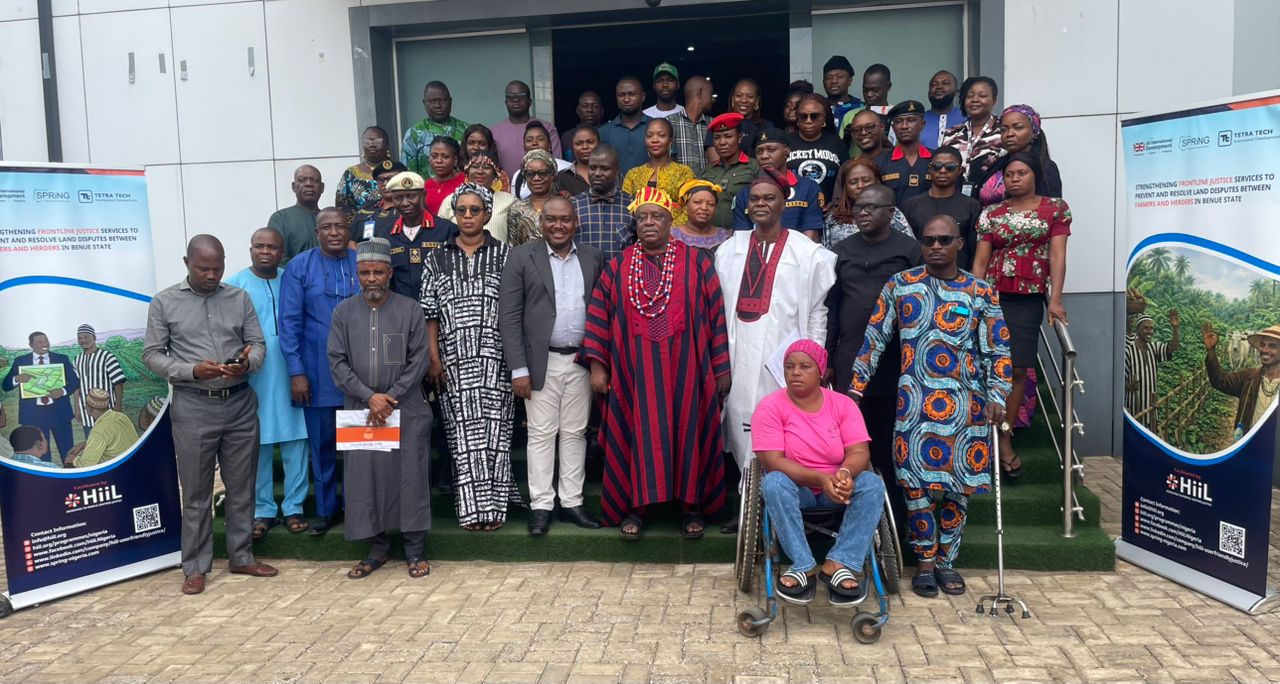
The Hague Institute for Innovation of Law (HiiL) has launched a comprehensive set of guidelines aimed at preventing and resolving the persistent farmer-herder conflicts in Benue State, as part of efforts to promote peace and improve access to justice at the grassroots.
Speaking at the launch in Makurdi, the Country Representative of HiiL, Mrs. Ijeoma Nwafor said the guidelines were developed through extensive research and consultations with key stakeholders across affected communities. A multi-state initiative under the Strengthening Peace and Resilience in Nigeria (SPRiNG) program, funded by the UK Department for International Development through Tetra Tech.
She said, “the guideline we are launching today is for the prevention and resolution of land conflicts between farmers and herders in Benue state.
“To come up with the guidelines, we conducted desk research, field interviews, questionnaires, and focus group discussions to understand what is truly happening and capture diverse perspectives,” she added.
Nwafor explained that the process involved not only farmers and herders but also traditional rulers, Civil Society Organisations, CSOs, community members, and government officials. “It is a combination of field responses and desk research,” she stated.
Highlighting HiiL’s impact so far, Nwafor disclosed that the organisation trained 600 individuals across Guma, Agatu, and Gwer West Local Government Areas, LGAs, communities most affected by the conflict.
“We want this to be the start of a broader conversation. If those 600 people train others in their communities, awareness will grow on how to prevent and resolve conflicts. That is how we create impact,’ she emphasized.
She noted that the guidelines go beyond addressing farmer-herder disputes and could be applied to other forms of community conflicts, including financial disputes and Gender-Based Violence, GBV.
Nwafor also raised concerns about limited access to justice in Nigeria, revealing that about 140 million Nigerians lack meaningful access to legal redress.
“In many rural areas, there are no courts, and people are forced to rely on informal systems that sometimes require payments like goats or chicken. Even where courts exist, the process can be too costly or inaccessible for ordinary citizens,” she said.
In his remarks, the Paramount Ruler of the Idoma Kingdom, the Och’Idoma, Dr. John Elaigwu Odogbo, represented by the First Class Chief of Enone, HRH Engr. George Ede, commended HiiL for the initiative, describing it as timely.
He said “this will go a long way in addressing farmer-herder conflicts in the state” noting that the state is being confronted by insecurity occasioned by armed herders who invade Benue communities.
The Royal Father who stressed that without peace there would no talk of justice assured that the traditional council would review the guidelines and disseminate it.
Also speaking, the Special Adviser to the Governor on Special Duties and Intergovernmental Affairs, Fidelis Unongo, represented by the acting Director of Special Duties, Dr. Charles Iornumbe, praised the initiative and expressed optimism that it would help tackle security challenges linked to the crisis.
Similarly, the Special Adviser to the Governor on Internal Security, Chief Joseph Har, acknowledged the persistent threat posed by armed herders despite government efforts, noting that the guidelines would contribute to restoring peace.
The State Chairman of the All Farmers Association of Nigeria (AFAN), Mr. Ernest Atoji, called for collaboration among farmers, stressing the need to adopt ranching as a sustainable solution.
“We are all farmers. To stop the crisis between crop and livestock farmers, we must embrace ranching and ensure peaceful coexistence for food security,” he said.
Disclaimer
Comments expressed here do not reflect the opinions of Vanguard newspapers or any employee thereof.