By Esther Onyegbula
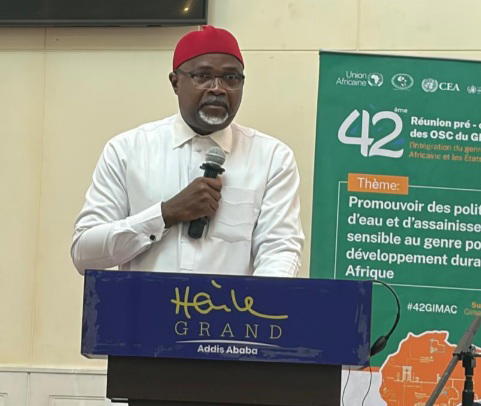
An international human rights scholar, Professor Uchenna Emelonye, has warned that Nigeria’s persistent water and sanitation deficits, particularly in schools, are undermining girls’ dignity, health and access to education, urging governments to treat water and sanitation as urgent human rights priorities.
Emelonye made the call while speaking at the African Union Pre-Summit Consultative Meeting on Gender Mainstreaming, themed “Advancing Gender-Responsive Water and Sanitation Policies for Sustainable Development in Africa.”
According to him, women and girls bear a disproportionate burden when water systems fail, stressing that Nigeria’s water and sanitation crisis goes beyond infrastructure challenges and has assumed the character of a gender justice emergency.
He noted that even in major urban centres such as Abuja and most state capitals, access to reliable public running water remains limited, forcing households to rely on water tankers, private boreholes and other largely unregulated sources.
“This fragile access in urban and peri-urban areas likely masks far more severe shortages in sub-urban, rural and conflict-affected communities, where infrastructure is weak and services are either irregular or completely absent,” he said.
Focusing on the education sector, Professor Emelonye explained that although some schools have marginally better access to water than surrounding communities, sanitation conditions remain largely inadequate.
Citing recent national Water, Sanitation and Hygiene (WASH) findings, he disclosed that only 30 per cent of schools in Nigeria have basic sanitation services, while just 37 per cent have access to basic water supply, making safe and hygienic learning environments the exception rather than the rule.
He further highlighted the gendered impact of the crisis, revealing that only eight per cent of schools have girls’ toilet compartments equipped with menstrual hygiene facilities.
According to him, the deficit has direct consequences for adolescent girls’ school attendance, participation, privacy and dignity, exposing them to daily health risks and quietly pushing many out of the classroom.
“When a Nigerian girl is forced to manage menstruation without safe and private sanitation, that is not a minor inconvenience; it is a rights violation and an education barrier. A development agenda that ignores sanitation is incomplete,” Emelonye stated.
He warned that with limited municipal water coverage even in the Federal Capital Territory and state capitals, the situation in rural and underserved communities should be of grave concern to policymakers, noting that in many local government areas and villages, public running water is virtually non-existent.
Professor Emelonye called on federal and state governments to prioritise school water and sanitation as core education and gender-equity issues, rather than treating them as peripheral infrastructure concerns.
He urged the Federal Ministry of Education and the Federal Ministry of Water Resources and Sanitation to establish and enforce national standards for safe, girls-friendly sanitation in all secondary schools, supported by dedicated and gender-responsive funding.
He also stressed the need to formally integrate menstrual hygiene management into school health policies and to strengthen monitoring systems that track progress using sex-disaggregated data.
According to him, without deliberate and coordinated action, Nigeria risks entrenching inequality and denying millions of girls their right to safe education and human dignity.
Disclaimer
Comments expressed here do not reflect the opinions of Vanguard newspapers or any employee thereof.