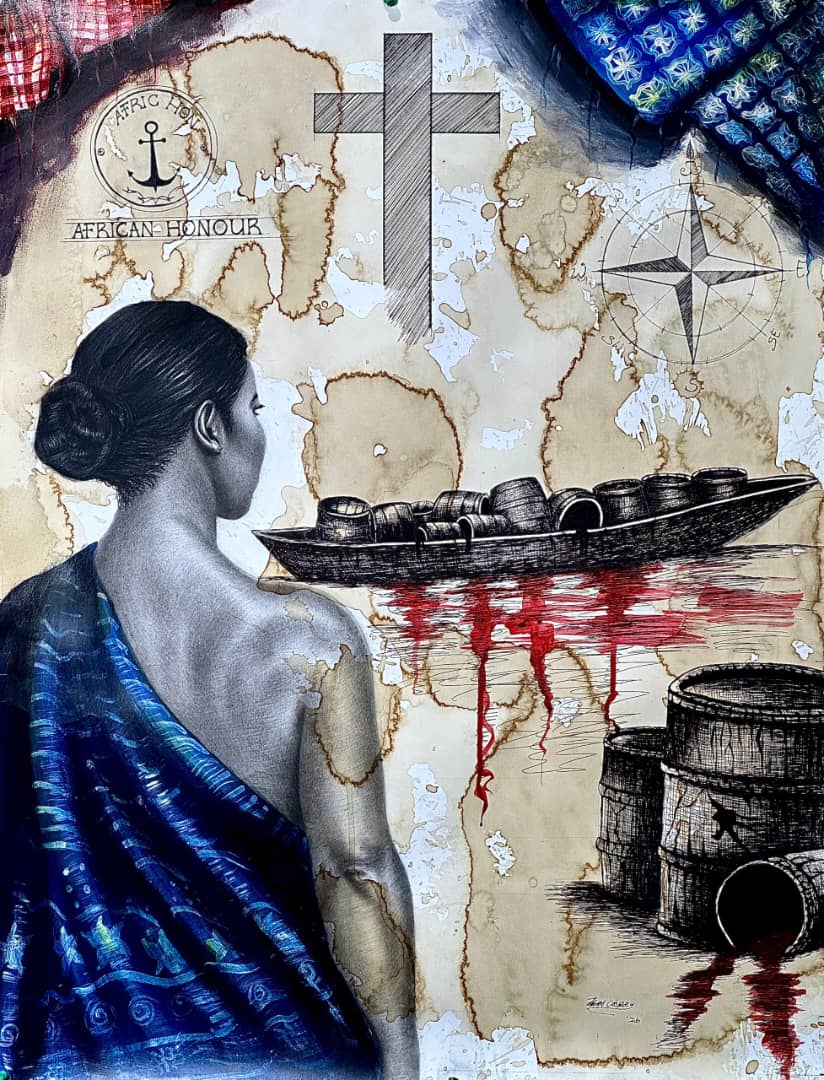
“Spills of the creek” (50cm x 65cm, mixed media, 2026) by Ibim Cookey.
By Osa Amadi
Mitochondria Gallery, Houston, Texas, presents “Spills of the Creek,” a special show by Nigerian artist and architect, Ibim Cookey, tracing the history of environmental pollution and resource exploitation in Nigeria’s Niger Delta. The exhibition runs from February 27 to February 28, 2026, at Golden Brown Ranch, Port Harcourt, 21 Link Road, Sani Abacha, G.R.A., Phase 3.
This intimate presentation in Port Harcourt serves as a homecoming for the collection before its major solo exhibition in Houston, Texas, this April. Through monochrome works and architectural storytelling, Cookey explores the Niger Delta as a living archive, reflecting on the history, trade, and memory of riverine city-states like Opobo and Bonny.
“Spills of the Creek” is curated by Frank Ugiomoh, Professor of Art Theory and History, University of Port Harcourt.
The exhibition explores the trade, culture, religion, commerce, and politics of the Niger Delta from the 19th century to the present. It also reflects on how waterways became routes of palm oil trade, colonial negotiation, missionary activity, and later crude oil extraction.
Across the works, red appears as a symbol of palm oil, crude oil, blood, and resistance, connecting past and present economies. Through portraiture layered with maps, compasses, barrels, boats, and archival references, the creek becomes both witness and evidence.
The works examine extraction, faith, negotiation, and unity, asking what has been gained and what has been lost in the process.
Some of the works for exhibition are “Spills of the Creek” (2026), 50 x 65 cm, mixed media. Here, a woman stands observing a canoe filled with barrels spilling red into the water. The red suggests palm oil, crude oil, and blood. With a cross and compass above her, the work reflects on trade, Christianity, and colonial navigation. The woman represents the community witnessing wealth extracted from their land.
There is also “Fragments of Negotiation” (2026), 63.5 × 90.5 cm, mixed media. A fragmented portrait emerges from torn surfaces, surrounded by trade symbols. Barrels, boats, and communication tools reference colonial treaties and modern political bargaining. The tearing of the paper suggests broken agreements and divided leadership within the Niger Delta.
“Faith and Letters” (2026), 60.5 × 91 cm, mixed media, is a provocative painting depicting a young woman holding sealed letters beneath a church tower. The work reflects on missionary education, literacy, and the role of Christianity in reshaping identity and power structures. The letters symbolize communication between colony and empire, faith and governance.
“The Red Economy” (2026), 63.5 × 91 cm, mixed media, is a central portrait surrounded by maps, trade vessels, and references to 19th-century tariffs. The red across the figure connects palm oil trade to crude oil extraction. The work examines how early colonial trade structures shaped present-day economic realities in the Niger Delta.
“Ties That Bind Us” (2026), 66 × 55.5 cm, mixed media, depicts two hands as they grip a twisted rope stretched across a map of Niger Delta states. The rope symbolizes unity, tension, and shared history. The work reflects on collective identity, bound by culture, conflict, and resilience.
Summary of Curator’s preview notes
Ibim Cookey’s exhibition powerfully responds to the Niger Delta’s environmental devastation and historical ruptures through portraiture, architecture-infused black-and-white imagery, and coffee-wash backgrounds. These elements fuse land, memory, and resilience, turning art into witness and resistance amid oil extraction’s scars on playfields, farmlands, and waterways.
A Niger Delta native trained as an architect at the University of Nigeria, Nsukka, Cookey applies structural thinking—load-bearing lines, spatial volumes—to human figures. His graphite-like portraits evoke buildings with ruinous vulnerability, set against evocative coffee washes that create insecure, contextual atmospheres. In “Fragments of Negotiation,” a face emerges from shredded paper ruins, draped like fabric, symbolizing fragmented histories. Ships, harbor crests, wooden barrels, and a table telephone evoke colonial trade, oil commodification, failed dialogues, and violence via red splatters. Inscriptions like “Niger Delta Trade” and “African Honour” highlight commerce versus dignity.
“Faith and Letters” features a serene female in a pyramidal pose, draped in a red Elizabethan gown, evoking historical burdens and tradition. A bundle of scripts on her arm signifies education and advocacy; a medieval church-like building and stele pillar inscribed “Niger Delta,” “Culture,” “Heritage” tie spirituality, intellect, and legacy. “The Red Economy,” “Spills of the Creek,” and “Ties That Bind Us” incorporate blues against browns, symbolizing threatened waters, cleansing hope, and interconnections of land, sky, and people.
Cookey’s mimetic precision is political, slowing the eye against visual excess. Scant coffee-brown grounds, evoking erased history, denuded landscapes, oil-slicked waters, anchor the sensory and conceptual. Brown, an earth color tied to colonial commodities like palm oil and coffee, echoes the region’s “Oil Rivers” extractive past, from palm to crude oil regimes of violence, spills poisoning soil and fisheries (as in George Osodi’s “Delta Nigeria: The Rape of Paradise,” Ken Saro-Wiwa’s writings, and Obari Gomba’s poetry). Sepia-like, it simulates archival memory, muting reds and blues into contemplative somberness, resisting spectacle for ethical restraint.
The human face becomes the inscription site for degradation, neglect, and contestation. Cookey relocates architecture to portraiture, questioning building on unbuilt land. Unlike Bright Ugochukwu Eke’s contaminant installations or Osodi’s photos, Cookey’s subtle portraits meditate on endurance, akin to El Anatsui’s material transformations. They form a counter-archive of presences against erasure, reconstituting the Delta as human terrain, not resource frontier.
Disclaimer
Comments expressed here do not reflect the opinions of Vanguard newspapers or any employee thereof.