…says Nigeria stands to upscale productivity, enjoy other benefits
By Gabriel Ewepu
ABUJA – THE Council of Palm Oil Producing Countries, CPOPC, Friday, urged the Nigeria to register as member of the organization instead to remain as an observer.
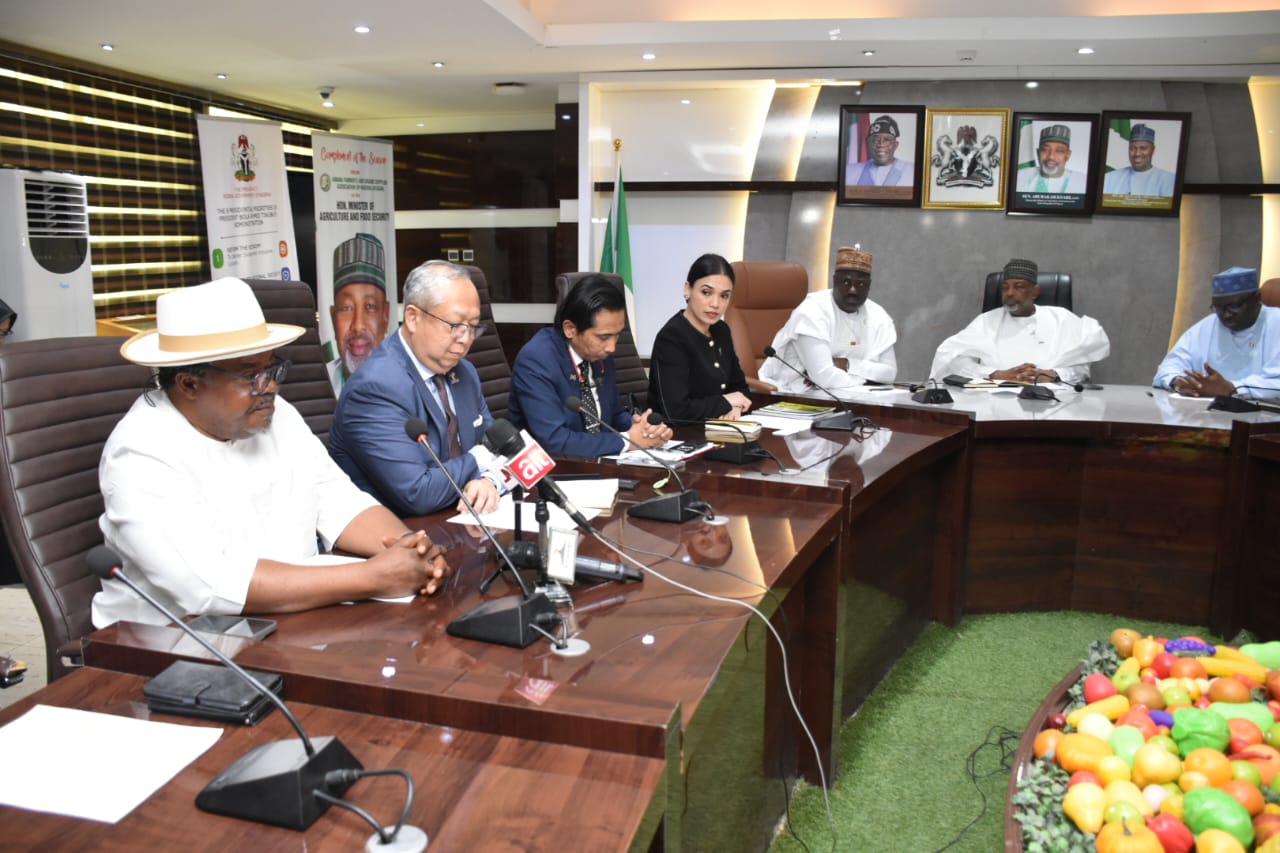
Speaking on the reasons and benefits of Nigeria registering to become a member of CPOPC, the Secretary General of the organization, Izzana Salleh, while on a meeting with the Minister of Agriculture and Food Security, Sen Abubakar Kyari at the Ministry’s headquarters in Abuja along with a delegation including the Director, Sustainability and Smallholder, CPOPC, Antonius Yudi Triantoro; National President, National Palm Produce Association of Nigeria, NPPAN, Amb Alphonsus Inyang; Indonesian Embassy; and Malaysian High Commission to Nigeria.
Saleh explained why the meeting became necessary as being a new leadership of the CPOPC, they deemed it fit to come to Nigeria and meet with the Minister and also his Foreign Affairs counterpart.
She also acknowledged Nigeria, where palm oil originated from, has contributed a great deal to all the other large producers, Indonesia being the largest, followed by Malaysia, and Thailand.
She said: “Nigeria is our observer country, so we come with the intention to share with you that the observer status for Nigeria, which started at the end of 2024, will end in November 2026 this year.
“And before that happens, we want to make sure that there is a transition, a good transition that happens from observership to member status, and we come here with our hearts and arms wide open.
“We want to be able to ensure the transition happens well, and we are very much looking forward to this possibility at the end of this year.
“CIPOC’s Ministerial Council had agreed to support a waiver of the fees, provided that we have our observer countries join by this year, and so I believe that this waiver of the fees for two years.
“For example, if you join this year, then 2026 and 2027 is the fee waiver, and it begins only in 2028, which I believe if we hit the ground running, which is naturally our style of working, there’s a lot that we can do together with Nigeria, for Nigeria, during this time.
“And I believe, I would encourage Honorable Minister and the Nigerian government to strike the iron while it’s hot, as they say.”
According to her, and other members include Indonesia, Malaysia as co-founding members, Papua New Guinea, Honduras, and Democratic Republic of Congo, while Nigeria, Ghana, and Colombia serve as observers.
Meanwhile, she underscored the importance of Nigeria becoming a member of the Council, “We know this industry, at the moment, contributes about 24 million jobs globally, and how we can raise people from rural livelihoods, into one that ensures food security, one that ensures employment.
“So we bring on behalf of our member countries to such platforms. We support a large part of sustainability and smallholders.
“And a large part of our task is to ensure that we have a strong collective voice, to ensure that observer countries become member countries, and also to bring in other fellow producers.”
Meanwhile, the Minister of Agriculture and Food Security, Sen Abubakar Kyari, disclosed that a technical committee on transition from an observer country to a member, which the Director, Planning, Policy and Coordination, Ibrahim Tanimu heads along with the National President, National Palm Produce Association of Nigeria, Amb Alphonsus Inyang. According to Tanimu, the draft will soon be ready for validation.
In his remarks, the National President, National Palm Produce Association of Nigeria, Amb Alphonsus Inyang, expressed optimism that Nigeria can still regain her lost glory in the global oil palm industry as she still remains Africa’s largest producer and exporter of palm oil.
“I strongly believe that Nigeria, being the fifth largest producer, and where oil palm actually started from, and the country that controlled the sector up to 60 per cent, up to around 1964, Nigeria controlled 60 per cent of the world’s production and exports up to 1964, and petroleum became popular, and we lost that position, and I strongly believe that we can work with the Council to see that we regain the glory of the oil palm sector.
“Nigeria is the largest producer in Africa, 1.4 million metric tonnes. The largest consumer, 3.2 million metric tonnes. So we import the rest, and also the largest exporter of palm oil in Africa. We hold these three enviable positions, and we have seen that country like DR Congo, with only 50,000 production per annum, is a member.
He added that the technical working committee set up by the Minister of Agriculture and Food Security “is coming out with a document that will see us produce over 10 million tonnes.
“Where will we sell them if Nigeria don’t join the Council to get Europe to understand that oil palm is good for health?”
Disclaimer
Comments expressed here do not reflect the opinions of Vanguard newspapers or any employee thereof.