…VC spotlights enduring relevance of family medicine in a fast-changing world
By Joseph Erunke, Abuja
Former Provost of the College of Medical Sciences and current Deputy Vice-Chancellor of Bingham University,Karu, Prof. Musa Dankyau, has delivered a compelling argument that the future of medicine may lie in its oldest tradition.
This is coming at a time when health systems across the world are buckling under the weight of rising costs, workforce shortages, digital disruption and an explosion of chronic diseases.
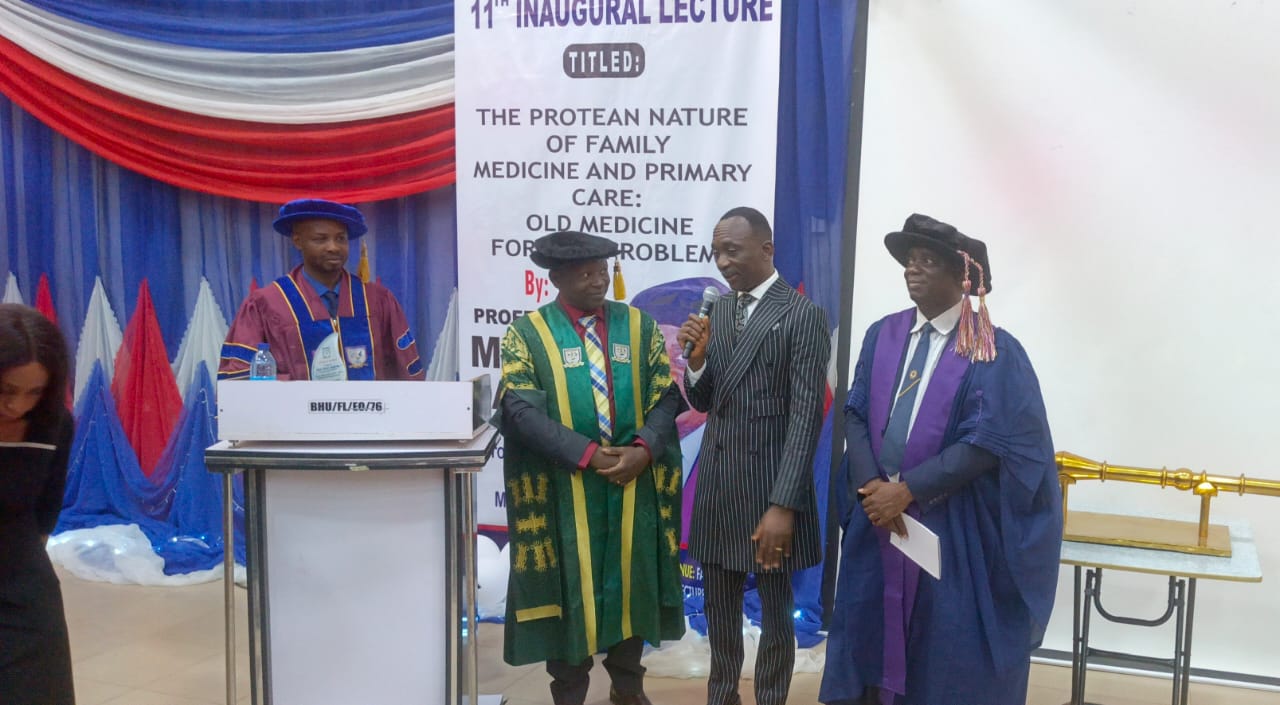
In his 11th Inaugural Lecture titled “The Protean Nature of Family Medicine and Primary Care: Old Medicine for New Problems,” delivered on Tuesday,Prof. Dankyau challenged the notion that Family Medicine is an outdated branch of healthcare struggling to stay relevant. Instead, he described it as the most adaptable and system-resilient response to the complex, interconnected health crises of the 21st century.
“Family Medicine,” he argued, “is not yesterday’s medicine fading into irrelevance. It is enduring system wisdom.”
Tracing the roots of Family Medicine to the earliest days of healing, Dankyau reminded his audience that medicine was once holistic, relational and deeply embedded in families and communities.
According to him,”Illness was not seen merely as a biological malfunction, but as a disruption affecting the whole person within a social context.”
Ironically, he noted that,” Family Medicine is also one of the youngest formally recognised medical specialties.”
Its 20th-century emergence,he said ,was a deliberate response to the unintended fallout of biomedical progressover-specialisation, fragmented care, and the gradual loss of attention to the person behind the disease.
What critics dismiss as “old medicine,” Dankyau contended, is in fact the stabilising foundation modern health systems desperately need: continuity of care, long-term relationships, contextual understanding, and an ethical commitment to human dignity.
Borrowing from Greek mythology, Dankyau likened Family Medicine to Proteus,the shape-shifting figure who could change form yet remained true to his essence.
Family Medicine, he said, adapts seamlessly across urban and rural settings, wealthy and resource-constrained communities, and from infectious outbreaks to chronic disease management. It thrives in analogue and digital health systems alike.
But its identity remains anchored in unchanging principles: care for the whole person, continuity over time, integration rather than fragmentation, sensitivity to family and community context, and ethical service rooted in compassion and dignity.
“When firmly held to these principles,” he explained, “Family Medicine changes form without losing coherence or purpose.”
The pathway to humane, equitable and resilient healthcare, he said, lies in strengthening smart, values-driven primary care,with Family Medicine at its core.
The lecture outlined what Dankyau described as a convergence of crises confronting modern healthcare:The rise of multimorbidity, where patients live with multiple chronic conditions that defy single-disease treatment guidelines.
In his welcome remarks at the event,the Vice Chancellor of Bingham University,Prof. Haruna Kuje Ayuba, spotlighted the enduring relevance of family medicine in a fast-changing world, as Vice-Chancellor, Prof. Haruna Kuje, declaring the discipline as a resilient and adaptive pillar of modern healthcare.
Prof. Ayuba described the inaugural lecturer as “a man of many parts,” whose academic journey and leadership record reflect dedication, effective administration and a deep commitment to advancing knowledge in medicine, academia, the church and society.
“As my Deputy Vice-Chancellor for about two years now, he has demonstrated exceptional administrative acumen, chairing numerous university committees and contributing meaningfully to our strategic decision-making processes,” the Vice-Chancellor said.
He described the lecture as a bold intellectual exploration of how foundational medical principles continue to hold relevance amid rapid technological innovation and shifting societal realities.
Explaining the significance of the word “protean,” Ayuba drew from Greek mythology, noting that Proteus was a god believed to change shape at will to avoid capture. In the same vein, he said, family medicine has shown remarkable flexibility and adaptability in responding to evolving health challenges.
“In today’s context, family medicine is protean because it is dynamic and responsive. It addresses a wide range of health issues and evolves to meet new challenges. It remains the cornerstone of comprehensive, continuous and patient-centred care,” he said.
The Vice-Chancellor emphasized that as a family physician, Prof. Dankyau champions the interconnectedness of the human spirit, mind and body, adopting a holistic approach to healthcare management , a philosophy he said is urgently needed in confronting contemporary health problems.
He expressed confidence that the lecture would deepen understanding of how traditional principles of family medicine remain crucial, even in an era defined by complex diseases, digital health technologies and shifting patient expectations.
The event also served as a moment of institutional reflection and pride. With Professor Dankyau’s lecture, the College of Medical Sciences now leads the university’s faculties with four inaugural professors.
The Faculty of Social Sciences follows with three, while the Faculties of Administration and Science and Technology have produced two each.
Prof. Ayuba challenged other faculties yet to present inaugural lecturers to “step up” and embrace what he described as a cherished academic tradition that strengthens scholarship and institutional legacy.
Looking ahead, he revealed plans to compile the first ten inaugural lectures into a published Volume One, aimed at providing postgraduate students and scholars with access to what he called “a rich tapestry of knowledge.”
The Vice-Chancellor thanked the Inaugural Lecture Committee for organizing the ceremony and paid special tribute to the wife of the inaugural lecturer “for standing by him through thick and thin.”
As applause filled the hall, Ayuba urged participants to draw inspiration from the lecture, expressing hope that it would not only advance academic discourse but also reinforce the university’s commitment to excellence in teaching, research and service.
Disclaimer
Comments expressed here do not reflect the opinions of Vanguard newspapers or any employee thereof.