By Agbonkhese Oboh
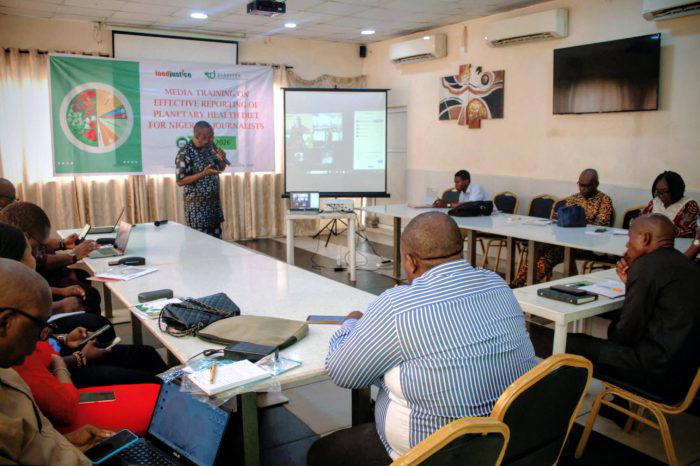
The Renevlyn Development Initiative, RDI, and Foodjustice have trained journalists across traditional and digital platforms on reports that enlighten and galvanise the public and policy makers to action on planetary health diet, PHD.
The one-day traning which held in Lagos, had professionals and advocates from across the world as resource persons.
While explaining the concept of PHD, and the need for the training in his welcome words, Philip Jakpor, Executive Director of RDI, said: “Planetary health diet, PHD, is a scientifically-backed dietary pattern designed to be healthy for individuals and sustainable for the planet, with emphasis on plant-based foods and reduction of consumption of red meat and processed foods.
“It reflects the intersections between what we grow, the ecosystem under which they grow and the positive outcomes when we consume them.”
Jakpor said illnesses, especially non-comunicable diseases, that were unheard of in Africa before, now account for the huge death burden across the continent due to urbanisation, lifestyle changes, and socio-economic issues.
“The task of addressing these challenges must start with proper understanding of the issues, backed with the readiness to embrace proven solutions that are science-based.
“It is for this reason that the resource persons include a Nigerian pediatrician, an environmental health expert as well as experts from Mexico, Milan,” he added.
Resource persons
Dr. Andrea Arango Angarita of Mexican National Institute of Public Health, spoke on “Environmental Impact and Cost of Healthy and Sustainable Diets in Mexico”.
She said seven healthy and sustainable diet scenarios were analysed for the environmental impact, cost, and nutritional adequacy, compared to the current Mexican diet.
The results showed reduced land use impact, carbon emission, and biodiversity loss. Also, they cost less by 24.7% in vegan diets. However, although most scenarios met nutritional adequacies, Vitamin B12 was deficient in vegan and vegetarian diets, while Vitamin D was deficient across all scenarios.
EAT-Lancet
Dr. Percival Agordoh, University of Health and Allied Sciences, Ghana, introduced journalists to EAT-Lancet 2 in “An Introduction to the EAT-Lancet Commission 2.0”.
Agordoh explained that the EAT-Lancet Commission 2.0 builds upon the original report that introduced PHD, addressing the interconnected challenges of human health and planetary sustainability.
“This new report was prompted by significant global disruptions post-2019, including volatile food supplies, economic shifts, and increased inequities, which highlighted the unmet need for a ‘Great Food Transformation’.
“The core aim of EAT-Lancet 2.0 is to secure a just transition to healthy, environmentally sustainable, and equitable food systems for all.
“Key innovations include an evolution of the Planetary Health Diet into four distinct and adaptable dietary patterns (flexitarian, pescatarian, vegetarian, and vegan), which cater to diverse demographics and preferences while maintaining nutritional adequacy and sustainability.
“A significant new aspect is the explicit integration of social justice and equity, focusing on fair access, distribution, and outcomes within the food system,” she explained.
Others resource person were Dr. Makoyawo Olayinka, “Planetary Health Diet and Children”; environmental health scientist and planetary health educator, Dr Chioma Joy Okonkwo, “Mainstreaming Planetary Health Diet into Public Health Policies in Lagos”; “Sustainable, just and healthy school feeding”, Ottavia Pieretto of Milan Urban Food Policy Pact, MUFPP, Secretariat, Food Policy Department, Milan, Italy, who gave an existential example a deliberate government policy of feeding school children free and healthy meals
Tope Oluwaleye, veteran journalist and media strategist, spoke on “Writing Impactful News Stories on Planetary Health Diet: Key Considerations”.
As Jakpor said, the training is expected to fill the gaps in the understanding of planetary health diet, and open pathways for in-depth news reports and articles that will ignite policy level intervention by government and all relevant stakeholders.
Disclaimer
Comments expressed here do not reflect the opinions of Vanguard newspapers or any employee thereof.