By Musa Ubandawaki, Sokoto
SOKOTO — In a region long battered by fear, displacement and loss, renewed efforts are underway across Nigeria’s North West to confront violent extremism through community-driven and non-kinetic approaches.
The Prevention Against Violent Extremism (PAVE) Network said its interventions are focused on prevention, strengthening community resilience and rebuilding trust between citizens and the state.
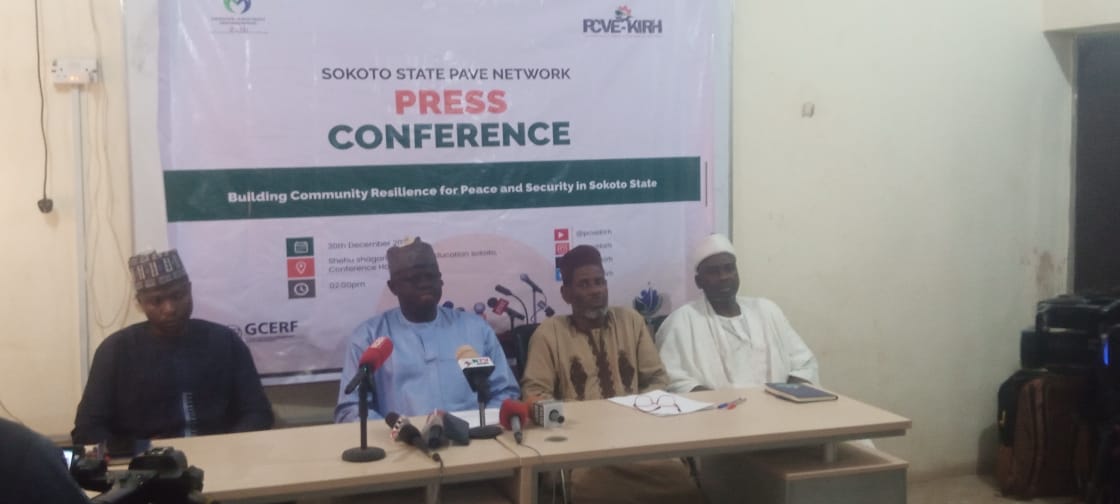
Speaking at a press conference on Tuesday at the Shehu Shagari College of Education, Sokoto, the Coordinator of PAVE Network, Dr. Ahmed Sarajo Mohammed, said violent extremism and banditry remain harsh realities for families in Sokoto, Kebbi, Zamfara and neighbouring states.
According to him, the crisis has forced many farmers to abandon their lands, driven children out of school and destroyed livelihoods, as armed groups exploit weak governance, porous borders and economic hardship.
“Violent extremism here is not an abstract policy concept. It is a lived experience,” Dr. Mohammed said, noting that military action alone has struggled to break the cycle of insecurity.
He outlined Nigeria’s broader risk landscape, which includes the proliferation of armed groups, rural poverty, kidnapping economies and fragile community safety structures, stressing that these trends mirror challenges seen in other conflict-prone regions globally.
“These realities reinforce the international consensus that lasting peace requires inclusive, non-kinetic solutions alongside security operations,” he said.
Dr. Mohammed explained that the Preventing and Countering Violent Extremism (PCVE) agenda has gained fresh urgency in the North West, with PAVE Network and its partners intensifying efforts to tackle the root causes of extremism while building local capacity for early detection and response.
He said capacity building has been central to the initiative, with multi-stakeholder workshops bringing together ministries, departments and agencies, security institutions, traditional rulers, women and youth groups, as well as civil society organisations.
Technical Working Groups, he added, have been trained to co-create State Action Plans and Local Action Plans, ensuring that prevention strategies are grounded in local realities rather than external assumptions.
Dialogue platforms have also emerged as key tools, with town hall meetings and consultation forums allowing communities to engage directly with government officials on drivers of radicalisation such as youth unemployment, broken social contracts and weak early-warning systems.
“These conversations are helping to replace suspicion with cooperation,” he said.
Dr. Mohammed further disclosed that peer learning among PAVE chapters across states has strengthened the region’s PCVE framework, enabling the exchange of lessons, adoption of best practices and avoidance of duplication, in line with international PCVE standards.
He noted that advocacy efforts have moved beyond conferences to direct engagements with state executives, legislators and security leaders, pushing PCVE higher on political agendas and securing the ownership needed for sustainability. In some states, he said, Technical Working Groups are already operational.
At the grassroots level, he revealed that 15-day community resilience campaigns have promoted peace education, tolerance messaging and conflict awareness, helping residents challenge extremist narratives and rebuild strained social bonds.
“These collective actions are yielding tangible gains,” Dr. Mohammed said, citing improved multi-sector collaboration, the drafting of State Action Plans and stronger alignment with Nigeria’s National Action Plan on PCVE.
He also pointed to emerging opportunities, including the inclusion of PCVE priorities in state budget proposals, growing private sector involvement and increased youth participation.
However, he acknowledged persistent challenges, such as the continued presence of armed groups in parts of the region, high youth unemployment, weak intelligence linkages at local government levels, funding gaps and inconsistent integration of PCVE into sectoral plans.
Stakeholders at the press conference stressed that security operations alone cannot end violent extremism, calling for shared responsibility involving citizens, traditional and religious leaders, women and youth, government institutions and security agencies operating with respect for human rights.
As the North West stands at a crossroads, Dr. Mohammed said the commitment of PCVE actors remains firm.
“Peace and resilience are not the responsibility of government alone, but of every citizen. Through collective action, the region can replace fear with stability and offer a people-centred security model for Nigeria and beyond,” he said.
Disclaimer
Comments expressed here do not reflect the opinions of Vanguard newspapers or any employee thereof.