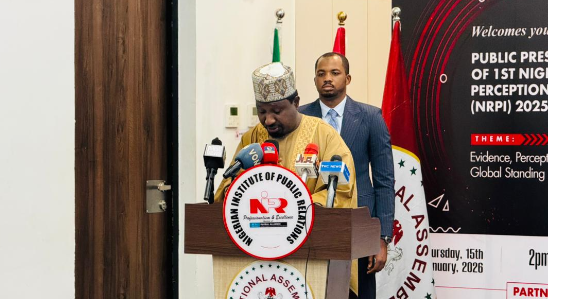
Chairman of the occasion and Deputy President of the Senate, Distinguished Sen. Barau Jibrin delivering his speech
By John Alechenu Abuja, Abuja
The 2025 Nigeria Reputation Perception Index, RPI, Report has revealed that the nation’s reputation is largely constrained by a structural trust deficit.
The report which is the first of its kind, was championed by the Nigeria Institute for Public Relations, NIPR. The document which took 7 years to prepare, polled 3, 911 respondents across 36 countries of the world, was unveiled to the public in Abuja, on Thursday.
Seven pillars namely: Culture, Social Equity, Leadership, Innovation, Performance, Communication and Credibility which were used to in carrying out the sample survey indicated that Culture which was ranked highest has a RPI score of 48.7. This score is rated below average.
Credibility which was identified as the weakest of the pillars surveyed has a RPI score of 28.1.
According to the report, “The overall RPI score of 35.2 places Nigeria in a low-trust reputation band, signaling significant confidence gaps relative to the country’s scale, visibility, and potential.
“The 9.6-point gap between domestic and international perception suggests that external audiences apply more stringent evaluation criteria, particularly around credibility and performance delivery.”
Earlier, while declaring the event open, Deputy Senate President, Barau Jibrin, stressed the importance attached to the subject of reputation and its management across the globe.
Jibrin said, “In today’s interconnected world, national reputation is no longer a matter of sentiment or propaganda; it is a strategic asset.
“How a nation is perceived by its citizens, investors, development partners, and the global community directly influences its economic opportunities, diplomatic leverage, social cohesion, and democratic legitimacy.
“Countries that understand, measure, and deliberately manage their reputation are better positioned to attract investment, tourism, innovation, and global partnerships.”
He commended the NIPR for taking the initiative to partner with other stakeholders to systematically assess how Nigeria is perceived across key dimensions such as governance, economy, security, institutions, culture, innovation, and social trust.
“From a legislative standpoint, evidence-based reports such as this empower legislators to draft responsive laws, strengthen institutional frameworks, and demand accountability where it matters most.”
He also admitted that reputation is ultimately built from lived realities. Adding that, “It is shaped by the quality of leadership, the integrity of institutions, the consistency of public policies, and the everyday experiences of citizens.
Jibrin enjoined stakeholders including the executive, legislature, the judiciary, the media and all Nigerians irrespective of political affiliation, ethnicity and religious beliefs to contribute their quota towards improving the nation’s reputation.
In his opening remarks, the President/ Chairman in Council of the NIPR, Dr. Ike Neliaku said, “Reputation is the invisible force that shapes investment decisions, borrowing costs, tourism confidence, and global trust.”
He described governance as key. Dr. Naliaku said, “Studies conducted for 15 years (2001-2016) across 74 countries, using the Sovereign Risk Instruments show that a nations sovereign risk declines with improved government effectiveness. Bottomline – Better governance reduces borrowing risk.
“Perceived corruption affects investment climate – The Corruption Perceptions Index reflects how corruption perception influences investor confidence and trust. Bottomline – Reputation breeds Trust. Trust is capital. Distrust is an economic tax.
“In today’s world, capital does not follow noise, it follows confidence, trust and reliability. Reputation is what allows value to travel.”
According to him, the report was a wake up call for all to take deliberate steps to bridge the gap in Nigeria’s reputation at home and abroad.
Disclaimer
Comments expressed here do not reflect the opinions of Vanguard newspapers or any employee thereof.