By Peter Duru, Makurdi
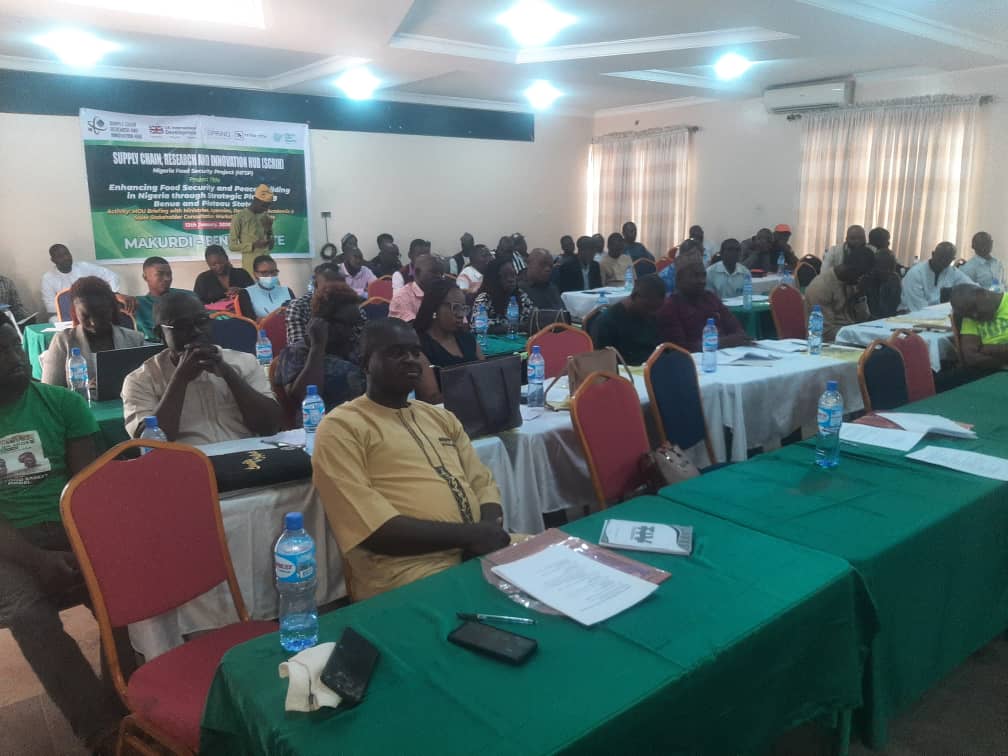
The Nigeria Food Security Project (NFSP), Supply Chain Research and Innovation Hub (SCRIH) under the UK Aid funded SPRiNG Project, has held consultations with stakeholders in Benue State on a pilot initiative aimed at strengthening food security, climate resilience and peacebuilding.
The engagement featured a stakeholders’ consultative workshop and review of a Memorandum of Understanding (MoU), held in Makurdi, with participants from key state ministries, agencies, the academia and development partners. The initiative is designed to culminate in a State Strategic Food Security Plan for Benue.
The three-month pilot project would be implemented in Agatu, Logo and Gwer-West Local Government Areas, LGAs, communities that have faced persistent challenges related to food insecurity, climate stress and conflict. The project is expected to serve as a model that could be scaled across the state.
Project Coordinator of NFSP, Dr. Shalem Shiekuma, disclosed that the engagement focused on refining the MoU, clarifying programme objectives, funding arrangements and administrative frameworks, as well as concluding a formal agreement with the Benue State Government through the Ministry of Agriculture and relevant agencies.
According to Dr. Shiekuma, the collaboration seeks to “cooperatively support the development and validation of a State Strategic Food Security Plan for Benue State through inclusive, multi-stakeholder processes,” while also supporting pilot community interventions centred on resource governance, market systems and inclusive livelihoods in the selected LGAs.
He noted that the consultation brought together critical actors needed for successful implementation. “It is a consultation workshop with key stakeholders, including the Ministries of Agriculture, Women Affairs, Health, Youth and Sports, the Peace Commission and other agencies that will help us implement this project,” he stated.
He emphasized that the project targets peacebuilding through strategic planning around food security, stressing that persistent food crises in Benue have deepened social and economic vulnerabilities.
“The project intends to develop a strategic food security plan for the state in line with promoting resilience and rebuilding communities that have been affected,” Dr. Shiekuma said.
He also explained that the pilot phase is meant to test ideas and identify challenges before full-scale adoption by the state government. “One of the key issues discussed was the MoU, with concerns around logistics, funding, programme objectives and administration. This is a pilot phase, and the funding is not coming from the state government. The project is funded by SPRiNG, a UK Aid-supported initiative,” he added.
Dr. Shiekuma described the SPRiNG Project as a holistic intervention that addresses the nexus between food insecurity, climate change and conflict, with a strong emphasis on inclusivity for women, youth and persons with disabilities.
He said the project would also conduct a Conflict and Food Security Audit to identify the core drivers of insecurity in Benue and explore opportunities for integrated peacebuilding and agricultural development, alongside joint analyses of target LGAs based on conflict incidence, agro-ecology and institutional readiness.
The MoU implementation framework provides for the establishment of a Joint Technical Working Group (JTWG) to coordinate activities, develop a clear roadmap and report monthly to the Commissioner for Agriculture and Food Security and the NFSP/SCRIH team, with the plan expected to be concluded within 90 days.
Earlier, the Commissioner for Agriculture and Food Security, Dr. Benjamin Ashaver, represented by the Acting Director of Planning, Research and Strategy, Mr. Edache Enyikwola, described the engagement as timely, noting the strong link between food security and social stability. He urged participants to actively contribute ideas that would “help better the lot of Benue State and its people.”
Disclaimer
Comments expressed here do not reflect the opinions of Vanguard newspapers or any employee thereof.