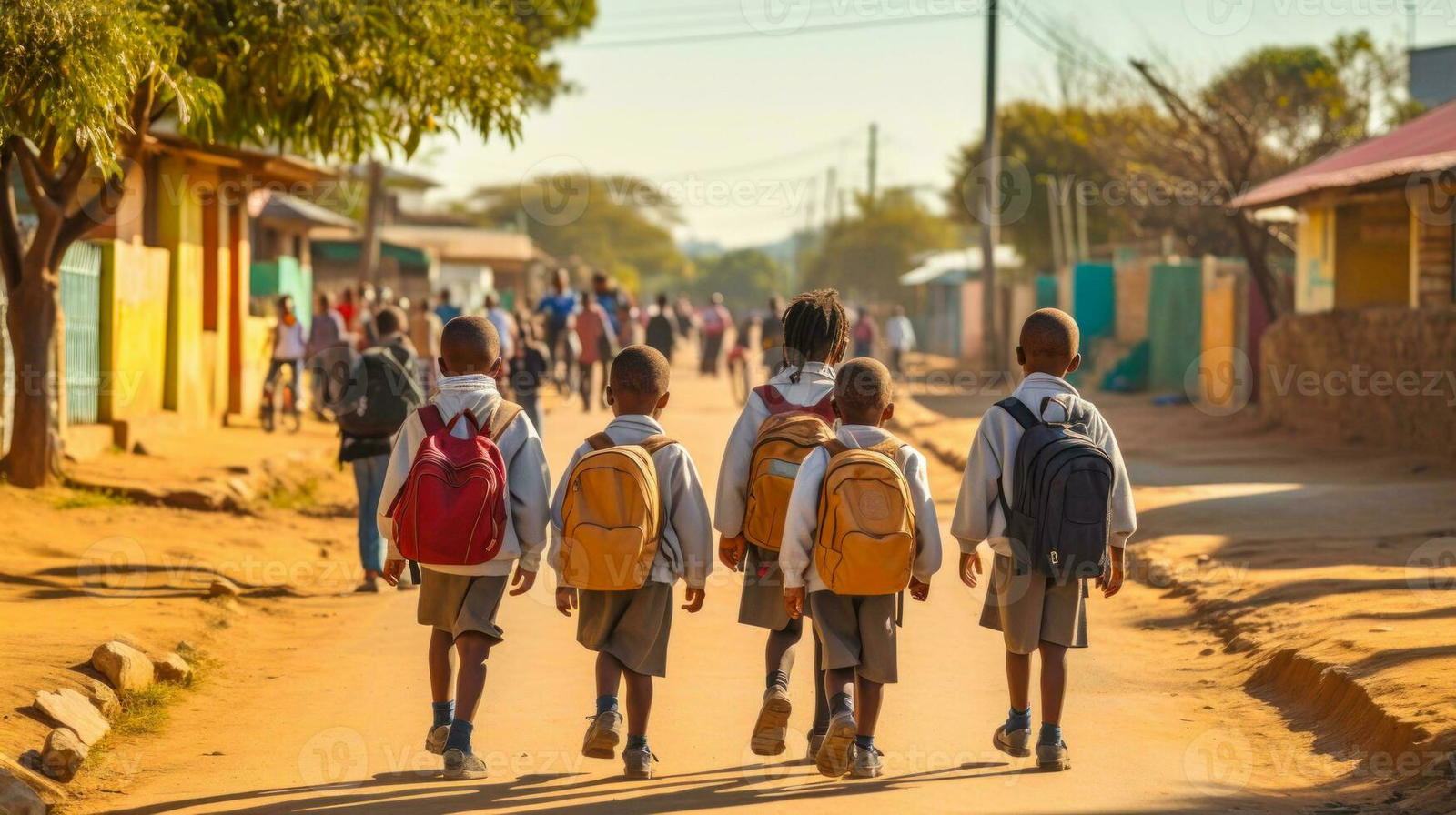
File image of African children going to school,
By Gabriel Ewepu
ABUJA – As Nigeria joins the rest of the world to commemorate the International Day of Education 2026 with the theme ‘The Power of Youth in Co-Creating Education’, SOS Children’s Villages Nigeria calls for deeper national reflection on what it truly means to educate, empower, and prepare Nigeria’s next generation.
In a statement signed by the National Director, SOS Children’s Villages Nigeria, Eghosa Erhumwunse, the CSO pointed out that education is nonnegotiable, With one of the largest youth populations globally, education remains Nigeria’s greatest opportunity—and its most pressing challenge. While notable progress has been made in expanding access to schooling, revising the national curriculum, strengthening teacher training, and improving learning environments, the reality remains sobering.
Millions of children and young people are still out of school, while many others learn in classrooms that are under-resourced, overcrowded, or disconnected from their lived realities and future aspirations.
However, Erhumwunse acknowledged that over the years, deliberate efforts have been undertaken to improve both physical and learning conditions in schools. These include the reconstruction and renovation of education infrastructure, provision of essential learning materials, improved water, sanitation and hygiene (WASH) facilities, and continuous training and retraining of teachers to strengthen learning outcomes. These interventions remain critical foundations for quality education.
However, infrastructure alone does not guarantee meaningful learning, just as curriculum reform without relevance does not inspire ownership.
He also warned that when education systems fail to harness the lived experiences, creativity, and ideas of young people, learning risks becoming distant and disengaging.
This is why the 2026 theme is both timely and necessary. Education is stronger, more relevant, and more sustainable when young people are recognised as co-creators rather than passive recipients. Globally, evidence shows that meaningful youth involvement—through participatory curriculum design, peer learning, youth-led research, and advisory roles—improves learning outcomes and deepens ownership.
He maintained that, For Nigeria, this is not optional. Achieving Sustainable Development Goal 4 will require more than infrastructure and policy reforms; it will demand a deliberate cultural shift that embeds youth voice, innovation, and leadership at the heart of education transformation.
This belief is actively translated into practice by SOS Children’s Villages Nigeria, which continues to champion youth-led approaches to education and sustainable development alongside investments in safe learning spaces, teacher capacity building, and access to essential learning resources.
Meanwhile, he disclosed that, Through the Eco Champions platform, young people are equipped not only with knowledge but also with the tools, confidence, and agency to design solutions that address real challenges within their communities.
One such example is the Eco Sustainable Future initiative led by an Eco Champion in Calabar. Recognising the gap between climate education and practical action, she developed a Climate Playbook to support self-learning and peer-to-peer knowledge sharing during and beyond her project cycle.
A total of 400 copies of the playbook were produced, with 360 distributed to students across eight secondary schools in Calabar and 40 donated to school libraries to ensure long-term access.
According to him, Beyond the numbers, the impact of the playbook was reflected in qualitative feedback from students. Many expressed enthusiasm for sections that provided clear, practical guidance on upcycling waste into reusable bags and footstools—linking climate knowledge with hands-on action, creativity, and potential livelihood opportunities.
In this context, the Climate Playbook evolved beyond an educational resource into a tool for behavioural change, youth empowerment, leadership development, and a meaningful contribution to Nigeria’s broader efforts to nurture environmentally conscious, action-driven young stewards.
Co-creation brings learning to life. It bridges theory and practice while nurturing problem-solvers who are invested in the wellbeing and future of their communities.
As Nigeria continues its journey toward achieving SDG 4, scaling such youth-led, context-responsive initiatives—alongside sustained investments in infrastructure, teacher development, learning materials, and safe school environments—will be critical.
This includes institutionalising youth participation in education planning, investing in digital, green, and vocational skills, and creating safe, inclusive spaces where young people can influence decisions that shape their learning experiences and futures.
On this International Day of Education, SOS Children’s Villages Nigeria calls on government, development partners, educators, and the private sector to move beyond rhetoric and commit to genuine partnership with young people.
Education systems that listen to youth, learn from them, and build alongside them are better positioned to deliver equity, relevance, and long-term impact.
The power of education is amplified when it is co-created, and the future of Nigeria’s education depends on how boldly this truth is embraced today.
Disclaimer
Comments expressed here do not reflect the opinions of Vanguard newspapers or any employee thereof.