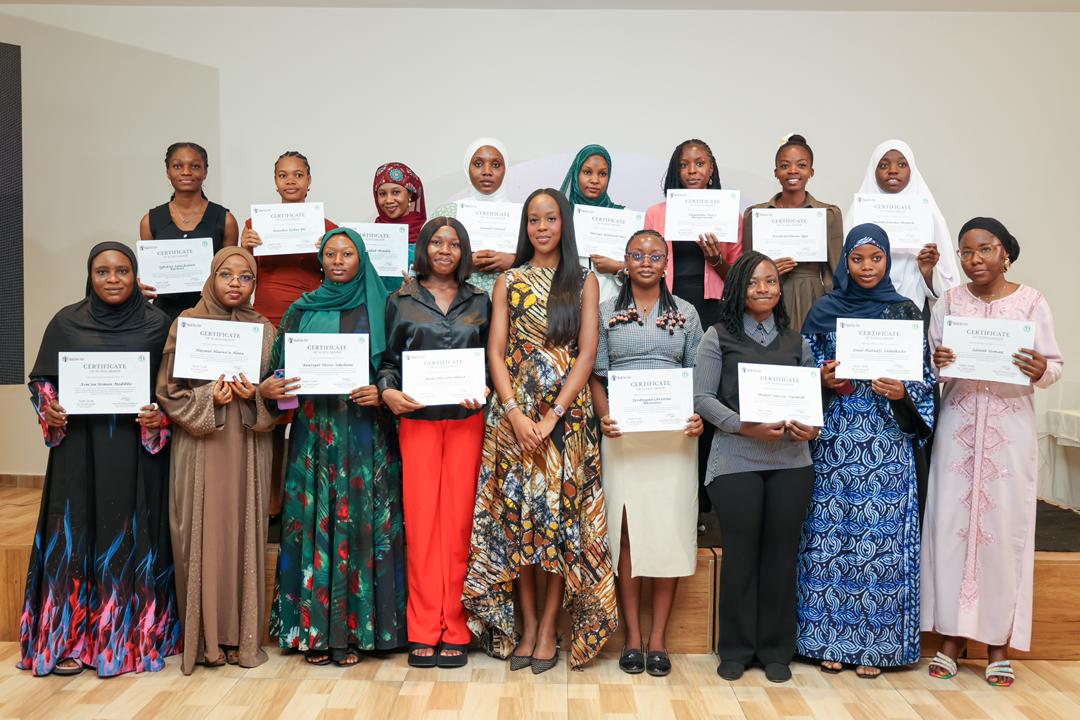
Dr Teniola Saraki, Founder, Built for Her Foundation; and beneficiaries of the maiden edition of the Built for Her Foundation Scholarship for Medical Students during the award presentation, yesterday in Abuja.
By Joseph Erunke, Abuja
The Built for Her Foundation has launched a National Medical Students Scholarship aimed at strengthening women’s representation in medicine and confronting the country’s persistent gender health gap.
The landmark event, held in Abuja, at the weekend, brought together policymakers, health professionals, academics, students, and civil society leaders, all united by a shared conviction: that the health of women and girls is inseparable from national development, economic growth, and social equity.
At the heart of the initiative is a fully funded scholarship programme supporting 30 outstanding female medical students in their 400 level,five beneficiaries selected from each of Nigeria’s six geopolitical zones.
Implemented in partnership with the Nigerian Medical Students’ Association,NiMSA, the programme is the Foundation’s inaugural intervention and a bold statement of intent.
Unveiling the scholarship, Founder of the Built for Her Foundation, Dr. Teniola Saaki, said the initiative was born out of a simple but powerful belief: that women and girls deserve a world intentionally built with them in mind.
According to her, the Foundation is dedicated to advancing women’s health and wellbeing through evidence-based, systems-driven solutions that go beyond rhetoric to deliver measurable impact.
“Female representation in the physician workforce is still below 50 per cent. Yet evidence shows that when women are included meaningfully in healthcare,whether in clinical care, leadership, research or poli,health outcomes improve across the board, “Dr. Saraki said.
She explained that the Foundation’s work is anchored on five strategic pillars adapted from the McKinsey framework for closing the gender health gap: counting women, including women, studying women, caring for women, and investing in women.
The newly launched scholarship, she said, directly addresses the pillar of inclusion by strengthening the pipeline of female doctors.
Dr. Saraki highlighted global data showing that women spend about 25 per cent more of their lives in poor health than men, translating to nearly nine additional years of ill health over a lifetime. “Women’s health is fundamental to gender equity.
It shapes how women learn, work, lead and care for others,” she noted.
Explaining the selection process, Dr. Saraki said applications were distributed to medical schools nationwide through NiMSA.
She explained that aplicants submitted academic transcripts and proof of enrolment, with selection based strictly on merit.
“It was purely merit-based,” she stressed. “You had to be a 400-level female medical student with outstanding academic performance.”
She disclosed that the programme is already fully financed, with tuition coverage varying depending on each beneficiary’s institution. More importantly, she revealed that the Foundation plans to make the scholarship an annual programme, expanding its reach in subsequent years.
One of the most powerful interventions at the event came from Mrs. Toyin Saraki, former First Lady of Kwara State and founder of several health advocacy initiatives.
Drawing from decades of engagement in health, education and social development, Mrs. Saraki underscored a fundamental truth: the health of women and girls is central to sustainable national progress.
She noted that global development frameworks, including the United Nations Sustainable Development Goals ,SDGs, clearly link women’s health to gender equality, quality education, reduced inequalities and economic growth.
Yet, she lamented that in countries like Nigeria, persistent gaps in access, representation and investment continue to drive unequal outcomes.
“These disparities reflect deeper structural weaknesses in how women are counted, studied, cared for and included within health systems,” she said.
Mrs. Saraki described the Built for Her Foundation as a timely and strategic intervention, entering the health space with a strong analytical framework, emphasis on research, partnerships and accountability.
By adapting global evidence,particularly from the McKinsey Health Institute,to Nigeria’s realities, she said the Foundation positions women’s health as a catalyst for educational attainment, workforce participation and intergenerational wellbeing.
Mrs. Saraki warned that this imbalance has far-reaching consequences for service delivery, policy priorities and medical research.
By investing across the education and leadership continuum, she said, the Built for Her Foundation is helping to build a more inclusive, responsive and effective healthcare system aligned with global commitments to universal health coverage.
She described the 30 scholarship beneficiaries as an emerging generation of clinicians, researchers and health leaders poised to shape healthcare delivery in Nigeria and beyond.
The Coordinating Minister of Health and Social Welfare, Mohammad Ali Pate, speaking through her Chief of Staff, Dr. Mayowa Alade, affirmed that the Foundation’s objectives align strongly with the Nigerian Health Sector Renewal Investment Initiative, which prioritises women’s health and seeks to reduce maternal mortality.
Dr. Alade disclosed that recent reforms have led to a 17 per cent reduction in maternal deaths in high-burden local government areas,an encouraging but insufficient step.
Maternal and child health challenges, she said, are shaped by social determinants such as education, poverty, access to care and financial protection.
Delivering the keynote address, Mrs. Zainab Kwaru Mohammad-Idris framed women’s health as the very foundation of gender equity.
According to her, health determines how women participate in society,as learners, workers, caregivers and leaders.
She challenged the narrow framing of women’s health as synonymous with reproductive health, noting that while some conditions are unique to women, the greatest burden comes from diseases that affect women differently or disproportionately.
“For decades, women were excluded from clinical trials,” she said. “As a result, many interventions do not fully serve women.”
Citing McKinsey Institute findings, she revealed that 64 per cent of women with interventional health needs fail to receive effective care due to access and effectiveness gaps.
She added that globally, women spend an average of nine more years in poor health than men.
Turning to Nigeria, she described the statistics as “emotional and unacceptable,” noting that more than 100 Nigerian women die daily from childbirth-related causes, while about 75,000 maternal deaths occur annually, representing nearly 29 per cent of the global burden.
She also raised alarm over cervical cancer, predicting that 1.6 million Nigerian women could die from the disease despite the availability of screening and vaccines.
An Economic Argument for Women’s Health
Beyond the moral case, the keynote speaker stressed that closing the gender health gap is an economic imperative. Failure to act, she warned, could cost Nigeria and similar economies trillions of dollars in lost GDP by 2040.
Outlining the foundation’s strategy, she reiterated its five pillars and expressed concern that women currently make up just 35–37 per cent of Nigeria’s physician workforce. Increasing women’s representation, she said, is central to building systems that truly respond to women’s needs.
Speaking on behalf of the beneficiaries,
Miss Hindat Abdulwahab, a fourth-year medical student of Ahmadu Bello University ,ABU,,Zaria, described the scholarship as more than financial support, calling it a powerful affirmation for women navigating the demanding path of medicine.
“I have always been drawn to medicine,” she said, describing the profession as one of humanity’s noblest callings. It is a privilege to meet people in their most vulnerable moments and help them through difficulty, “she said.
Disclaimer
Comments expressed here do not reflect the opinions of Vanguard newspapers or any employee thereof.