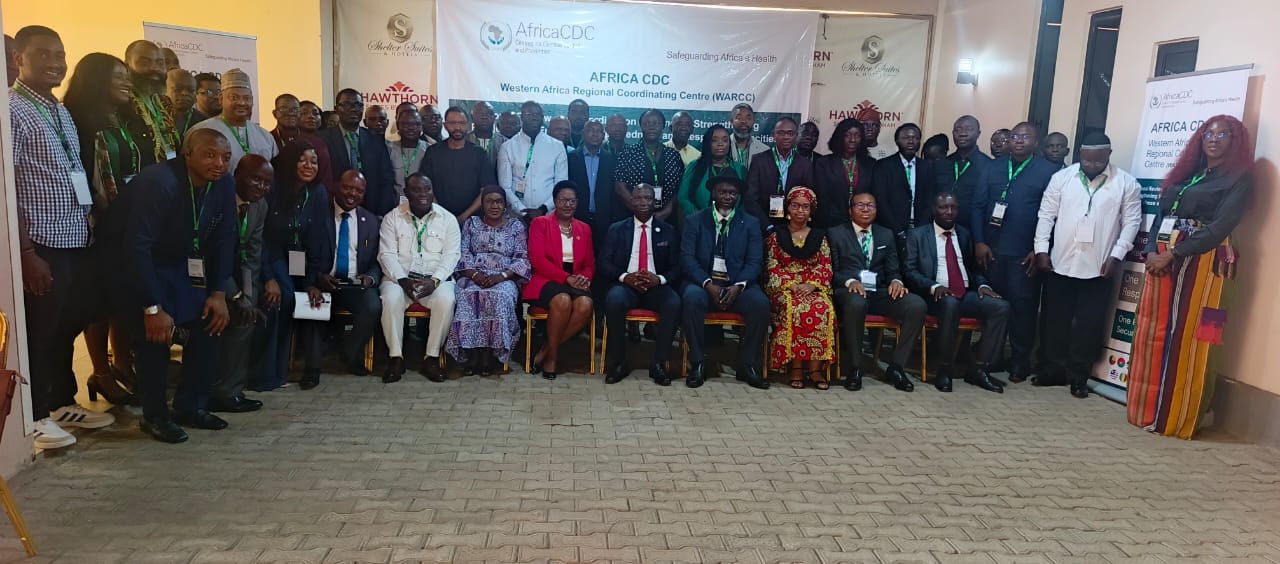
…at Africa CDC Regional Meeting
By Joseph Erunke, Abuja
Member states of the Africa Centres for Disease Control and Prevention (Africa CDC) in the West African region have concluded a four-day technical coordination meeting in Abuja with a renewed commitment to strengthen disease surveillance, emergency response systems, and overall public health readiness ahead of 2026.
The meeting brought together directors of surveillance, heads of National Public Health Institutes (NPHIs), and emergency preparedness officials from 15 countries. Participants reviewed progress in their respective states and identified key gaps that will inform the continent’s 2026 health security work plan.
Speaking at the close of the sessions, the Africa CDC Regional Director for West Africa, Dr. Alinon Kokou, said the interactions offered “a real picture” of public health preparedness across the region.
“Countries shared experiences, learned from one another, and we, as Africa CDC, obtained the necessary information to plan effectively for 2026,” he said.
A major outcome of the meeting was the push for faster adoption of the global 7-1-7 emergency response benchmark, which aims for detection of outbreaks within seven days, notification within one day, and initiation of response within the following seven days.
“Some countries are still behind. Member states want us to strengthen the 7-1-7 target and support them to be fully compliant,” Dr. Kokou said.
The establishment and strengthening of National Public Health Institutes also emerged as a priority, with Africa CDC pledging to expand support to countries that have yet to complete their institutional structures.
“The realities differ from country to country. Our role is to help each nation set up or strengthen an NPHI that fits its national context,” he said.
Participants also highlighted the rising burden of non-communicable diseases (NCDs), which now account for more than 60 percent of hospital deaths in the region. Discussions centred on integrating innovative health-promotion strategies to reduce risk factors.
Rising maternal mortality across several West African countries was another major concern. Dr. Kokou said Africa CDC will collaborate closely with UNFPA and other partners to design targeted interventions.
“The data on maternal mortality is worrying,” he said, adding that new support programmes are in development.
A common challenge raised by all countries was inadequate funding for public health programmes, compounded by cuts in foreign aid.
“Many U.S.-funded projects have been affected due to cuts,” Dr. Kokou noted, calling for innovative domestic resource mobilisation.
Countries affected by conflict—including Mali, Niger, Burkina Faso, and parts of northern Nigeria and Togo—reported severe declines in immunisation coverage, particularly in addressing zero-dose children. Africa CDC is exploring alternative strategies to deliver vaccines in hard-to-reach and insecure areas.
Addressing concerns that political transitions in parts of the region could hinder cooperation, Dr. Kokou emphasised that Africa CDC treats all member states equally.
“We are a public health institution. Disease has no interest in democracy or military rule. We support all member states equally. No country should be left behind,” he said.
He also expressed appreciation to journalists for their role in public health risk communication and acknowledged the support of WHO, UNICEF, UNFPA, ECOWAS, and other partners.
Also speaking, Dr. Yusupha Touray, Permanent Secretary of The Gambia’s Ministry of Health and Chair of Africa CDC West Africa, described the sessions as “highly educative” and praised the quality of country presentations.
He said discussions on NPHIs and unified surveillance systems represent a major step toward coordinated regional health security. “Africa CDC is definitely here to help,” he stated.
Asked how quickly countries would implement the region’s unified surveillance and response plan, Touray expressed optimism.
“Diseases don’t wait for the right moment. With the motivation we’ve seen, and with Africa CDC’s follow-up, implementation will start quickly,” he said.
He added that member states are ready to support one another to strengthen emergency preparedness:
“That is the strength of this union,” he declared.
Disclaimer
Comments expressed here do not reflect the opinions of Vanguard newspapers or any employee thereof.