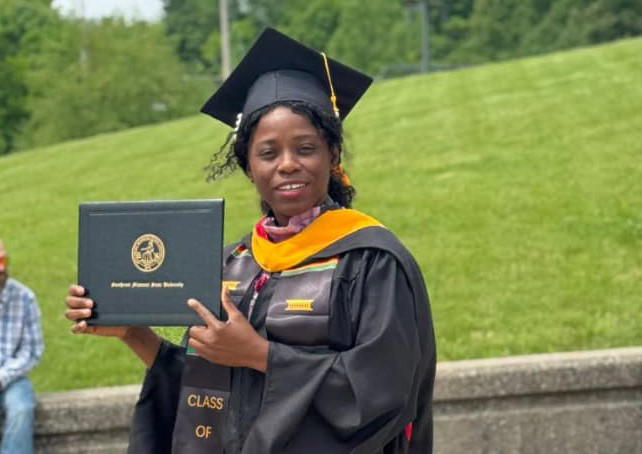
Bridget Ugochi Anyanwueze is part of a growing network of young African scientists redefining research and mentorship in the digital age.
She recently completed her master’s degree in Biology/Biological Sciences at Southeast Missouri State University, United States, where her research focused on invertebrate immunology and the trade-offs organisms make when balancing nutrition and immune defence.
Beyond the laboratory, Anyanwueze has supported more than 130 students through her mentorship platform, Scholar Spot, while reaching millions through her online educational content. In this interview, she reflects on her academic journey, her passion for immunology, and her commitment to preparing the next generation of scholars.
How has your academic journey shaped your perspective as a biologist and researcher?
My academic journey began in Nigeria, where I studied Microbiology at Tansian University, Umunya. For my undergraduate research, I assessed the microbial quality and internal spoilage of avocado pears. That early exposure to microbial systems sparked my interest in how microorganisms interact with their environments, influence human health, adapt to environmental pressures, and evolve over time. I also became fascinated by how these systems can be harnessed for biotechnology and sustainable solutions.
After graduating with second-class honours in Microbiology, I moved to the United States to pursue a master’s degree in Biology/Biological Sciences. During this period, I became deeply interested in invertebrate immunity, particularly encapsulation and melanization responses. I worked with Zophobas morio, commonly known as the superworm, as my model organism. Studying this system pushed me to think about immunity not as an isolated process, but as one that is closely linked to nutrition, energy allocation and life-history strategies.
This perspective has shaped how I approach research and training. I constantly try to connect molecular mechanisms back to broader ecological and evolutionary questions. I graduated summa cum laude, finishing among the top five per cent of students in my graduating class.
What drew you to immunology, and why is this research important today?
Immunology sits at the intersection of survival, adaptation and evolution. Insects rely primarily on innate immunity, and their immune responses are tightly linked to the availability of resources such as energy and protein. Understanding how organisms allocate limited resources between immunity and other biological functions helps us understand survival strategies in changing environments.
In a world facing climate change, habitat loss and unpredictable food availability, these questions are increasingly relevant. Studying immune trade-offs in insects offers insights that extend beyond entomology to ecology, agriculture and even human health, because the basic principles of energy allocation and immune investment are conserved across species.
Your recent work examines how food limitation affects immune responses in Zophobas morio. What have you learned?
My research investigates how different diets influence the larvae’s ability to mount encapsulation and melanization responses following an immune challenge. The findings show that nutrition plays a significant role in immune performance. Larvae on enriched diets are better able to invest in immunity without compromising survival, while those on restricted diets face strong trade-offs between immune defence and essential functions such as growth, survival and body maintenance.
This work highlights that immune responses come with real biological costs and that effective immunity is closely tied to nutrient availability.
How does this research contribute to the broader field of immunology?
My work reinforces the idea that immunity is not “free” and depends heavily on environmental conditions, particularly diet quality. By using Zophobas morio as a model, the research demonstrates how nutrients interact with immune systems in ways that are applicable across biological systems.
These findings have implications for pest management, conservation biology and biomedical research that uses insect models to study innate immunity. The study is currently on track for peer review and publication in a scientific journal, with the aim of addressing key gaps in our understanding of invertebrate immune responses and guiding future research.
What direction do you hope your work will take as you advance in your career?
As I continue in immunology, I am increasingly interested in how insights from insect models can inform our understanding of immune trade-offs in humans. Insects provide a simple yet powerful framework for studying how nutrition, stress and environmental factors shape immune responses, and these principles often extend across species.
In the long term, I hope to explore questions that intersect more directly with human health. I am interested in collaborating with researchers, pharmacists and clinicians to better understand why individuals respond differently to treatments. Ultimately, my goal is to contribute to personalised approaches to medicine that improve treatment effectiveness and reduce adverse reactions by considering genetics, immune response patterns and medical history.
You’ve taught and mentored students during graduate school. How has that influenced your outlook on science?
Teaching anatomy and physiology, as well as genetics, reinforced my belief that science is strongest when it is shared. Explaining complex concepts to students deepened my own understanding and challenged me to communicate science more clearly.
Mentoring early-career researchers, especially those new to laboratory work or scientific writing, has been incredibly rewarding. It has strengthened my commitment to building supportive and inclusive scientific communities. I teach because I genuinely love science.
You have helped over 130 students navigate scholarships. What motivates this work, and how do you measure its impact?
Mentorship is deeply personal to me. I have directly supported over 130 individuals through webinars, workshops and one-on-one mentorship at Southeast Missouri State University, not including the more than five million people reached through my social media platforms.
I won over $45,000 in scholarships to fund my master’s degree in the United States, and I understand firsthand how life-changing access to guidance can be. Impact, for me, is not just about numbers. It is seeing students secure scholarships, publish their work, grow in confidence, and eventually mentor others. Those ripple effects are what matter most.
What challenges have you faced as an international student in science?
Adjusting to a new academic culture came with a learning curve. There were moments of self-doubt, especially when adapting to different expectations in research and teaching. However, those challenges sharpened my focus and strengthened my resilience. They also inform how I now support other international students navigating similar paths.
Disclaimer
Comments expressed here do not reflect the opinions of Vanguard newspapers or any employee thereof.