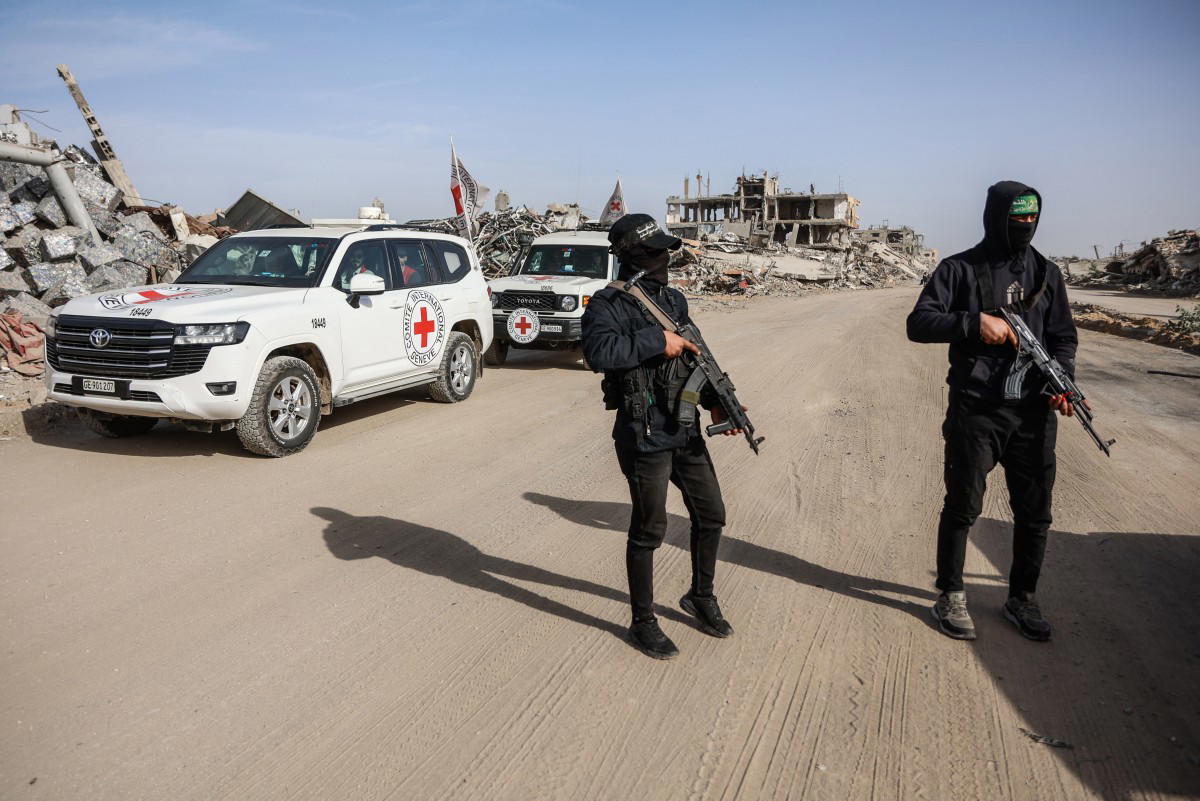
Palestinian Hamas militants secure the area as Egyptian workers accompanied by members of the International Committee of the Red Cross (ICRC) search for the remains of the last Israeli hostage in the Zeitoun neighbourhood of Gaza City on December 8, 2025. Qatar and Egypt, guarantors of the Gaza ceasefire, called for the withdrawal of Israeli troops and the deployment of an international stabilisation force as the necessary next steps in fully implementing the fragile agreement. The measures were spelt out in the US- and UN-backed peace plan that has largely halted fighting, though the warring parties have yet to agree on how to move forward from the deal’s first phase. Its initial steps saw Israeli troops pull back behind a so-called “yellow line” within Gaza’s borders, while Palestinian militant group Hamas released the living hostages it still held and handed over the remains of all but one of the deceased. (Photo by Omar AL-QATTAA / AFP)
Reporters Without Borders said on Tuesday that Israel was responsible for nearly half of all journalists killed this year worldwide, with 29 Palestinian reporters slain by its forces in Gaza.
In its annual report, the Paris-based media freedom group said the total number of journalists killed reached 67 globally this year, up from 66 killed in 2024.
Israeli forces accounted for 43 percent of the total, making them “the worst enemy of journalists”, RSF said in its report, which documented deaths over 12 months from December 2024.
The most deadly single attack was a so-called “double-tap” strike — where dual bombings are staged — on a hospital in south Gaza on August 25, which killed five journalists, including two contributors to international news agencies Reuters and the Associated Press.
In total, since the start of the Gaza war in October 2023, after the Hamas attack on Israel, nearly 220 journalists have died, making Israel the biggest killer of journalists worldwide for three years running, RSF data shows.
The Israeli military says its raids and shelling target Hamas fighters and leaders.
– ‘Not stray bullets’ –
Foreign reporters are still unable to enter Gaza — unless they are in tightly controlled tours organised by the Israeli military — despite calls from media groups and press freedom organisations for access.
The RSF annual report also said that 2025 was the deadliest year in Mexico in at least three years, with nine journalists killed, despite pledges from left-wing President Claudia Sheinbaum to protect them.
War-wracked Ukraine (three journalists killed) and Sudan (four journalists killed) are the other most dangerous countries for reporters, according to RSF.
The overall number of deaths last year is down from the peak of 142 journalists killed in 2012, linked largely to the Syrian civil war. It is also below the average since 2003 of around 80 killed per year.
RSF editorial director Anne Bocande noted a growing tendency to “smear” journalists as a way to “justify” the crime of targeting them.
“These are not stray bullets. This is a deliberate targeting of journalists because they inform the world about what’s happening on the ground,” she told AFP.
The RSF annual report also counts the number of journalists imprisoned for their work, with China (121), Russia (48) and Myanmar (47) the most repressive countries, RSF figures showed.
As of December 1, 2025, 503 journalists were detained in 47 countries, the report said.
Other organisations use different qualifiers to calculate journalist deaths. According to UNESCO, 91 journalists were killed in 2025.
Disclaimer
Comments expressed here do not reflect the opinions of Vanguard newspapers or any employee thereof.