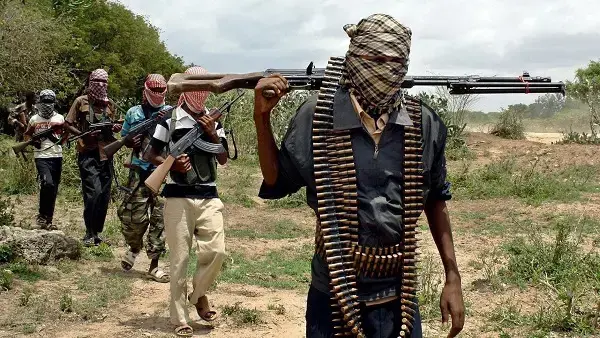
File image of bandits
*Urge coordinated action to calm country’s security crisis
By Luminous Jannamike
ABUJA – The Nigerian KAICIID Fellows have warned that Nigeria’s escalating violence, fuelled by weak security structures and sharpened by rising international rhetoric, is driving the country toward a deeper national crisis.
The interfaith network of 35 peacebuilders said urgent, coordinated action is needed to prevent further bloodshed.
In a statement signed by Prof Awal Abdulsalam, Chairman, and Elder Justina Ngwobia, Secretary, the Fellows said the widespread attacks across Plateau, Kaduna, Benue, Niger, Zamfara, Katsina, Kebbi, Sokoto, Borno and Yobe reflect a humanitarian emergency affecting Nigerians of all faiths.
“Our intention is not to diminish the unimaginable suffering of victims and families, but to draw attention to the deeper causes: long-standing governance failures, inadequate security systems, injustice and the erosion of social cohesion,” the Fellows said.
They stressed that the violence is driven by banditry, extremist ideologies, ethnic tensions and resource disputes, not a singular coordinated religious campaign.
“The violence we face is fundamentally a tragedy of failed protection, not a coordinated campaign of extermination,” they added.
The Fellows also cautioned that foreign commentary is worsening tensions, especially narratives framing Nigeria’s crisis strictly as religious persecution. They said this includes comments made nearly a month ago by U.S. President Donald Trump, who designated Nigeria a ‘Country of Particular Concern’ and threatened military intervention ‘guns-a-blazing.’
“Militaristic language risks worsening an already delicate situation and it could exacerbate conflicts, displace more families, and deepen mistrust among our diverse populations,” they said.
According to the Fellows, alarmist rhetoric can embolden violent actors, distort Nigeria’s complex crisis, and undermine grassroots peace efforts that rely on trust and dialogue.
They highlighted ongoing KAICIID initiatives that protect religious sites, counter hate speech and strengthen community resilience.
“Sustained dialogue reduces violence, strengthens community resilience, and empowers youth, faith leaders, and civil society actors to build peace from the ground up,” they said, referencing their impact report covering 2015–2024.
Call to Action
The Fellows urged government at all levels to demonstrate visible leadership and protect citizens decisively. They called on faith leaders to deepen intercommunal dialogue, on civil society to expand peacebuilding efforts, and on international partners to support Nigeria in ways that strengthen institutions rather than inflame tensions.
“If we continue to turn against one another, we risk weakening our unity when we most desperately need it,” they warned.
Reaffirming their commitment to dialogue, they insisted that unity, justice and shared responsibility remain Nigeria’s best path to lasting peace.
“Every Nigerian life is sacred and dialogue, justice and shared responsibility remain the only sustainable paths toward a peaceful and harmonious Nigeria,” they said.
Disclaimer
Comments expressed here do not reflect the opinions of Vanguard newspapers or any employee thereof.