By Frank Onyegbule
Amid the rising global tension over who truly benefits from automated creativity, Onyinye Odita has become a defining voice in the push to ensure that human imagination is neither erased nor exploited in the age of AI. Her work positions her at the centre of international debates on how artificial intelligence should engage with culture, creative labour, and the rights of the people whose works power these systems.
A leader and one of the most closely watched emerging thinkers in AI governance and copyright law, Onyinye is reshaping international discussions about how artificial intelligence should interact with culture, creativity, and the people behind the works it learns from. “The question isn’t whether AI can create,” she often says. “It’s whether it can do so ethically with respect for the people whose art it learns from.”
This insistence on ethical grounding has positioned her at the forefront of a rapidly evolving field where law, policy, culture, and code collide.
At the core of Onyinye’s work is a conviction that every dataset tells a human story. Millions of songs, images, scripts, and texts feed today’s generative AI systems, yet the creators whose work makes this possible often remain unseen and uncompensated. Her influential “Train-and-Pay-to-Influence” proposal imagines a future where artists receive remuneration when their work directly contributes to training generative models. It is a vision grounded in transparency, traceability, and fairness—principles she argues are achievable through a fusion of digital provenance, copyright, and market-based design.
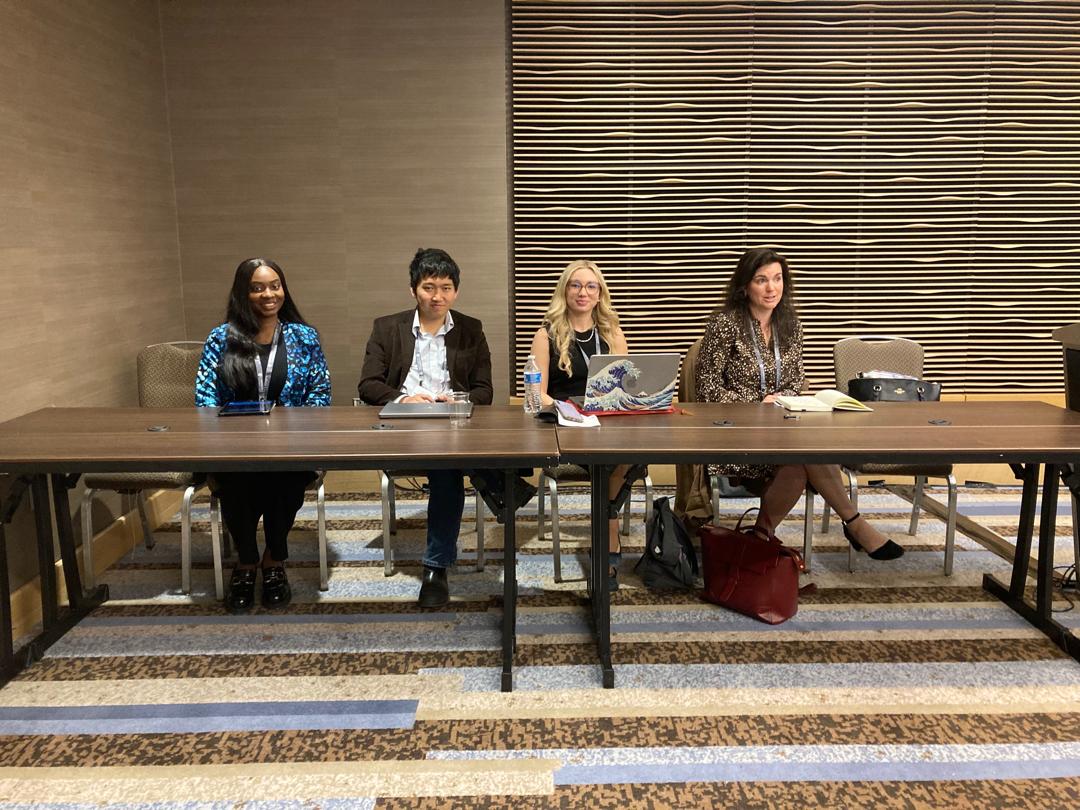
Throughout 2025, Onyinye has brought this message to major global platforms. In Chicago, she contributed to a landmark dialogue on AI and copyright at the Law and Society Association Conference. In Calgary, she presented research at the Cyber Threats to Canadian Democracy Conference, demonstrating how technical standards such as C2PA, originally designed for misinformation defence, can also be repurposed to trace copyrighted works inside training datasets. By bridging cybersecurity infrastructure and creative rights, she reframed democratic resilience and cultural protection as parallel concerns.
Just weeks later, she carried the conversation to India at the 27th International Seminar of the Kerala Law Academy Law College, where she spoke on “Artificial Intelligence, Intellectual Property, and the Common Heritage of Mankind.” Her session invited global jurists to rethink AI datasets as shared resources that must still honour the moral and economic rights of their human contributors.
Her growing international profile has been further strengthened by her peer-reviewed article in the World Journal of Advanced Research and Reviews (WJARR), titled Should creators be compensated for the use of their works in training AI-generated music systems? (Onyinye Odita, 2025).
In the article, she examines the legal and ethical consequences of training AI on copyrighted musical works, highlighting how current frameworks undervalue creators whose music forms the backbone of AI-generated output. She argues that large-scale text and data mining, when used commercially, cannot be meaningfully separated from the creative labour of human artists. Her proposed solution—a statutory remuneration scheme governed by collective management organizations—offers a practical pathway for ethical AI development.
Onyinye’s scholarship sits at the intersection of technology, law, and social consciousness. Her research argues that copyright should evolve beyond protectionism into a framework for empowerment: one that shields creators, recognizes global cultural contributions, and guides innovation rather than reacting to it. She is part of a generation of thinkers who believe that responsible AI does not happen by accident; it must be architected.
Colleagues describe her influence as globally resonant. By connecting cybersecurity, copyright, and culture, she demonstrates how the same verification infrastructures that safeguard democracies can and should safeguard artists. “She connects technical insight with moral clarity,” one researcher noted. “Onyinye isn’t just interpreting the law, she’s shaping what the next generation of digital rights could look like.”
As world bodies such as WIPO and UNESCO grapple with questions of algorithmic accountability and the future of authorship, Onyinye’s ideas are increasingly entering the global policy bloodstream. Her call for provenance transparency, remuneration fairness, and ethical data governance is informing international conversations about how nations might legislate creative rights in an automated age.
Her message remains constant: progress must honour its sources.
“AI can learn from existing creativity,” she says, “but it must also learn to respect it.”
Disclaimer
Comments expressed here do not reflect the opinions of Vanguard newspapers or any employee thereof.