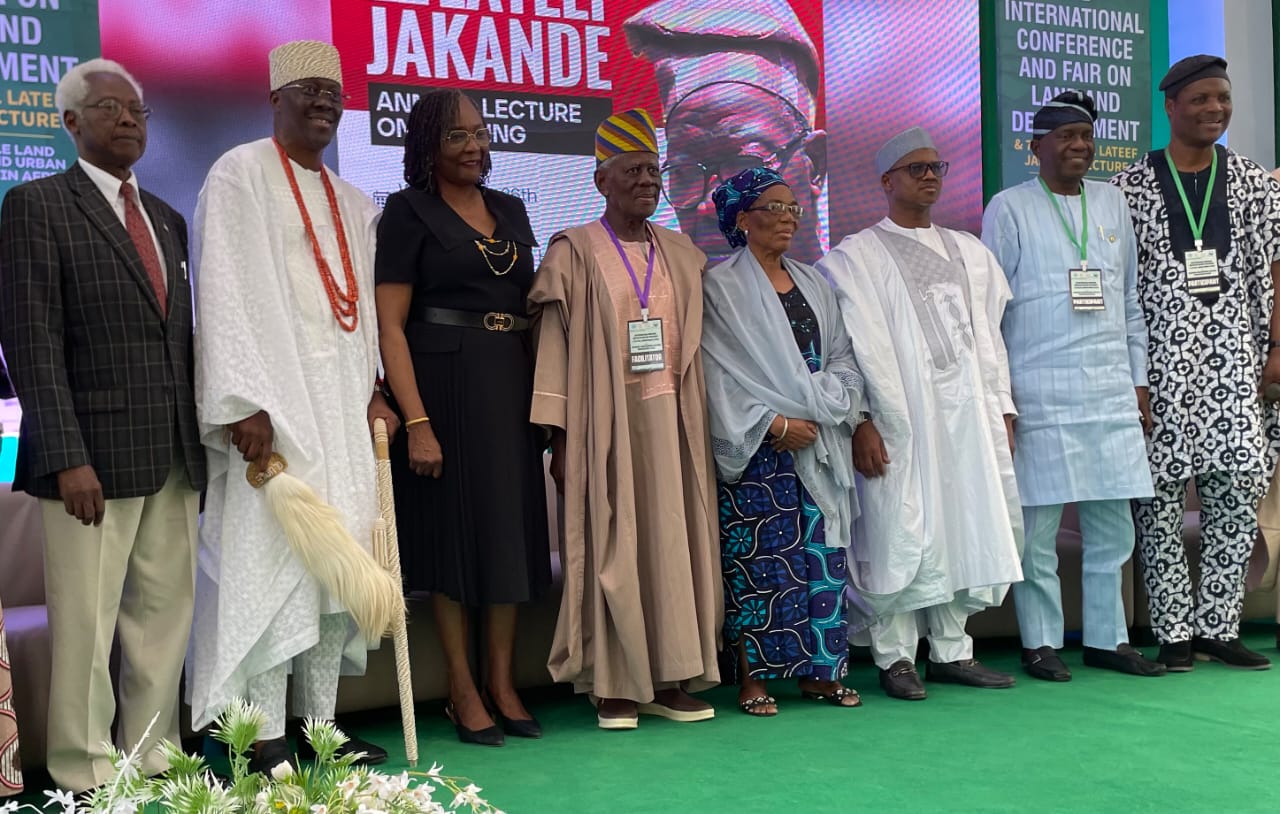
Chairman, Board of Trustees, Real Estate Developers Association of Nigeria (REDAN), David Garnvwa (left); REDAN President, HRM Oba Akintoye Adeoye; UNILAG Vice Chancellor, Prof. Folasade Ogunsola; REDAN Life Patron, Tunde Fanimokun; Wife of late former Lagos governor, Lateef Jakande, Abimbola Jakande; Managing Director of the Federal Mortgage Bank of Nigeria, Shehu Osidi; Lagos State Commissioner for Housing, Moruf Akinderu-Fatai and Founding Director, UNILAG Centre for Housing and Sustainable Development, Prof. Timothy Nubi during the 7th lateef Jakande yearly lecture in Lagos.
By Kingsley Adegboye
Stakeholders in Nigeria’s housing sub-sector who participated at the just concluded 3rd International Conference and Fair on Land and Development and 7th Annual Later Jakande Lecture, have rooted for sustainable land reforms that will make Nigerian cities become engines of inclusive prosperity,resilience and productivity.
The three-day event organised by the Centre for Housing and Sustainable Development (CHSD), and ARUA Centre of Excellence in Urbanisation and Habitable Cities for sustaining an intellectual platform that bridges research, government policy and real economic outcomes, had its theme as “Sustainable Land Development and Urban Infrastructure in Africa.”
The Special Guest of Honour, Arc. Ahmed Musa Dangiwa, who represented by the Managing Director of Federal Mortgage Bank (FMBN), Shehu Usman Osidi, said land reform alone cannot unlock the promise of urban development unless it is matched with infrastructure transformation, pointing out that this is why under National Urban Renewal and Slum Upgrade Programme, “We have already completed more than150 urban renewal and slum upgrading projects across the six geopolitical zones of the country, providing roads,drainage, water, schools, power and sanitation to underserved communities.
“Along side these reforms,the Renewed Hope Housing Programme is making historic strides. Currently, we are delivering more than 10,000 housing units across14 locations, surprising the delivery achieved in the previous eight years combined.
“These include the 3,112-unit Renewed Hope City in Karsana, Abuja, the 2,000-unit Renewed Hope City in Ibeju-Lekki, Lagos, the 1,500-unit Renewed Hope City in Kano plus an additional500-unit estate, and 250-unit estates in states such as Oyo, Akwa Ibom, Benue, Nasarawa, Ebonyi and others. These developments are more than houses. They are complete communities with commercial hubs, green spaces, healthcare facilities schools.”
Speaking on quest for affordable housing in Nigeria, Lagos State Commissioner for Housing, Moruf Akinderu Fatai, said the story of housing in Lagos and indeed Nigeria cannot be told without pausing to study Lateef Jakande’s years.
Akinderu Fatai noted that Jakande’s short tenure as Governor of Lagos State between 1979 and 1983, still stands as the most successful housing delivery era in Nigeria’s national history.
According to him, in just four years, he demonstrated what is possible when leadership is driven by clarity of purpose, courage in execution and empathy for the ordinary citizen.
The Commissioner however, noted that in advancing the quest for affordable housing, it is beyond the government’s effort alone, stressing that it also needs a solid collaboration from all stakeholders.
“Our public higher institutions must continue to play a central and transformative role. Universities such as University of Lagos remain the intellectual engines of national development. They are uniquely positioned to produce the research that guides best practices, to generate climate-resilient models for our rapidly changing urban environments, and to train the next generation of architects, planners, engineers and housing professionals who will build the cities of tomorrow.
“Through rigorous evaluation of policy outcomes, innovation in sustainable and locally sourced building materials, and the provision of accurate and timely housing and urbanisation data, our universities stand as the knowledge centres upon which modern housing systems must rely.”
In his lead paper, “Navigating Complexity: Land Policy and Urban Infrastructure Development in Africa”, Chudi Ubosi, Managing Partner, Ubosi Eleh & Co, a firm of estate surveyors and valuers, said the way the Land Use Act has elevated the Certificate of Occupancy CofO, is almost like a holy grail.
Chudi added that bureaucratic and government bottlenecks make it impossible to obtain title, pointing out that even Nigerians are reluctant to obtain CofO which is viewed with suspicion in terms of rates, taxes, revocation and others.
He said the land use act has actually slowed down development in all spheres in Nigeria, saying from the simple issues of acquisition,to compensation to titling,there is no doubt that Nigeria should have been several miles ahead of where we are today.
He therefore, called on government at all levels to act with urgency in implementing the recommendations to fast track the development of the nation.
In his address, the President of the Real Estate Developers’ Association of Nigeria (REDAN), Oba Akintoye Adeoye, said “Our nation faces growing housing deficit, with challenges ranging from inadequate financing mechanisms to rising construction costs. This lecture series provides an opportunity to explore sustainable solutions for housing finance, drawing lessons from both Pa Jakande’s visionary models and contemporary approaches to infrastructure investment.
“We aim to inspire collaboration among government, private sector developers, financial institutions and other stakeholders to create inclusive housing solutions that are economically viable and socially impactful.”
Disclaimer
Comments expressed here do not reflect the opinions of Vanguard newspapers or any employee thereof.