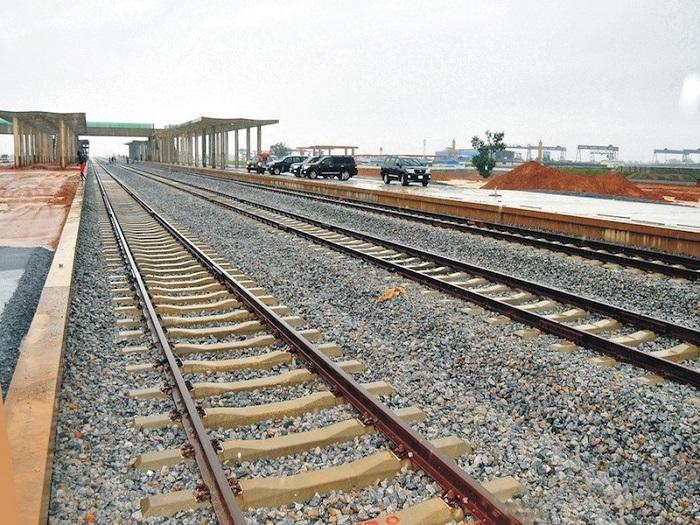
File image
By Godwin Oritse
The Federal Government on Wednesday unveiled far-reaching reforms to overhaul Nigeria’s transportation system, pledging to modernise rail infrastructure, deepen intermodal connections and slash the crippling costs of logistics that continue to undermine trade and economic growth.
Speaking at the 2025 Nigeria Transport Sector Summit of the Transport Correspondents Association of Nigeria (TCAN) in Lagos, Minister of Transportation, Senator Said Ahmed Alkali, said President Bola Tinubu’s administration is “deliberately rebuilding the backbone of the economy” to deliver safe, affordable and integrated public transport.
Represented by the Managing Director of the Nigerian Railway Corporation (NRC), Dr. Kayode Opeifa, the minister announced rapid progress on key rail projects, including the Lagos–Kano standard gauge line, the rehabilitated Lagos–Kano narrow gauge corridor, and the Port Harcourt–Maiduguri line, where the Port Harcourt–Aba segment is already operational.
The Kaduna–Kano and Kano–Maradi lines have moved from less than 15 percent completion to over 50 and 60 percent respectively, with the Kano–Maradi track expected to reach Katsina by December 2025 and be completed by March 2027.
Alkali also disclosed Federal Executive Council approval for modern bus terminals in Abeokuta, Onitsha, Warri, Kano, Lokoja and Gombe to tackle chaotic parks and intra-city congestion. He cited training initiatives at the Federal University of Transportation, Daura, and the Nigerian Institute of Transport Technology (NITT), Zaria, where over 6,000 professionals were trained in 2024, as well as 12 new Compressed Natural Gas (CNG) conversion centres to drive cleaner, cheaper transport.
He further announced the long-awaited approval of a National Land Transport Policy, a framework expected to guide long-term development across road, rail and urban transit after decades of policy vacuum.
Also addressing the summit, Minister of Marine and Blue Economy, Mr. Adegboyega Oyetola, declared that the government is making intermodal transport the centrepiece of national logistics reforms.
He pointed to the operational Lagos–Ibadan standard gauge rail now evacuating containers directly from Apapa Port, the rapid expansion of barge services from Lagos and Onne ports, the reconstructed Apapa–Oshodi Expressway, the newly commissioned 27-kilometre Lekki Port Access Road, and new dry ports in Ibadan, Kaduna, Kano and Funtua as evidence of progress.
Oyetola unveiled a new National Policy on Marine and Blue Economy to cut logistics costs, attract private capital and align Nigeria with global trends in smart, green transport. “Every container moved seamlessly from port to the hinterland represents not just efficiency gained but a job created and revenue enhanced,” he said.
Earlier in his welcome remarks, TCAN Chairman, Mr. Tola Adenubi, warned that Nigeria’s transport sector remains dangerously unbalanced, with over-reliance on road haulage leaving highways in disrepair and citizens at risk.
He cited the “daily menace” of falling containers, persistent boat mishaps on inland waterways, and chronic neglect of barge operations despite their potential to relieve road congestion and lower costs.
“At 65, Nigeria is yet to have an acceptable protocol to guide the entire transport system,” Adenubi lamented, urging government to enforce the 2023 Inland Waterways Transportation Code and invest in safer alternatives across rail and water.
Closing the session in his own capacity, Dr. Kayode Opeifa delivered a stark economic warning, revealing that the logistics sector contributed only 3.73 percent of GDP in 2024, with rail and maritime combined accounting for less than 0.33 percent despite Nigeria’s strategic location and 223-million population.
“Transportation inefficiencies directly
into economic losses,” he said, noting that over 80 percent of freight still moves by road even though less than 20 percent of the network is in good conditions
Opeifa argued that aggressive freight-rail expansion, private sector participation and revival of inland waterways could cut logistics costs by up to 40 percent, unlock the job-creating potential of the African Continental Free Trade Area (AfCFTA) and stimulate industries from vehicle assembly to steel production.
“The story of Nigeria’s future will not be written only in oil rigs and refineries,” he said. “It will be written on the shoulders of the rails, ports and roads we build and in the prosperity we create when transportation finally works.”
Disclaimer
Comments expressed here do not reflect the opinions of Vanguard newspapers or any employee thereof.