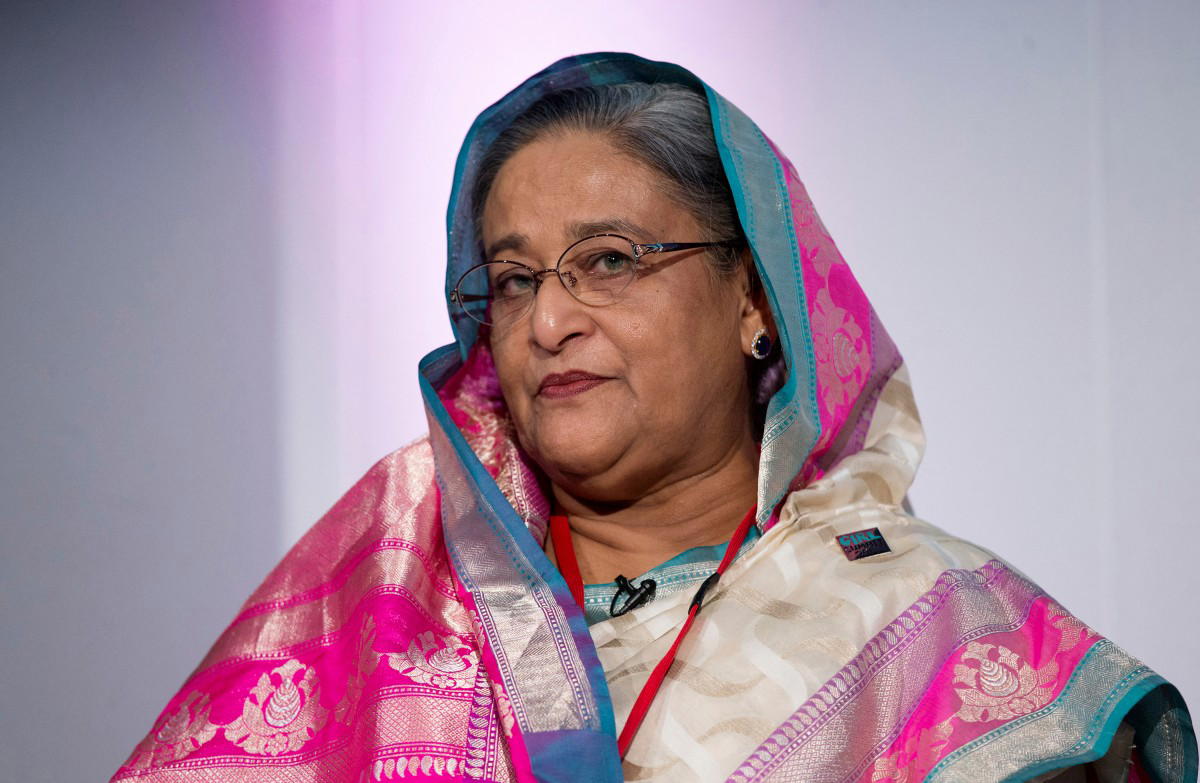
(FILES) Bangladeshi Prime Minister Sheikh Hasina Wajed, speaks at the ‘Girl Summit 2014’ in Walworth Academy on July 22, 2014 in London, England. Britain and the UN’s children’s agency hosted the first ever “Girl Summit” to mobilise international efforts to end female genital mutilation and child marriage, practices that affect millions of girls around the world. A Bangladesh court on November 17 sentenced ousted prime minister Sheikh Hasina to death for crimes against humanity, with cheers breaking out in the packed court as the judge read out the verdict. Hasina, 78, defied court orders that she return from India to attend her trial about whether she ordered a deadly crackdown against a student-led uprising that ousted her. (Photo by Oli SCARFF / POOL / AFP)
The UN said Monday that former Bangladesh prime minister Sheikh Hasina’s sentencing for crimes against humanity marked “an important moment for victims”, but she should not have been sentenced to death.
Hasina, 78, remained in hiding in India during the trial on charges that she ordered a bloody crackdown against a student-led uprising last year that eventually ousted her.
She was sentenced in absentia to be hanged for crimes against humanity over the crackdown, in which up to 1,400 people were killed between July and August 2024, according to the United Nations.
The UN rights office, which determined in a report in February that Bangladesh’s former government was behind systematic attacks and killings of protesters that possibly amounted to crimes against humanity, welcomed that verdicts had been reached.
Since publishing the report, “we have been calling for perpetrators -– including individuals in positions of command and leadership -– to be held accountable in accordance with international standards”, rights office spokeswoman Ravina Shamdasani said in a statement.
“We have also called for victims to have access to effective remedies and reparation,” she added.
However, she stressed that the office had also “consistently advocated for all accountability proceedings -– especially on charges of international crimes -– to unquestionably meet international standards of due process and fair trial”.
“This is particularly vital when, as was the case here, the trials have been conducted in absentia and led to a capital punishment sentence.”
“We … regret the imposition of the death penalty, which we oppose in all circumstances.” the spokeswoman added.
Shamdasani highlighted that UN rights chief Volker Turk was hoping that “Bangladesh will move forward with a comprehensive process of truth-telling, reparation and justice as the pathway to national reconciliation and healing.”
“This should include meaningful and transformative security sector reform, which respects international standards, to ensure that these violations and abuses are never repeated.”
The rights office, she said, was ready to help Bangladesh. In the meantime, Turk was calling for “calm and for all to exercise restraint” in response to the verdicts, she added.
AFP
Disclaimer
Comments expressed here do not reflect the opinions of Vanguard newspapers or any employee thereof.