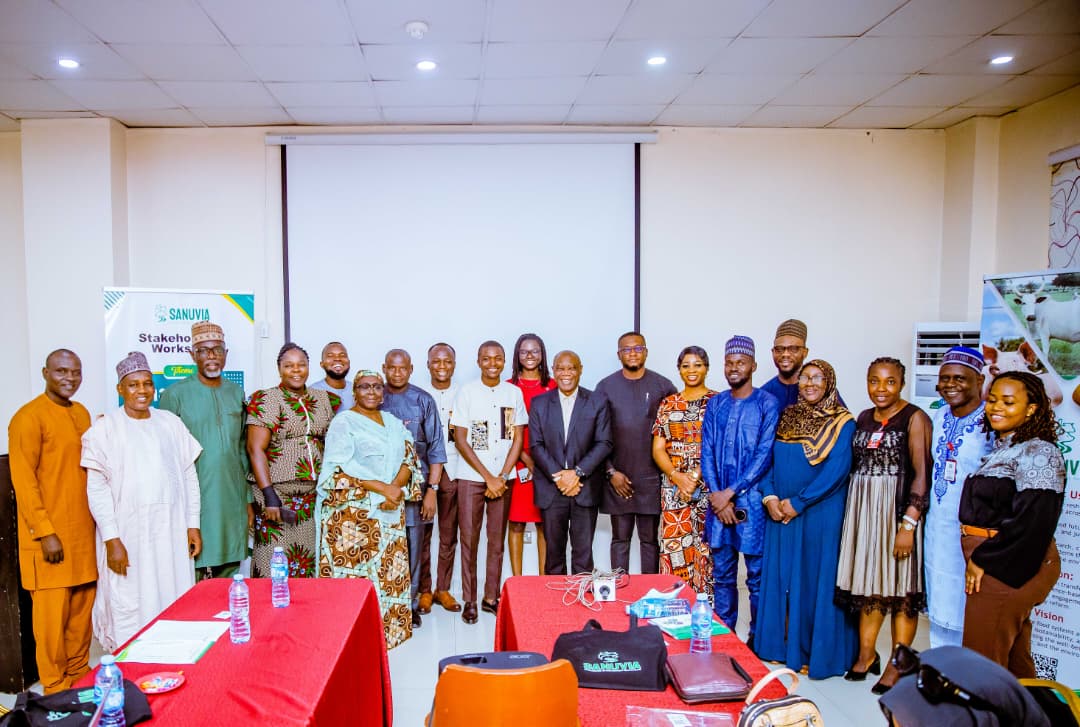
.as stakeholders move to safeguard lives of Nigerians
By Gabriel Ewepu
ABUJA – IN a bid to safeguard the lives of Nigerians, a livestock initiative called Sanuvia Project, Thursday, called on relevant stakeholders in both public and private organisations to synergize and urgently regulate developments in the Nigerian livestock industry.
The call was made at the Sanuvia Project Team’s one-day Multi-Stakeholders workshop titled ‘Charting a Sustainable Path: Enhancing Nigeria’s Livestock Regulations in Response to Industrial Livestock
Farming’, where serious issues affecting the health of Nigerians were pointed out, which many are infected and killed by zoonotic diseases by consuming contaminated animals including chickens.
The workshop was to strengthen regulatory frameworks in Nigeria’s livestock sector to address environmental, public health, animal welfare, and socioeconomic implications of industrial livestock sector in order to promote more just, sustainable and compassionate food system.
Basically, the organiser of the workshop, Sanuvia Project, expressed deep concerns of livestock expansion with the current reality of poor implementation of policies by relevant government agencies, especially, in the agricultural, livestock, health, water and sanitation, and environmental sectors.
The Sanuvia’s co-founders, Isaac Fasipe, and Daniel Ayinde, speaking on the sidelines of the workshop, argued that while modernization can yield growth, poorly regulated expansion introduces serious risks in terms of animal welfare, public health, environmental impact, economic equity, governance and regulations.
According to them, experiences from global operations by major players in the industrial farming sector have been marked by controversies in different areas underscore what can go wrong when rapid industrial
growth outpaces regulation.
They said public health concerns include increased risks of zoonotic disease transmission and the development of antimicrobial resistance (AMR) due to routine antibiotic use in crowded facilities.
Environmental degradation manifests through methane emissions contributing to climate change, as well as water and air pollution from concentrated animal
waste. Animal welfare issues arise from the dense confinement of animals in indoor facilities and
inadequate handling practices during transportation and slaughter.
Additionally, socioeconomic
impacts often include the displacement or marginalization of smallholder farmers who struggle
to compete with large-scale industrial operations.
Understanding these interconnected risks is essential as countries, including Nigeria, consider pathways toward livestock sector modernization.
These risks justify urgent stakeholder engagement and stronger regulation. Nigeria must ensure that modernization strengthens rather than undermines food security, health, and sustainability.
By learning from the impact of large scale industrial farming in other climes, Nigeria has an
opportunity to avoid replicating harmful industrial models and instead build a framework that
protects people, animals, and the environment.
Ayinde said, “We all know that the livestock industry in Nigeria, for example, is kind of expanding, which is very evident in the attempt or the new development of the Ministry of Livestock Development, so we observed that this expansion, why it comes, it’s promises like job employment and improvement of livelihood.
“However, we are concerned about the risk that is posed as a result of this expansion – public health, environmental degradation, and antimicrobial resistance.”
However, he expressed optimism and assured that Sanuvia “will do a proper follow-up to ensure that we don’t just end here or just discuss and leave. We will also follow-up to ensure that it results to an action. We are very positive about it.”
An official from the Department of Quality Assurance and Certification, Federal Ministry of Livestock Development, Dr Iliya Yohanna, said, “The Ministry of Livestock Development will do something on sensitization because animal welfare look like something that is new to many. Even the farmer, they don’t know much about it.
“The greatest thing that we will do now is, when we start this work and when we reach certain level, sensitization has to be strengthened so that everybody will know that animal welfare is important.”
Meanwhile, speaking on expansion in the livestock industry, the Co-Founder, Sanuvia, Isaac Fasipe, asserted that big players are to be adequately regulated in order to safeguard the lives of Nigerians.
“We don’t ask them not to operate, they should operate but they should do the right thing so that the government can also benefit from this because when the government ensures that they prioritize the one health concept or one health aspect, the government will also generate revenue because in terms of creating jobs, generating revenue, the smallholder farmers will also benefit from this because they won’t be exploited. So we just want the government to have different guidelines and framework for this”, he added.
Meanwhile, stakeholders resolved to work together and forge a common front to strengthen existing frameworks in the livestock sector for the best interest of the health and lives of Nigerians.
Disclaimer
Comments expressed here do not reflect the opinions of Vanguard newspapers or any employee thereof.