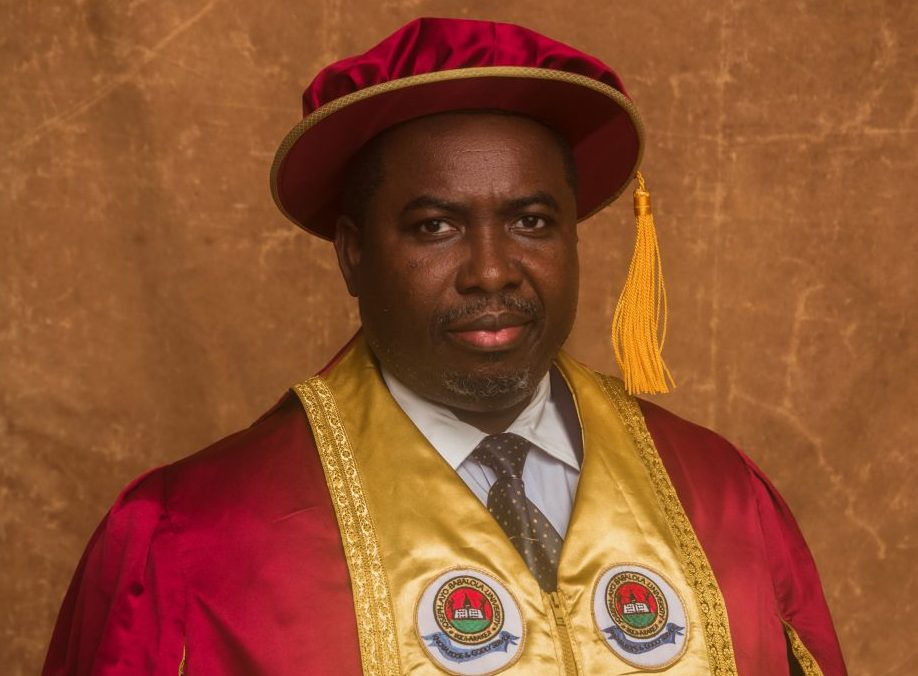
Amupitan
By Okon N. Efut
The acronym SAN means Senior Advocate of Nigeria, an award reserved for distinguished members of the legal profession in Nigeria, who, by dint of hard work, loyalty, ability, and integrity, have contributed to the development of law and legal practice in Nigeria. It is the Nigerian equivalent of the King’s Counsel (KC) in the UK. The Independent National Electoral Commission (INEC) is a creation of the Nigerian Constitution (1999) as amended. It is listed in the Third Schedule (Part 1) to the Constitution of the Federal Republic of Nigeria,1999 (as amended), as one of the Federal Executive Bodies established by section 153 of the Constitution.
Section 153 of the Constitution provides: “There shall be established for the Federation, the following bodies, namely: a. Code of Conduct Bureau; b. Council of State; c. Federal Character Commission
d. Federal Civil Service Commission; e. Federal Judicial Service Commission; f. Independent National Electoral Commission; g. National Defence Council; h. National Economic Council; i. National Judicial Council; j. National Population Commission; k. National Security Council; 1. Nigeria Police Council; m. Police Service Commission; n. Revenue Mobilization, Allocation and Fiscal Commission”. Section 154(1) of the Constitution provides -”except in the case of ex officio members or where other provisions are made in the constitution, the chairman and members of any of the bodies so established shall, subject to the provisions of the constitution, be appointed by the President and the appointment shall be subject to confirmation by the Senate.”
Section 154(3) provides “In exercising his power to appoint a person as chairman or member of the Independent National Electoral Commission,National Judicial Council, the Federal Judicial Service Commission or the National Population Commission, the president shall consult the Council of State. “
The constitutional provision guiding and regulating the appointment of the Chairman and members of the Independent National Electoral Commission should leave no one in doubt that the drafters of the constitution intend the process to be cumbersome and constrictive. A process that requires the confirmation of no less than the Nigerian Senate (the Legislature), and the consultation of an Elite body, such as Nigeria’s Council of State, is deliberately programmed to produce a competent man or woman of integrity. However, in spite of the constitutional safeguard to ensure that a square peg is put in a square hole, our recent past electoral experience does not show that the intended purpose has been realized. The president’s appointees to that high and exalted office have not been able to deliver on the noble intendment of the Nigerian Constitution and the high expectations of the Nigerian people. INEC has been fumbling and faltering with each change of leadership and each circle of electoral exercise, except between 1988 and 1993, during Prof. Humphrey Nwosu’s interlude.
Our recent experience has shown that in the appointment of the INEC Chairman, the President will always have his way, and would simply seek the confirmation of his choice by the Senate and the consultation with the Council of State as a mere formality. We have not had any instance where the president’s choice of the INEC chairman encountered any opposition or objection from either the Senate or the Council of State. This implies that the President’s choice is always right and goes without blemish or reproach. This presumed infallibility of the President’s choice cannot continue to be the case because our electoral process has not witnessed any marked improvement, in spite of the several changes we have had in the leadership of INEC. One is left to wonder whether the constitutional requirement of subjecting the appointment of an INEC Chairman to the Senate, in consultation with the Council of State, is of any practical utilitarian value. It is therefore recommended that Section 154(1), (3) of the 1999 constitution be deleted, to squarely place the burden of appointing the chairman and other members of INEC and other federal executive bodies wholly in the hands of the president, since the constitutional safeguards have failed to yield the intended purpose of checks and balances. It is equally worthy of consideration for the Nigerian constitution to be amended to vest the power to appoint the INEC Chairman in the Chief Justice of Nigeria, as a separate branch of government.
The original intent and spirit of the makers of the Constitution, which, in principle, was to guarantee checks and balances in the appointment to those sensitive federal executive bodies, appears to now exist only notionally in the statute book. In practical terms, the office of the President has been made to become too powerful and potentially dictatorial. Yet, this seems to rear its ugly head as one of those unintended consequences of our constitutional dictatorship-a dictatorship permitted indirectly by the constitution itself. How can the constitution empower the President to make such critical appointments into sensitive and strategic executive offices, only to subject those appointments to the confirmation of a single chamber of the legislature and merely consultation with an advisory Council of State? The two constitutional requirements of confirmation by the Senate and consultation with the Council of State cannot effectively check the overwhelming executive powers conferred on the President by the 1999 Constitution of the Federal Republic of Nigeria (as amended).
However, coming back to “SANitizing INEC”, there seems to be a novel feature, a pleasant and renewed hope in the current choice of Mr. President. For the first time in the history of INEC, a Senior Advocate of Nigeria (SAN) has been appointed and confirmed by the Senate as the Chairman of the Independent National Electoral Commission. As a SAN, there is a presumption (though rebuttable) that he is an accomplished legal practitioner and man of proven integrity, having been so adjudged by the LLPC (Legal Practitioners Privileges Committee)- a body of eminent jurists, lawyers and patriots in Nigeria charged with the responsibility of scrutinizing and conferring the rank of Senior Advocate of Nigeria on deserving members of the legal profession.
The new Chairman of the INEC (Prof. Joash Amupitan) comes in, riding on the shaky foundation laid and built upon by a coterie of some eminent and accomplished Nigerians who had gone down this slippery and bumpy slope before him:
1. Eyo Esua (1964-1966) (FEDECO)- A Teacher
2. Michael Ani (1976-1979) (FEC)- A Civil Servant
3. Victor Ovie-whiskey (1980-1983) (FEDECO)- A retired Judge
4. Prof. Eme Awa (1987-1989) (NECON)- Prof. of Political Science
5. Humphrey Nwosu (1989-1993) (NECON)- Prof. Political Science
6. Okon Uya (June 1993-Nov 1993) (NECON)- Prof. of History
7. Summer Dagogo-Jack (1994-1998) (NECON)- Public Administrator
8. Ephraim Akpata (1998-2000) (INEC)-Rtd. Justice of the Supreme Court
9. Abel Guobadia (2000-2005) (INEC)- Ambassador
10. Maurice Iwu (2005-2010) (INEC)- Prof. of Pharmacognosy
11. Attahiru Jega (2010-2015) (INEC)- Vice Chancellor
12. Mahmood Yakubu (2015-2025) (INEC)- Prof. of Political Science
From the array of former holders of this exalted office, we cannot but agree that they were carefully chosen from credible and formidable backgrounds, and that each of them possessed the requisite professional acumen and institutional pedigree to deliver on the job. Yet, the predominant view has remained that, except for Prof. Humphrey Nwosu, each of them failed the nation woefully.
It is now the turn of Prof. Joash Amupitan, learned and eminent Senior Advocate of Nigeria, Professor of Law, and distinguished academic, to demonstrate beyond every reasonable doubt that his lofty accolades and laurels are not a mere fluke. He belongs to the highest rank in the noble profession and has attained the peak of academic accomplishment in the university system. If he fails, we must not blame Mr. President or his government. We should equally exonerate the Nigerian Senate (the Legislature) and the Council of State from any blame. We would then be left with no option but to fault the legal profession, the academia, and the Nigerian system that incessantly builds up and throws up such personalities of proven accomplishment for a task which ultimately remains undone-the conduct of a free, fair, and credible election in Nigeria.
May we, as a country, not be condemned, yet again, to witness another failed experiment in entrusting a sensitive national responsibility to someone with a proven track record of accomplishment who ends up disappointing. Let the Professor of Law not only profess and parade his enviable academic and professional credentials but also do more to protect the dignity of the legal profession and the integrity of his own person. Delivering a fair and credible election for hope-starved Nigerians and Nigeria is a task that must be done. The time to do it is now, with a SAN at the helm of affairs. Only then shall we applaud the wisdom and courage of Mr. President for SANitizing INEC and indeed the Nigerian electoral process.
Okon N. Efut, SAN, writes from Abuja
Disclaimer
Comments expressed here do not reflect the opinions of Vanguard newspapers or any employee thereof.