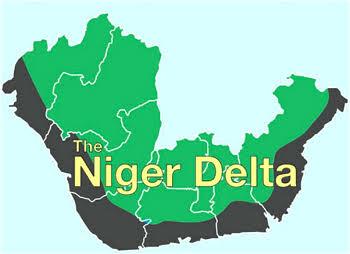
Delta State map
Emma Ujah, Abuja Bureau Chief
The Foundation for Partnership Initiatives in the Niger Delta (PIND) has unveiled a data-driven crisis preparedness framework that leverages Artificial Intelligence (AI) to predict, prevent, and respond to conflicts and environmental shocks in the oil-producing region.
The new initiative was launched during a three-day Niger Delta Scenario Planning Workshop on Resilience in Port Harcourt, Rivers State, according to a PIND statement sent to media organisations today.
It represented a strategic shift from crisis response to anticipatory governance with emphasis on foresight, collaboration, and innovation as tools for stability and inclusive growth.
The workshop, themed “From Risk to Resilience: Building a Future-Ready Niger Delta,” was convened in partnership with the Deutsche Gesellschaft für Internationale Zusammenarbeit (GIZ) GmbH, the Office for Strategic Preparedness and Resilience (OSPRE), and The Fund for Peace (FFP), with support from the ECOWAS Peace, Security and Governance (EPSG) Project, co-financed by the European Union (EU) and the German Federal Ministry for Economic Cooperation and Development (BMZ).
Addressing partipants, Dr. David Udofia, who represented PIND’s Executive Director, Mr. Sam Ogbemi Daibo, said the deployment of AI for resilience planning marked a critical milestone for the Niger Delta’s sustainable development agenda.
He said: “The Niger Delta’s future depends on our ability to anticipate challenges rather than merely react to them.
“This workshop demonstrates how data, foresight, and partnerships can transform uncertainty into opportunity and ensure that resilience becomes a shared responsibility across communities, institutions, and sectors.”
He said for his organisation, the initiative underscored how technology, partnerships, and foresight could enhance resilience in the Niger Delta’s socio-economic landscape, positioning the region as a testbed for data-driven peacebuilding in West Africa.
His words, “As Nigeria and West Africa face rising climate and security risks, innovation offers the pathway to transform risk into resilience”.
Also speaking, Nate Haken, Senior Advisor for Research and Innovation at the Fund for Peace said the initiative integrated technology with governance to build a stronger regional peace architecture.
He said, “By linking data to decision-making, we are laying the foundation for a resilient Niger Delta and a safer West Africa.
“This model shows how collaboration among government, academia, and civil society can drive long-term peace and stability.”
Participants, drawn from NEMA, SEMA, NiMet, HYPREP, the Nigeria Police Force, NSCDC, and state ministries of environment and agriculture, engaged in AI-assisted scenario building and “red teaming” sessions to identify policy gaps and co-create adaptive resilience strategies.
The workshop produced a Niger Delta Resilience Strategy, a Scenario Planning Report, and a replicable methodology that could be integrated into state-level emergency management systems and the Partners for Peace (P4P) Network.
Stakeholders 9from the public and private sectors, academia, civil society, and the media participated in the exercise, which introduced AI-powered tools such as the Fragile States Index (FSI), State Resilience Index (SRI), and Crisis Sensitivity Simulator (CSS) advanced systems designed by FFP and SAS to forecast risks and strengthen institutional response capacities.
Disclaimer
Comments expressed here do not reflect the opinions of Vanguard newspapers or any employee thereof.