By Ebunoluwa Sessou
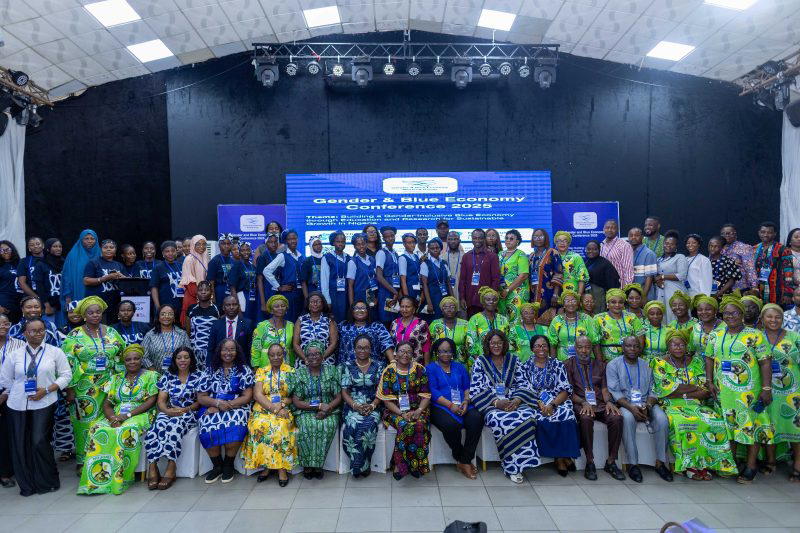
Policymakers, industry leaders, academics, and coastal community representatives gathered at NECA House, Ikeja, Lagos, on Thursday November 20, for the 2025 Gender and Blue Economy Conference, organized by the Center for Gender Economy Working Group, with the theme, “Building a Gender-Inclusive Blue Economy Through Education and Research for Sustainable Growth in Nigeria,” to spotlight the pivotal role of women and girls in shaping the country’s maritime and aquatic economy.
The event drew attention to coastal communities, particularly adolescent girls, whose engagement and training in maritime skills, aquaculture, and ocean entrepreneurship remain central to bridging gender gaps.
The 2025 Gender and Blue Economy Conference highlighted Nigeria’s resolve to build a sustainable, inclusive, and innovative blue economy, where women and men alike can thrive, innovate, and lead.
In her speech, the Permanent Secretary to the Lagos State Government, Barr Bimbola Salu-Hundeyin, FCMC, represented by Mrs. Toyin Ogunlana, emphasized Lagos State Government’s commitment to gender inclusion.
According to her, “Gender inclusion is a fundamental principle integrated into all our initiatives. Under the visionary leadership of our HeForShe Governor, every Lagosian, regardless of gender, can fully participate in the state’s development.”
She highlighted efforts to empower women through vocational training, digital skills, and education for the girl child. Lagos State has achieved a 50-50 balance of permanent secretaries, including women with disabilities, and women are increasingly assuming leadership roles across public service and enterprise.
“Education and leadership for a gender-inclusive blue economy must be intentional. Women must be equipped with knowledge and confidence to break barriers in maritime engineering, oceanography, policy-making, and other traditionally male-dominated fields, ” she said.
She cited initiatives like Leave No One Behind and Charity Begins at Home, which empower women to create business opportunities from waste and climate-related ventures.
In her message, President of the World Aquaculture Society, African Chapter, and President-Elect of WAS, Dr. Foluke Areola, highlighted global best practices in sustainable aquaculture, emphasizing youth, women, and marginalized communities’ participation. She lauded CGE Africa for its advocacy, research, and capacity-building efforts in promoting gender equality in Africa’s blue economy.
“The World Aquaculture Society WAS, is dedicated to advancing the field. It aims to promote sustainable, environmentally responsible, and economically viable aquaculture practices worldwide, supporting food security, social equity, and the conservation of aquatic resources.
“Our ongoing goal is to promote sustainability and inclusivity by supporting environmentally responsible aquaculture that protects ecosystems and biodiversity.
“We aim to empower youth, women, and marginalized communities to participate in and benefit from aquatic food systems. We encourage science and innovation through research, technology transfer, and education to enhance aquaculture practices and results.
Earlier in her address, Executive Director of Centre for Gender Economics for Africa, CGE Africa, Ms. Uchenna Idoko, underscored the urgency of integrating gender equality into Nigeria’s blue economy. She said the blue economy cannot thrive without women’s knowledge, leadership, and labour.
“If we do not intentionally centre gender equality in this emerging economic frontier, we risk building yet another economy that leaves half the population behind,” she said, emphasizing the transformative power of education, research, and leadership in creating an inclusive future.
“The Blue Economy is not just an economic secto but a promise to protect our waters, empower our girls, elevate our women, and create a Nigeria where every child who grows up by the ocean can see possibility on the horizon”, she said.
Speaking on the book that was launched at the conference, ‘Girls by the Shore’, A girl’s guide to the blue economy, Idoko noted that the opportunities in the blue economy is enough for girls in the coastal areas to take their place in the seat of power.
“We are hoping to engage more girls and boys and create a blue club aimed at engaging coastal secondary school students in the blue economy:
“Students from coastal communities already have skills from living around the ocean. With training and education, they can become maritime engineers, sailors, divers, or entrepreneurs, breaking cycles of poverty.”
“Through initiatives like Blue Clubs and vocational mentorship, young people are being equipped to turn informal ocean skills into certified, income-generating opportunities.
In her goodwill message, Okele representing Nigerian Maritime Administration and Safety Agency (NIMASA), reaffirmed the organization’s commitment to gender-responsive policies, capacity-building, and empowering women to take on leadership roles across the maritime sector.
“We remain committed to promoting gender-responsive policies, empowering our women to take up more leadership positions, strengthening capacity-building initiatives, and fostering a safer, more inclusive maritime environment. This conference is timely, and we believe that its outcomes will contribute meaningfully towards shaping a more equitable and prosperous blue economy for the Nation”, she said.
One of the students, Amao Hannah, from Tomaro Senior Secondary School, shared her aspirations: “My understanding of the blue economy has shown me that making money is not only from petroleum. I want to focus my studies on maritime and other opportunities in this sector.”
Disclaimer
Comments expressed here do not reflect the opinions of Vanguard newspapers or any employee thereof.