By Marie-Therese Nanlong
Jos – Stakeholders in Plateau State have raised fresh concerns over the rising cases of Sexual and Gender-Based Violence, SGBV, and the persistent culture of silence that prevents survivors from reporting violations or seeking justice.
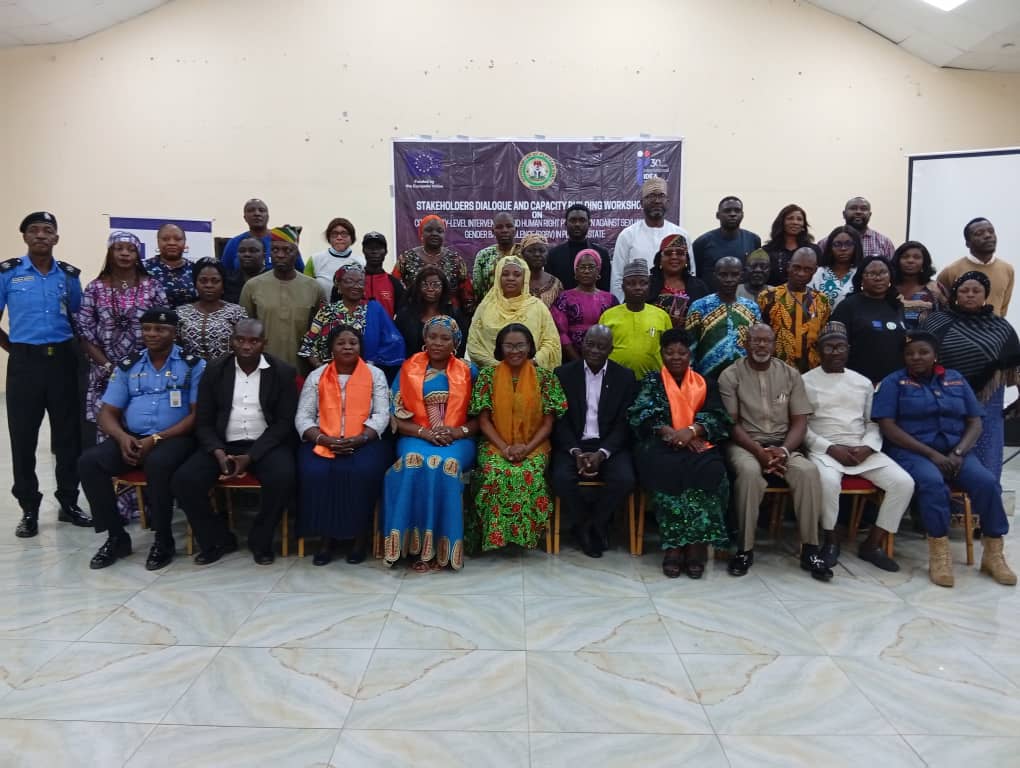
The discussions took place on Thursday at the Stakeholders Dialogue and Capacity-Building Workshop on Community-Level Intervention and Human Rights Protection Against Sexual and Gender-Based Violence in Plateau State.
The event was organised by the National Human Rights Commission (NHRC) in collaboration with the Plateau State Ministry of Women Affairs and Social Development and the State Ministry of Health, with support from the Rule of Law and Anti-Corruption (RoLAC) Programme, implemented by International IDEA and funded by the European Union.
A key highlight of the workshop was a paper presented by the Plateau State Coordinator of NHRC, Kiyenpiya Mafuyai, titled “The Intersection of Human Rights and Gender-Based Violence in Plateau: A Call for Community-Level Complaints and Referral Systems.”
Mafuyai stressed that SGBV in Plateau State cannot be addressed effectively without grassroots structures that allow survivors to report safely.
She emphasised the need for community complaint mechanisms and survivor-centred referral systems linking victims to healthcare, psychosocial support, legal aid, and justice institutions.
Her words, “From January 2025 to October, 2025, the Commission recorded 97 cases of domestic violence, 17 rape cases, 12 cases of harmful widowhood practices, one case of forced marriage, 45 cases of denial of female inheritance, three cases of spousal eviction, and one case of emotional abuse.”
On child’s rights, she disclosed 661 cases involving children defilement and molestation, child abandonment, child abuse, denial of access, custody, paternity and identity were recorded, and majority of the reports came from Jos, the State capital.
According to her, most cases remain buried because communities lack functional channels for reporting and responding to violations.
During the strategy session, participants assessed major challenges hindering justice for SGBV survivors, and identified widespread ignorance about the existence of justice institutions such as the Family Court, NHRC, and Legal Aid Council, high levels of illiteracy, conspiracy of silence, inadequate training for SGBV desk officers, intimidation of survivors, and slow prosecution processes.
They also raised concerns about broader human rights violations, including denial of female inheritance, which reinforce gender inequality.
The participants further identified a deeply rooted culture of silence as a major barrier saying, many victims are pressured by family or community members not to speak out, while others fear retaliation.
They recommended capacity building for frontline actors, awareness campaigns in rural communities, monitoring of reporting channels, and the creation of school-based champion clubs to help inculcate values of equality and respect at an early age.
In her goodwill message, the Commissioner for Education, Kachollom Gang expressed concern about increasing cases of student molestation and child abuse in schools, and highlighted cultural barriers, especially parents who hide molestation out of fear of marital repercussions or social shame.
She urged mothers to speak out, protect their children, and reject the culture of silence.
The Commissioner for Information and Communication, Joyce Ramnap reaffirmed her Ministry’s commitment to combating molestation across the State, noting that public enlightenment remains a key priority.
She pointed to a public enlightenment unit within the Ministry that simplifies informative messages and broadcasts them, recommending its use for sustained rural sensitisation, and pledged stronger collaboration with the NHRC to enhance justice and protection for women and girls.
Similarly, the Commissioner for Women Affairs, and Social Development, Caroline Dafur, represented by her Permanent Secretary, Rebecca Shase-et emphasised the need for inter-sectoral collaboration in addressing SGBV.
She also identified fear of stigmatisation as a major obstacle and called for mechanisms to support survivors and reduce stigma.
A representative of the Attorney General and Commissioner for Justice expressed concern over the low reporting of SGBV cases despite the government’s willingness to prosecute perpetrators, and stressed that victims must report violations for the law to take its full course.
In his remarks, the RoLAC State Coordinator, Mantim Dala called for stricter bail conditions for SGBV offenders, describing the offence as abhorrent and requiring strong deterrence.
He pointed out that accountability also involves justice, calling for the use of the lawyer to punish perpetrators of SGBV.
Dala noted that RoLAC is promoting access to justice for vulnerable people, and stressed, the organisation is helping to strengthen models that have worked elsewhere using the law.
Across presentations, stakeholders unanimously recommended improved awareness at the community level, targeted training for SGBV desk officers, protection of survivors’ identities, elimination of harmful cultural practices, economic empowerment for women and girls, creation of psychosocial support centres, and stronger, more effective prosecution of offenders.
They stressed that meaningful change will only occur when communities embrace reporting, reject silence, and support survivors through accessible and responsive justice systems.
Disclaimer
Comments expressed here do not reflect the opinions of Vanguard newspapers or any employee thereof.