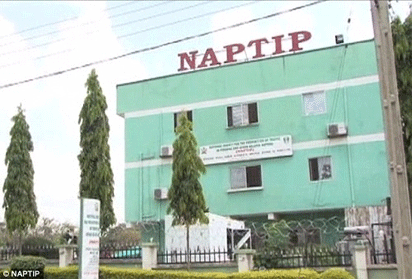
File: NAPTIP
The International Centre for Migration Policy Development (ICMPD) and partners launched a teacher-training initiative on anti-human trafficking advocacy on Tuesday in Edo to curb trafficking through classroom instruction.
The workshop, part of the broader rollout of Trafficking in Persons (TIP) content infused into the revised Basic Education Curriculum, brought together 150 teachers from across Edo.
The teachers were selected from 50 schools participating in the ICMPD’s School Anti-Trafficking Education and Advocacy Project (STEAP).
The STEAP is being funded by the Government of the Netherlands in partnership with the National Agency for the Prohibition of Trafficking in Persons (NAPTIP) and the Edo Ministry of Education.
In her address, Mrs Fatima Adamu, Director-General, NAPTIP, described the training as another milestone in the collective journey to safeguard children’s future.
Adamu, who was represented by her Special Adviser, Hassan Tahir, said the teachers’ training would strengthen the national response to human trafficking through education.
She noted that “children account for more than 55 per cent of identified victims of trafficking in the world.
These, she said, were school-aged boys and girls who, instead of being safe in their learning environments, are targeted, exploited and abused by traffickers.
She explained that Nigeria’s journey toward integrating anti-trafficking content into the curriculum began over a decade ago, culminating in the 2017 partnership with the Nigerian Educational Research and Development Council (NERDC).
“By mainstreaming TIP concepts into selected subjects in both primary and secondary schools, we aim to catch them young and empower them early,” she said.
The NAPTIP DG emphasised that the newly revised curriculum now demanded well-trained teachers who could deliver these lessons accurately and sensitively.
Adamu praised the Government of the Netherlands, ICMPD and NERDC, highlighting their “invaluable support” and describing the teachers as front-liners in prevention.
“I encourage you to approach this training as more than a workshop. It is an opportunity to acquire life-saving knowledge.
“Children who are victims or at risk of trafficking often show signs that a trained eye can detect.
“Apply trauma-informed teaching approaches, create safe spaces for your learners,” she said.
In his keynote address, Dr Paddy Iyamu, the Commissioner for Education, reinforced the state government’s commitment to prevention through education.
Iyamu, who was represented by Mrs Mercy Isibor, Desk Officer for STEAP in the ministry, stressed that the training aligned strongly with the administration’s human security priorities.
“This training is not just another workshop. It is a strategic investment in the human infrastructure that supports our fight against Trafficking in Persons,” he said.
The commissioner recalled Edo’s painful history with human trafficking, noting that although progress had been made, the state must continue to consolidate its gains.
“Every child in Edo State must learn in a safe environment, be equipped with accurate knowledge about trafficking, and be empowered to make informed and protective choices,” he stated.
Iyamu underscored the importance of the STEAP initiative as a structured, evidence-based intervention that offers age-appropriate, context-sensitive learning on trafficking dynamics.
“As the frontline custodians of the classroom, you are not only educators; you are protectors, advocates, and influencers,” he said.
Earlier, Ms Isabelle Wolfsgruber, Head of Office, Nigeria of the ICMPD, described human trafficking as “one of the most pressing challenges facing children and young people in Nigeria.
Wolfsgruber, who was represented by Favour Simeon, STEAP Project Officer in Abuja, added that “over 75 per cent of trafficking victims in West Africa are children.”
She noted that the STEAP project was leveraging schools as powerful prevention platforms, equipping children, teachers, and communities with the knowledge needed to recognise risks and stay safe.
She highlighted the significance of the curriculum’s approval earlier in 2025 as a “major turning point” in national prevention efforts.
“However, even the best curriculum can only succeed when delivered by confident and well-prepared teachers,” she stressed.
She emphasised that the two-day workshop would equip teachers with practical skills to deliver trafficking content effectively while fostering safe classroom environments.
Disclaimer
Comments expressed here do not reflect the opinions of Vanguard newspapers or any employee thereof.