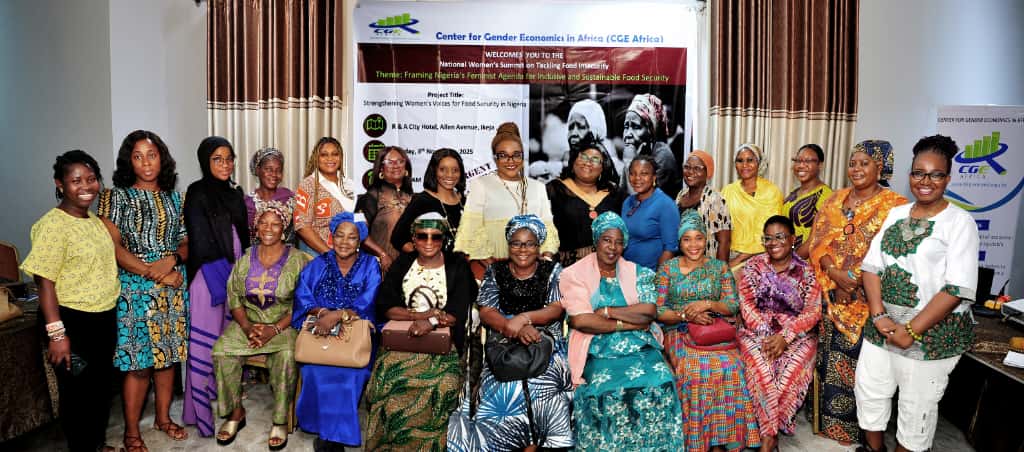
…. As CGE Africa pushes feminist food agenda
By Ebunoluwa Sessou
“When women eat last and least, families and nations suffer most.” This was discourse at the just concluded National Women’s Summit on Tackling Food Insecurity organised by the Centre for Gender Economics in Africa, CGE Africa.
The discourse was pushed forward to trigger conversation around hunger, agriculture, and inclusive growth while calling for the integration of women at every level of Nigeria’s food system from production to policy-making.
With the theme, ‘Framing Nigeria’s Feminist Agenda for Inclusive and Sustainable Food Security’, the summit, which was held under the project “Strengthening Women’s Voices for Food Security in Nigeria,” brought together market women, agricultural innovators, policymakers, and development experts to highlight how gender inequality continues to undermine Nigeria’s food systems and how women, if empowered, can be the game-changers in restoring food sustainability.
“Women feed the nation, yet starve at the table” — CGE Africa
Speaking at the summit, Executive Director of CGE Africa, Uchenna Idoko, underscored the need to recognize women as central to Nigeria’s food security.
“Food is cooked at home, and without it, the household collapses. Women are the heartbeat of food production and consumption, yet they remain at the tail end of the value chain. Men control the cash crops; women are left with perishables and small-scale farming.”
Idoko pointed out that systemic barriers including lack of land ownership, limited access to credit, and exclusion from agricultural policy that prevent women from thriving.
“You cannot plant cocoa or coffee on land you don’t own. Women are locked out because culturally, they don’t control land. Government must change that narrative,” she urged.
She also called for gender-sensitive agricultural policies that target women directly rather than through male-dominated household heads.
“When subsidies or inputs are given to households, they go to men. Distribute them at the individual farmer level, and women will flourish,” Idoko said.
Idoko further decried the social inequality saying that “In most homes, women eat last sometimes the least. They make sure everyone else eats before themselves. Until every woman can eat from her own cooking pot without sacrifice, we haven’t achieved food security.”
Presenting the paper, Programme Manager, Centre for Gender Economics in Africa (CGE Africa, Regina Solomon, disclosed that, as food prices soar and inflation bites harder, women across Nigeria are facing the heaviest toll of the nation’s worsening food insecurity.
The paper titled, ‘The Impact of Food Insecurity on Women in Nigeria: A Gendered Lens on the Food Crisis’, Solomon painted a grim picture of how economic pressures, environmental disasters, and social inequalities have combined to push women further into hunger, poverty, and exclusion.
“Food insecurity in Nigeria is deepening due to economic, environmental, and social pressures,” she said. “Women, who are central to food systems as farmers, caregivers, and entrepreneurs, are disproportionately affected.”
Women bear the brunt of Nigeria’s deepening food crisis
According to her, record-high food inflation has left many women in low-income households skipping meals so that their children can eat. She noted that the rising cost of food has weakened women’s ability to provide diverse and nutritious meals, resulting in increased malnutrition, stress, and health complications for both women and children.
“Women traders are also struggling. Many are making little or no profit due to fluctuating prices and unstable market conditions.”
Climate change, flooding worsen the crisis
Solomon highlighted that unpredictable rainfall patterns and recurrent flooding continue to destroy crops and farmland, disrupting the livelihoods of women farmers.
“Women farmers often lack access to early warning systems, climate information, and post-disaster recovery support. Without savings or access to credit, it becomes almost impossible for them to rebuild after these losses”, she said.
Insecure land rights, limited access to inputs
Only a fraction of Nigerian women own agricultural land, with most relying on male relatives for access which is a system that leaves them vulnerable to displacement and loss of livelihood.
“Women own less than 20 percent of agricultural land in Nigeria Their productivity is further constrained by limited access to quality seeds, fertilizers, financing, and extension services that often exclude them.”
Conflict, displacement aggravate hunger
Beyond economic and environmental challenges, insecurity and armed conflict have compounded the situation. In regions affected by violence, women and girls face hunger, displacement, and gender-based violence.
“Farming and trading have become riskier, especially in conflict-prone zones where markets and transport routes are unsafe or shut down,” she said.
The multiple burdens women carry
From feeding families during food shortages to coping with floods, loss of farmland, and caring for displaced relatives, women bear multiple burdens. Solomon stressed that these challenges have increased unpaid care work and widened gender inequalities.
“Women are at the heart of food systems, yet they are the least supported,” she lamented. “Their voices are missing in the spaces where decisions about food security and national budgeting are made.”
Nigeria needs a feminist agenda for food security
With Nigeria’s population projected to reach 400 million by 2050, experts have called for a transformative, feminist approach to building inclusive and sustainable food systems capable of meeting the country’s growing needs.
In her presentation titled ‘What would a feminist agenda for inclusive and sustainable Food Security in Nigeria Entail’, Specialist, Project and Manager, Lagos Office of ActionAid Nigeria, Vivian Efem-Bassey, quoting the Food Systems Profile–Nigeria (FAO, FARC, EU, 2022), observed that large food deficits remain a cardinal challenge in the country’s food system despite Nigeria’s vast agricultural potential.
She stressed that achieving food self-sufficiency will require more than technological improvements it must include structural transformation, inclusive governance, and the recognition of women as key drivers in the food chain.
“Food self-sufficiency can only be attained not just through production technologies but by entrenching sustainable and inclusive food systems in the very structure, governance, and administration of agriculture,” she said.
Understanding food security
Efem-Bassey recalled the 1996 World Food Summit definition of food security, which exists “when all people, at all times, have physical and economic access to sufficient, safe and nutritious food to meet their dietary needs and preferences for an active and healthy life.”
She emphasized that food security is multidimensional, encompassing three pillars, availability ensuring sufficient quantities and quality of food; access – enabling households and individuals to obtain food and utilization ensuring proper nutrition through a balanced diet, clean water, and adequate sanitation.
A glimpse into Nigeria’s food security landscape
According to Efem-Bassey, 2025 marks a pivotal moment for Nigeria’s efforts toward inclusive and sustainable food security, with government and stakeholders reviewing policies, investing in climate-resilient agriculture, and promoting nutritious food systems.
However, she noted that insecurity, poor fertilizer usage, and policy inconsistency continue to undermine progress. “Women, particularly in rural areas, experience food insecurity at higher rates than men and bear the greatest burden of food scarcity within families,” she explained.
Over 80 percent of Nigerian women work in the informal economy from smallholder farming to petty trade, yet these sectors remain low-income and unstable. As homemakers and caregivers, women often skip meals to feed their families, sacrificing their own nutrition in the process.
Barriers to women’s Inclusion
Efem-Bassey highlighted structural and cultural barriers that prevent women from participating fully in the food system including discriminatory gender norms and a disproportionate burden of unpaid care work; limited access to resources such as land, credit, and technology;weak legal frameworks that fail to protect women’s rights; and restricted mobility and time poverty, which hinder productivity.
She added that without deliberate efforts to address these inequities, policies on food security will continue to exclude the very population most affected by hunger.
“We need storage, not sympathy” — Market women
For Precious Modupe Ojo, the Market Leader at Kosofe, Orisunbare Group of Markets, Mile 12, and the conversation about food security cannot be divorced from the everyday struggles of market women.
According to her, there is a need for storage facility for the food. “There is too much wastage in Nigeria. If the government can build silos and hubs for us to store food, it will save millions of naira lost daily. I remember when I was a little girl, we used to can our food we can still do it today.”
Ojo lamented that most government agricultural programs fail because they rarely reach those who need them most.
“Most times, the ideas are good, but they get to the wrong people. We, the real food handlers, do not feel the impact. The government needs to talk directly to us, not through intermediaries,” she said.
The market leader, however, expressed optimism that Nigeria can overcome its food insecurity if the country begins to look inward. “Our garlic is the best in the world, but we import garlic. The moment we start valuing our own produce, Nigeria will thrive. I have hope that it is going to be better, no doubt.”
Waste-to-Wealth: Turning rot into revenue
Meanwhile, CEO of Ample Eco Limited Dr. Aisha Ime-James, during the summit noted that, the country can do more in the area of transforming food waste into economic opportunity.
She explained that her organization is addressing post-harvest losses by training smallholder farmers in food dehydration and powder processing.
“We preach sustainability by integrating Environment Society ad Governance, ESG principles into food production, through our training, farmers now dehydrate and powderize perishable goods, which reduce spoilage and secure their income.
“With support from the Federal Ministry of Women Affairs and Wema Bank, my team has created dehydration hubs in farming communities. These hubs, managed cooperatively by women, ensure accountability and prevent the misuse of empowerment tools.
“Our model is simple: community-based production hubs. Instead of giving women machines they might later sell, we make them co-owners. They share, maintain, and benefit collectively,” she explained.
Dr. Ime-James emphasized that food waste has hidden economic potential. “There is no end in food, it is a chain. What one person discards, another can use for compost, animal feed, or even biogas. Waste can also be turned into fruit concentrates and natural oils that are exportable. We just need to change our mindset and collaborate,” she added.
Building a feminist agenda for food security
Efem-Bassey however proposed a feminist agenda which is a transformative framework aimed at tackling the structural gender inequalities embedded in Nigeria’s food system.
“A feminist agenda for food security must go beyond integrating women into existing systems; it must challenge the power dynamics that keep them marginalized,” she said.
A feminist path to food sovereignty
At the end of the summit, participants agreed that solving Nigeria’s food insecurity requires a feminist approach which recognizes women’s roles not as mere caretakers but as decision-makers, producers, and entrepreneurs.
The summit’s communique urged government at all levels to build community-based food storage hubs to curb post-harvest losses, provide accessible credit and land rights for women farmers, support cooperatives that ensure accountability and sustainability and encourage waste-to-wealth programs that generate income and protect the environment.
Policy recommendations
To address these challenges, CGE Africa called for urgent gender-responsive policy action, including protection of women’s land and property rights, targeted inclusion of women farmers in climate adaptation and relief programmes, expanded access to affordable food, farm inputs, and credit facilities, inclusion of women in national food security planning and decision-making, and strengthening of nutrition-sensitive social protection for vulnerable women and households.
As Idoko put it, “Food security is not just about ending hunger , it is about giving women the power to decide what grows, how it is shared, and who benefits.”
In her words, Precious Ojo, “We have everything we need in Nigeria. We just need to start listening to the women who feed the nation.”
Solomon concluded that tackling food insecurity through a gender lens is not just about alleviating hunger, but about ensuring equity, inclusion, and sustainable development.
“When women thrive, families eat, communities prosper, and the nation becomes food-secure,” she said.
Disclaimer
Comments expressed here do not reflect the opinions of Vanguard newspapers or any employee thereof.