By Osa Mbonu-Amadi
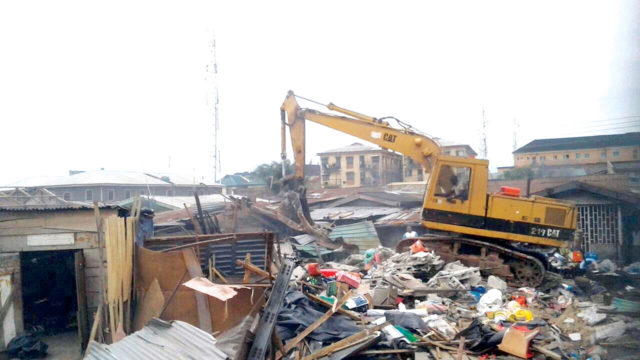
The recent spate of house demolitions across Lagos State, culminating most visibly in Oworonshoki, has stirred intense controversy, opposition, and public alarm. Lagos State Government insists these demolition exercises are imperative components of an urban renewal agenda focused on environmental safety, targeting illegal structures that obstruct waterways and impede drainage systems critical for flood control. However, the unfolding evidence from site visits, resident testimonies, legal tussles, and the pattern of post-demolition land development tell a far more complicated and troubling story.
This article investigates the environmental claims behind the demolitions, the glaring absence of any credible Environmental Impact Assessment (EIA), and the troubling trend toward upscale redevelopment like that seen with the Eko Atlantic project, which together cast serious doubt on the official narrative, suggesting that land grabbing and redevelopment schemes drive the bulldozers rather than genuine environmental concerns.
Lagos State officials frame demolitions as necessary enforcement against unauthorised and unsafe building practices that imperil lives and the environment. The Attorney General and Commissioner for Justice, Lawal Pedro, SAN, assured the public that demolitions focus on structures built without approval, particularly those obstructing waterways or lying on government-acquired land. The government cites ongoing urban renewal and regeneration plans that include clearing canals, riverside spaces, and floodplains to reduce Lagos’s chronic flooding and environmental degradation.
Formal building regulations in Lagos, legally binding developers to acquire building plans approval and conduct Environmental Impact Assessments for sizable projects, are often referenced to justify these demolitions. Consequently, government agencies maintain that structures lacking official consent are illegal and subject to removal, ostensibly to reorder urban spaces for safety and sustainability.
Despite these official claims, multiple investigations and eyewitness accounts of the demolitions tell a grim story of sudden, violent forced evictions frequently conducted at night, with little or no adequate notice, compensation, or resettlement arrangements.
Residents of Oworonshoki report bulldozers accompanied by police teargassing protesters while leveling their homes, even as court injunctions against demolition were reportedly ignored or not formally served to government agencies. Outraged victims describing their homes as lifelong hard-earned investments have been displaced, traumatised, and left homeless, many now living under plastic sheets or church compounds.
The Coalition of Oworonshoki Demolition Victims dismissed government compensation efforts as selective, opaque, and insufficient, alleging favouritism toward palace loyalists and leaving most affected residents uncompensated. Adding to suspicions, residents emphasise that many demolished houses were far from canal or waterway zones, with some structures dating back decades and enjoying a semblance of legality or established occupancy.
Crucially, no credible evidence of prior Environmental Impact Assessments conducted specifically for these demolitions or broader community clearance exercises has been made public. EIA is a lawful requirement for any major urban intervention impacting environment and residents, designed to evaluate potential ecological consequences, social displacement, and plan mitigation measures. Absence or evasion of this requirement represents a fundamental breach of both Nigerian environmental regulations and international best practices.
This failure points to a government approach that prioritises rapid enforcement and clearance over thorough environmental governance, jeopardising trust and community resilience. If the demolitions were genuinely motivated by environmental safety, transparent EIAs detailing the necessity, scope, and impact of removal would be foundational. Their conspicuous absence raises questions on whether environmental claims serve as convenient rhetoric to disguise other agendas.
Beyond the immediate demolition sites, a disturbing pattern emerges: the cleared lands are rapidly handed over for upscale developments and estates, intensifying fears among affected communities that the government’s real motive is lucrative land grabbing rather than public interest.
The famous Eko Atlantic City project epitomizes this displacement-development dynamic. Situated on reclaimed land along Lagos’s coastline, it is a massive urban development that has transformed the city’s waterfront with luxury residential and commercial estates.
While Eko Atlantic underwent some environmental assessments, the scale of ecological disturbance it caused, in terms of loss of natural aquatic habitats, altered coastal hydrology, and carbon emissions, illustrates how major projects are pushed forward in Lagos often prioritising economic expansion over environmental or social sustainability.
Residents of areas like Oworonshoki fear a similar conversion: their modest homes, shops, and local schools replaced by sprawling estate developments, managed or owned by elites with government backing. These concerns are amplified by eyewitness reports that many demolished structures were situated outside crucial waterways, contradicting the state’s stated environmental justification.
The demolitions have also sparked significant legal disputes. Human rights lawyers like Femi Falana, SAN, have accused the Lagos State Government of breaching injunctions issued by the Lagos High Court, ordering suspension of demolitions pending resolution of legal protocols. The government counters, insisting it was not served with court orders before demolition exercises resumed, claiming actions are lawful and necessary.
Regardless of procedural technicalities, the use of force, police teargas, and night-time demolitions reflect a troubling approach incompatible with humane and transparent governance. The emotional toll on displaced families, loss of livelihoods, and destruction of community spirit have been devastating, with social indicators like child schooling and family cohesion severely impacted.
But environmental protection requires genuine sustainable planning. True environmental protection and urban renewal demand more than demolition and displacement. It requires transparent urban and environmental planning backed by comprehensive and publicly disclosed Environmental Impact Assessments. It also requires meaningful community engagement that respects residents’ rights and embraces participatory decision-making. There should be programmes for adequate compensation, relocation, and social support for displaced persons. There must be investments in sustainable infrastructure that preserve waterways without disrupting social fabric. And finally, true environmental protection and urban renewal demand vigilance against exploiting environmental reasons as covers for land grabbing or elite-driven redevelopment.
Ignoring these principles threatens Lagos State not only socially and politically but ecologically, as unplanned demolition and redevelopment risk increasing vulnerability to flooding, habitat loss, and community collapse.
Lagos State Government’s demolition campaigns in Oworonshoki and other locales, while officially framed as environmental imperatives, falter under scrutiny. The clear lack of Environmental Impact Assessments, ongoing legal disputes, night-time forced evictions, inadequate compensation, and conspicuous upscale redevelopment on cleared lands all combine to undermine the state’s narrative.
Such actions reveal a deeper crisis of governance where public interest and environmental stewardship are compromised by practices resembling land grabbing and social exclusion. For Lagos’s vision of sustainable urban renewal to be credible and just, governmental agencies must enforce laws fairly, execute proper environmental evaluations, protect residents’ rights, and ensure development benefits all Lagosians—not just elites poised to capitalise on demolished communities.
Only then can Lagos truly transform its urban environment without destroying the dignity and futures of its people.
Disclaimer
Comments expressed here do not reflect the opinions of Vanguard newspapers or any employee thereof.