By Marie-Therese Nanlong
Jos – The Nigerian Army has renewed its call for a stronger and more structured partnership with the media, emphasising that effective security management in the country depends on a unified narrative that balances national interest with public enlightenment.
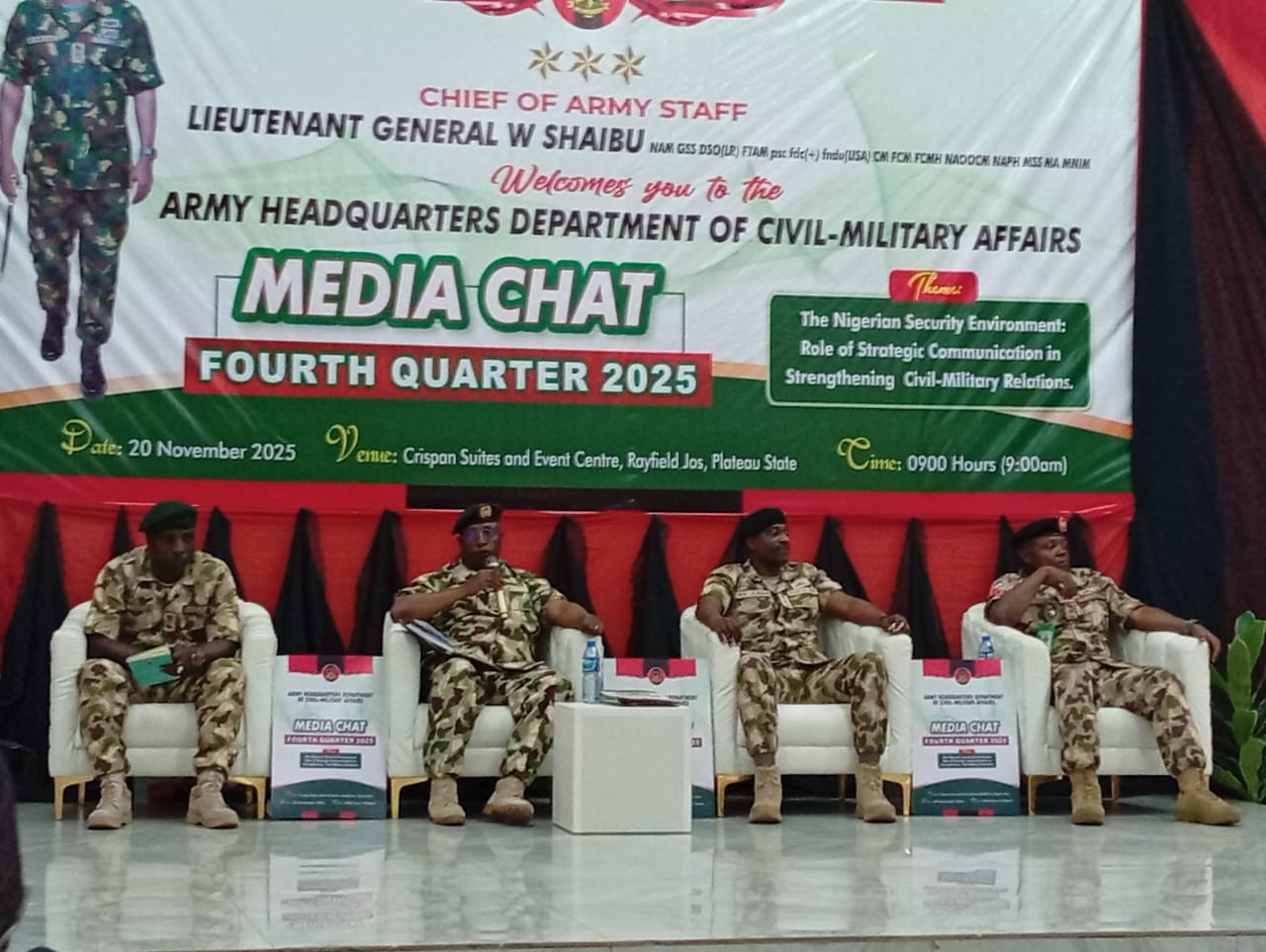
This position was disclosed during the Fourth Quarter 2025 Media Chat of the Army Headquarters Department of Civil-Military Affairs, held in Jos, Plateau State.
Represented by the General Officer Commanding 3 Division, Major General Eyitayo Oyinlola, the Chief of Army Staff (COAS), Lieutenant General Waidi Shaibu, stressed that the evolving threat landscape requires a deeper convergence between security operations and media reportage.
He explained that although the pen has long been seen as mightier than the sword, the present climate demands that both instruments work in harmony to protect the nation and guide public perception.
General Shaibu said the Army views the media as a vital partner in shaping accurate narratives, countering falsehoods, and sustaining public trust in military operations.
He appealed to journalists to embrace responsible and evidence-based reporting, warning that misinformation, often amplified through digital platforms and artificial intelligence, poses its own danger to national cohesion.
The Army Chief called on Nigerians to verify security-related content before sharing it, to prevent the circulation of material capable of undermining unity or inciting unrest.
His words, “…We must maintain regular communication channels to ensure transparent reporting on military operations, timely dissemination of information, countering disinformation and misinformation while building public confidence.
“As the Army intensifies operations to eliminate the threats bedevilling our beloved country, I call on all Nigerians to support the Nigerian Army, and urge the media to practise responsible and balanced reporting…”
Major General Musa Etsu-Ndagi, Chief of Civil-Military Affairs, reinforced the COAS’s position, noting that the Army is increasingly investing in non-kinetic efforts that strengthen public engagement and clarify its activities.
He said initiatives such as the media chat are aimed at improving communication channels, promoting transparency, and fostering a sense of collective ownership in the national security project.
According to him, building a safer society requires citizens and institutions to work together to understand the dynamics of the ongoing threats and the measures being taken to counter them.
The event, themed “The Nigerian Security Environment: Role of Strategic Communication in Strengthening Civil-Military Relations”, featured presentations addressing the shifting media landscape, the role of technology in information dissemination, and the relevance of strategic communication in tackling extremism.
Retired Brigadier General Sani Usman discussed the influence of emerging technologies on modern journalism, while Professor Eze Cosmos explored how communication strategies can serve as tools against violent extremism and insurgency.
Journalists at the event acknowledged the Army’s efforts and encouraged it to continue refining its strategies to meet the demands of a rapidly changing security environment.
The State NUJ Chairman, Ayuku Pwaspo, joined other panellists in discussing how a consistent and transparent flow of information can reduce suspicion and strengthen trust between the public and the military, and the State NUJ Correspondents’ Chapel Chairman, Polycarp Auta, assured the military of the media’s willingness to support national security goals through accurate reporting.
There was a question and answer session as participants asked questions and got clarification on issues, and agreed that the Army and the media are engaged in complementary roles, hence by fostering mutual respect, maintaining open communication, and prioritising national interest, both institutions can contribute more effectively to stabilising the country and safeguarding its future.
Disclaimer
Comments expressed here do not reflect the opinions of Vanguard newspapers or any employee thereof.